

Published On 7/8/2026
The World Cup competitions have entered the decisive stage; All eyes are on the stars who are able to make a difference and lead their national teams to glory.
The impact here is not limited to scoring individual goals, but extends to complex tactical roles and the ability to reshape the collective system on the field.
Read also
list of 2 itemsend of list
The following technical analysis, supported by digital data and Futi performance indicators, reviews the winning cards of the most prominent competing teams and the keys to their tactical strength.
1. Michael Olisey (France): Engine of the Roosters’ offensive machine
The French team enters the quarter-finals facing a unique tactical challenge. The system seems closer to a “disintegrated team” tactically due to the absence of traditional harmony between the lines. The role of the four defenders is limited to defending, and the four attackers are limited to attacking, with two midfielders making great physical efforts to run without a regular ability to link defense with attack.
In light of this tactical separation, Michael Olise emerges as the most important element that gives France critical balance. Simply put, the Roosters’ system will not succeed without him, and with his presence they become the most prominent candidate for the title.
It is common knowledge in football that increasing attacking effectiveness means sacrificing passing accuracy or defensive effort, but Olissi breaks this rule completely, according to data from the Footy platform:
Olissi participates in 11% of France’s playing phases (the highest percentage in the team), yet he ranks second in expected goals rate.
He also leads the tournament with 5 assists, and his passing accuracy has reached 83%, even though he leads the attacking game and leads the team with 32 advanced assists.
Besides, he ranks second in the team in terms of defensive tackles in the opponent’s half, and at the same time leads France in successful advanced dribbles.
- Technical vision: Olissi combines good passing and great shooting ability. He is a world-class striker who touches the ball frequently and rarely loses it, like the best midfielders.
- Tactical conclusion: While all teams are preoccupied with how to stop the danger of Kylian Mbappe, the real key to stopping the danger of France and Mbappe begins first by disabling Michael Olise, because he is the hidden engine that doubles the team’s performance at all levels.

2. Achraf Hakimi (Morocco): Defensive and offensive balance
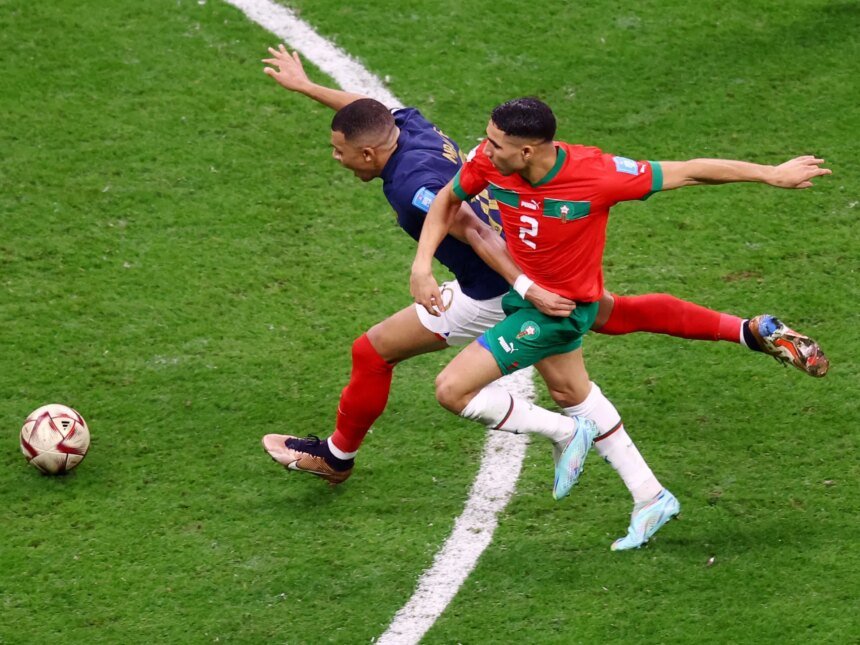
In front of the upcoming confrontation between Morocco and France, the expected bilateral battle between Achraf Hakimi and Kylian Mbappe stands out.
- Tactical reading: Although it is difficult to completely neutralize the threat of a player of Mbappe’s size, or outperform him in all individual statistics during the 90 minutes, Hakimi remains the only option in the world capable of keeping up with Mbappe physically and technically.
- Added value: Hakimi has a unique advantage represented in his exceptional ability to perform strict defensive duty against the French left front, without losing his great attacking effectiveness in the final third of the field, which makes him the main pillar on which the Atlas Lions can build their strategy to achieve surprise.

3. Erling Haaland (Norway): Tactically flexible and space-destroying
Erling Haaland (25 years old) represents the living example of a lethal modern striker, and the numbers prove that he is more than just a traditional scorer.
- Digital efficiency versus possession: Although Haaland only participates in 4% of Norway’s game (he completed only 35 passes), he ranks in the top 1% globally in terms of value created from shots and receiving passes.
- Offensive decisiveness: Haaland took 18 shots (far ahead of his closest teammate), recording an expected goals rate of 4.9, compared to 1.0 for his teammate Martin Odegaard.
- Tactical flexibility: Haaland’s genius lies in giving Norway the ability to implement any style of play; After destroying defenses on the counter-attack, he succeeded in breaking Brazil’s defensive structure in the round of 16 with two decisive goals when Norway was forced into possession.

4. Jude Bellingham (England): The hidden engine and first tactical pillar
While some see Harry Kane as the best player, Jude Bellingham is proving to be the most important and integral player in the England squad.
- Superpower (movement without the ball): Bellingham ranks in the top 1% globally for passes received. This advantage was evident in his goal against Mexico, where he traveled a distance of 40 yards, beating 5 defenders to reach the penalty area immediately after Bukayo Saka started dribbling.
- Breaking the English reserve: The English team usually relies on a conservative possession style, and Bellingham’s longitudinal runs from deep are the main tactical risk that dismantles opponents’ defenses and creates goals.
Digital inclusion:
- He leads England players with 58 successful runs.
- He received 37 advanced passes (a team record), giving Kane the freedom to drop back.
- He leads the team in the number of touches inside the attacking third, and successful dribbles.
- Strong defensive roles: He ranks third in tackles in the offensive half, and sixth in the defensive half.

5. Lamine Jamal (Spain): Converting “absolute possession” into goals
The Spanish national team is experiencing a state of record control; The team recorded 2,944 touches in the attacking third during 5 matches, a number that reflects the historical possessions genes of Spanish football.
- Dribbling engineering: Jamal is ranked among the top 1% in the world in the value of dribbling and carrying the ball, according to “Footie” statistics.
- The tactical dilemma: Despite his high penetrating skill, Jamal faces a crisis in individual effectiveness during the current World Cup. He is ranked 56th in receiving shots and 22nd in making them. So far, he has only scored one goal and created 5 chances, which forces Spain to find a combination to translate Gamal’s quirks into tangible scoring results.

6. Jeremy Doku (Belgium): The trump card to break expectations
Belgium enters the quarter-finals as one of the least fortunate teams with an advance rate of no more than 26% against Spain. However, Jeremy Doku (24 years old) remains the chaotic weapon capable of turning the tide.
- Contrast between club and country: Doku did not provide much in the minutes he played in the tournament (he started 3 out of 5 matches, with a low expected goals and assists rate of 0.2).
- Market and technical value: Despite his international weakness, Doku is classified as the best player in the world at carrying the ball, with 238 advanced carries in the Premier League last season with Manchester City, and he was ranked the fourth best player in the English Premier League behind Haaland, Rayan Sharqi, and Bruno Fernandes.
- Expected impact: If the coach succeeds in exploiting Doku’s ability to convert ball carries into assists (8.2 expected passes in England), he will be the driving force for Belgium in the final minutes of complex matches.

7. Lisandro Martinez (Argentina): Edited by Lionel Messi
There is no dispute that Lionel Messi is the strategic focus of Argentina (among the top 1% globally in added value of possession, and leader in expected goals and assists in the tournament). However, Argentina’s tactical development depends on its rear support system.
- Scaloni’s new philosophy: Coach Lionel Scaloni refuses to rely on traditional wings, which forces the team to move the ball deep across the field with high numerical and physical density to provide the physical effort for Messi.
- The hidden key to construction: The role of centre-back Lisandro Martinez is highlighted here. As he is the main engine of building play from the back, he completed 31 advanced passes (the highest in the team after Messi), and assisted the opening goal against Cape Verde.
- Defensive balance: Since Messi is relieved of defensive roles, Martinez carries out a double physical load. He ranks second on the team in terms of defensive tackles recovered in the attacking third.

8. Gregor Koppel (Switzerland): The World Cup Berlin Wall
Switzerland enters the quarter-finals against Argentina as the weaker side in theory, which places full strategic weight on goalkeeper Gregor Kupil.
- Historical statistics: Coppell has a terrifying record as a goalkeeper; During his 5 years with Borussia Dortmund, it was expected that his net would concede 199.5 goals based on the quality of the shots, but he only conceded 181 goals (with a save difference of 19 goals above average, which is the highest number in the Bundesliga).

- Current situation: Coppell continued his brilliance by saving a decisive penalty kick in the round of 16, conceding goals far below the expected value of the shots he faced (4.96), making him the most prominent safety valve to thwart the Argentine attack.