


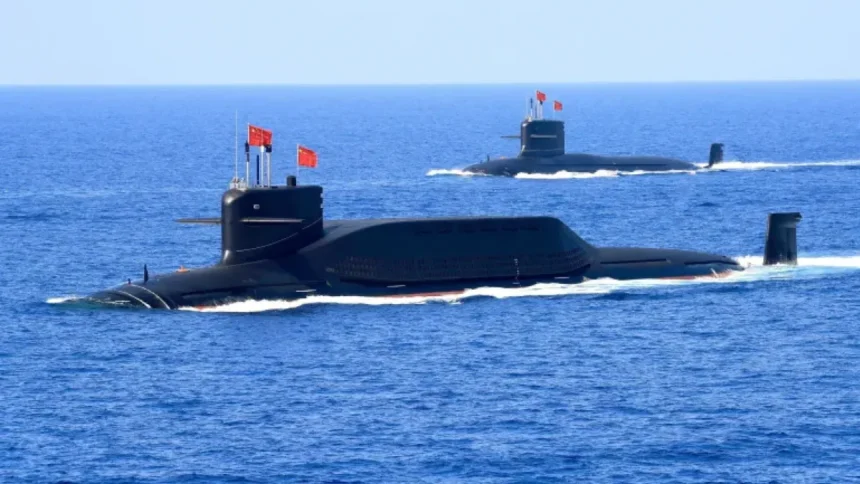
Maritime tensions are rising in the South China Sea and other parts of the Indo-Pacific region, where sovereignty claims intersect with power calculations and alliances.
In light of this scene, the tools of international law overlap with the scales of military deterrence, making border disputes, especially between China and the Philippines, an open arena for what can be described as a battle of maps and law.
Read also
list of 4 itemsend of list
Background of the legal dispute
Reports published by Chinese media indicate that Beijing is based on a historical and legal reading that considers that the territorial borders of the Philippines were determined during the Spanish and American colonial eras, and were fixed through subsequent international treaties.
According to a report issued by the Maritime Strategy Institute of the Chinese Ministry of Natural Resources, Manila began – since the 1970s – to expand the scope of its territorial claims through constitutional amendments, internal legislation and political declarations, which included islands and reefs in the South China Sea such as “Huangyan” and parts of “Nansha.”
The report confirms – as reported by the Chinese news agency “Xinhua” – that these demands lack a historical and legal basis, considering that they represent an attempt to bypass the restrictions of international treaties and threaten the international legal order and regional stability.
The law as a defense tool
The Chinese approach reflects a clear focus on refuting the legal foundations of Philippine claims. In a report reported by the China Daily newspaper, researchers concluded that the evidence provided by Manila does not prove sovereignty, and that its legal positions have witnessed repeated contradictions, which weakens its credibility.
Beijing also believes that the Philippine steps, including internal legislation and illegal occupation, cannot produce sovereign rights in accordance with international law. The report argues that these movements misapply international law and distort historical facts.
Why Xiao Lu:
Principles of international law as stipulated in UNCLOS require that the demarcation of bilateral maritime boundaries shall not prejudice the claims or rights of a third state.
Central point of contention
The arbitration decision issued in 2016 constitutes a major focus of the dispute between the two sides. While the Philippines relies on it as a legal reference, China categorically rejects it.
An analysis published by the Asia Times website indicates that the resolution was not designed to end the conflict, but rather to clarify how to apply the United Nations Convention on the Law of the Sea.
Although the court rejected the legal basis for China’s claim to what is known as the “nine lines,” it did not resolve the issue of sovereignty or demarcation of maritime borders.
However, according to Asia Times, the decision has become “a legal framework that the Philippines uses permanently in its maritime policy, which strengthens its diplomatic position even in the absence of an implementation mechanism.”
On the other hand, Huan Chiu newspaper believes that this ruling lacks legal legitimacy, considering that it was subject to clear politicization and exceeded the principle of consent of the parties, and that – at the same time – it did not contribute to achieving stability, but rather increased the complexity of the conflict.
Border demarcation and regional movements
The bilateral dispute goes beyond its scope to include other regional parties. The maritime border demarcation talks between Japan and the Philippines have raised sharp Chinese objections. The China Daily newspaper quoted Chinese Foreign Ministry spokeswoman Mao Ning as saying, “These negotiations violate international law and affect China’s sovereign rights,” especially in the waters east of the island of Taiwan.
Academic Li Xiaolu from the China Institute of Boundary and Ocean Studies at Wuhan University believes that “the principles of international law, as stipulated in the United Nations Convention on the Law of the Sea, require that the demarcation of bilateral maritime borders not prejudice the claims or rights of a third country,” stressing that this step represents an attempt to expand maritime claims beyond geographical and legal reality.
Chinese field response
The Chinese response was not limited to the legal path, but rather included field measures. According to China Daily, Chinese Coast Guard ships carried out patrols to monitor and enforce Chinese laws in the waters that Beijing says are subject to its jurisdiction in the disputed waters, in addition to scientific research and environmental monitoring operations.
The Academy confirms that these activities fall within the legitimate exercise of jurisdiction in accordance with the United Nations Convention on the Law of the Sea, and include protecting resources and regulating navigation.
The newspaper also reported statements Spokesman for the Ministry of National DefenceZhang Xiaogang, in which he stressed that China will take firm and strong measures to protect its territorial sovereignty and maritime rights and interests if the moves it deems provocative continue.
Manila used the 2016 arbitration award as “legal language” to mobilize international support, as it became part of diplomatic discourse with its partners such as the United States and Japan.
Legal framework and alliances
On the other hand, the Philippines is adopting a dual strategy that combines adherence to the legal framework and strengthening security partnerships. The Asia Times website indicates that Manila used the 2016 arbitration decision as “legal language” to mobilize international support, as it became part of diplomatic discourse with its partners such as the United States and Japan.
The Philippines also seeks to expand its base of allies through bilateral defense cooperation agreements, which Beijing sees as an attempt to internationalize the conflict and attract external powers, which may lead to complicating the regional scene instead of calming it, according to what was reported by Huan Chiu newspaper.
In addition to the legal framework and alliances, another battle emerges over concepts and wording, as the newspaper believes that the Philippines is seeking to reformulate the dispute by presenting itself as an injured party, taking advantage of concepts such as “freedom of navigation” and “rules-based order,” while China stresses the necessity of returning to historical facts and direct negotiation between the parties concerned.
This discrepancy reflects – according to an analysis by Asia Times – the nature of the relationship between the tools of law and the elements of power, as the law alone does not decisively resolve disputes, but rather constitutes a framework used to justify policies and restrict the behavior of conflicting parties.
Narrative conflict
Readings from Chinese newspapers show that the conflict between China and the Philippines is no longer just a traditional border dispute, but has turned into a multi-dimensional confrontation that includes international law, field movements, coalition building, and narrative formulation.
While Beijing is focusing on delegitimizing Manila’s demands and related movements, the Philippines is seeking to establish the arbitration award as an international reference and strengthen its position through partnerships.
In light of this overlap, it seems that the battle of maps and law will remain open, as military or legal superiority alone is not sufficient to resolve it, but its features may be determined by the ongoing interaction between them, especially if the parties are able to transform this competition into a negotiating path that maintains regional stability.