

Published On 7/8/2026
The 2026 World Cup in North America proved wrong the expectations that prevailed three and a half years ago (during the Qatar 2022 tournament), which saw that edition as the final farewell to a generation of modern football legends.
Contrary to the expectations that imposed the imminent international retirement of Ranana names, the 2026 tournament witnessed the largest attendance of veteran players, officially recording “the oldest in the history of the World Cup” in terms of the average age of players and starting lineups since the start of monitoring statistical data in 1966.
Read also
list of 2 itemsend of list
Breaking the “final farewell” premise of the game’s legends
Many expected the Qatar 2022 Championship to be the end of the international careers of a number of giants, but the 2026 Championship witnessed their continuity and effective presence, most notably:
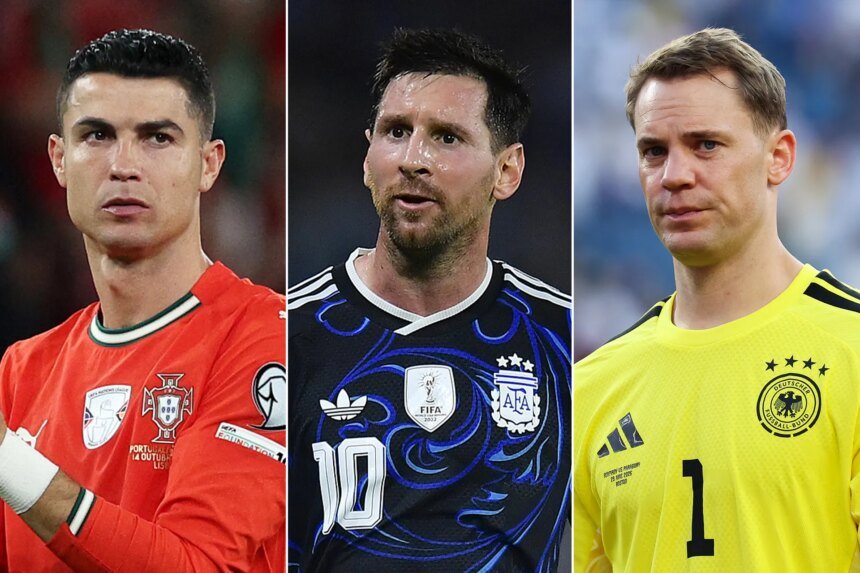
- Lionel Messi and Cristiano Ronaldo: Despite talk about Messi being content with his legacy and Ronaldo being content with his existence, both of them participated in this edition.
- Luka Modric and Ivan Perisic: They continued to lead their team despite crossing the thirty mark by a distance.
- Manuel Neuer: He returned and was present in the tournament to respond to doubts about his declining level due to previous injuries.

Relying on the element of experience
Analytical data for the 2026 edition revealed unprecedented numbers that confirm the trend towards the “age of experience”:
The tournament recorded the highest average age of starting lineups in the history of the World Cup since 1966, at 28 years and 117 days, exceeding the previous record set in the 2018 World Cup (which was 28 years and 11 days) by 106 days.
Looking back, the average age of the main players between the 1982 and 2014 tournaments ranged between (27 years and 18 days) and (27 years and 248 days), which shows that the 2018 tournament was the first tournament in which the average exceeded the 28-year-old barrier, before the 2026 World Cup came to completely break this number.
Top of the list of older players
Of the ten greatest players who have ever participated in the World Cup, four players are from the 2026 edition alone, which is a unique achievement as no other tournament has ever included more than one player in this golden list.
The tournament witnessed the entry of five veteran players into the list of the best 25 oldest players in the history of the World Cup, and they are:
1-Manuel Neuer (40 years and 94 days)
2-Fosinia (40 years and 30 days)
3-Fernando Muslera (40 years and 11 days)
4-Yuto Nagatomo (39 years and 287 days)
5-Hernan Galindez (39 years and 93 days)

Record achievements for teams and matches
- England National Team: Dan Byrne became the oldest English player to participate in a World Cup for the first time since 1950 (since Stanley Matthews), as he played in the quarter-final match against Mexico at the age of 34 years and 58 days.
- Knockout rounds: The 2026 tournament witnessed the participation of three of the four oldest players (and squads) in the history of the knockout rounds since 1966. The Cape Verde national team recorded the largest starting lineup in the history of these rounds at (31 years and 197 days) against Argentina, followed by the Colombia national team at (30 years and 344 days) against Ghana.
- Group stage: The Iranian national team had the largest starting lineup in the World Cup since at least 1966, at a rate of (32 years and 181 days) during its match against Belgium, which ended in a goalless draw.
The underlying reasons for veteran persistence
The upward increase in the average age of players is due to two main pillars:
- Teams vs. Clubs Philosophy: Clubs tend to build young squads to ensure an investment future, while national teams look for the “instant recipe for success” in short combined tournaments, and currently, experience is proving to be the safest option and achieves positive results.
- Scientific and technological development: The great breakthrough in sports science, deep understanding of nutrition, physiology, digital analysis of data, and modern recovery methods have contributed to significantly extending the playing life of stars compared to previous decades.

Future challenges and threats
Despite the success of players in prolonging their careers, this trend faces a clear physical threat represented by the accumulation of matches and the crowded international agenda:
- Increasing the number of Champions League matches under its new system, and creating a larger Club World Cup tournament.
- Expanding the 2026 World Cup from 32 to 48 teams, which significantly doubled the number of matches (similar to what happened previously in UEFA Euro 2016 by increasing the teams to 24).