Published On 9/7/2026
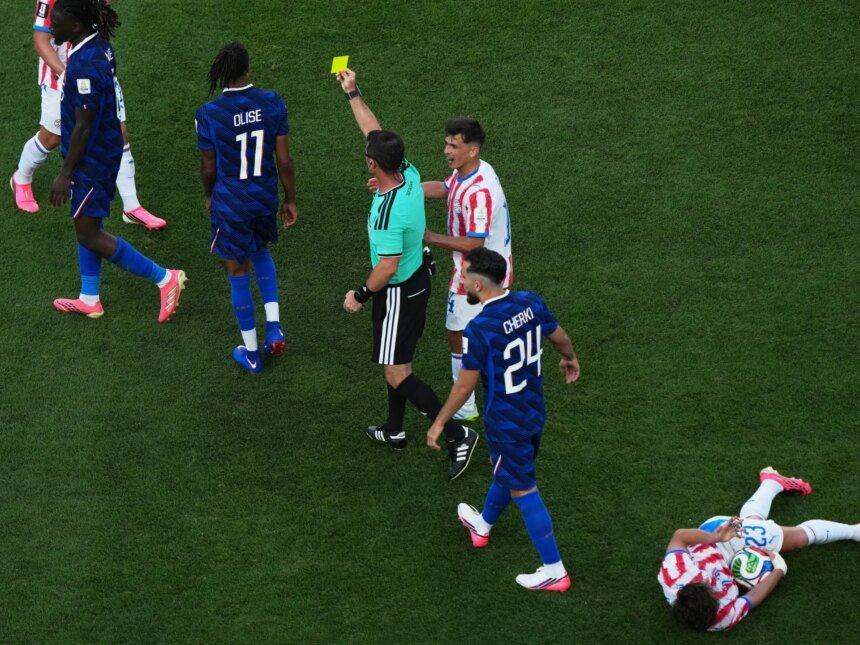
The French national football team received bad news before its expected confrontation with its Moroccan counterpart, after the International Federation of Association Football (FIFA) refused to cancel the yellow card obtained by striker Michael Olisey during his match against Paraguay in the round of 16 in the 2026 World Cup, according to what the Rooster’s coach, Didier Deschamps, announced today, Wednesday.
With this decision, the German Bayern Munich player faces the risk of missing the semi-finals if his country qualifies, if he receives a warning in the quarter-final match against the “Atlas Lions” scheduled for Thursday.
Read also
list of 2 itemsend of list
This decision came after the competent committees in FIFA rejected the grievance submitted by the French Federation for the game, as Deschamps confirmed in the press conference on the eve of the match: “Nothing has changed regarding the yellow card. We received an official notification from FIFA this morning.”

The details of the incident go back to the last breaths of the 16-final match last Saturday, when the referee showed a yellow card in Ulissi’s face following a contact with Paraguayan player Matias Galarza. Although the television replay showed that the French striker grabbed his opponent’s shirt without directing any blow, the latter pretended to be attacked and fell to the ground, writhing in pain, and this trick was fooled by the refereeing team.
In the face of this complex reality, Olise must play with extreme caution to avoid an automatic suspension penalty in the golden square set for July 14, provided that the French first succeed in crossing the difficult Moroccan obstacle.
In this context, Deschamps stressed the difficulty of the upcoming confrontation, warning against underestimating the opponent. He said: “Morocco is not Paraguay. We faced them four years ago, and they succeeded in reaching the final of the African Cup of Nations. They have excellent elements, and their style depends on possession and offensive initiative, and they have very high technical qualifications.”