

Published On 7/8/2026
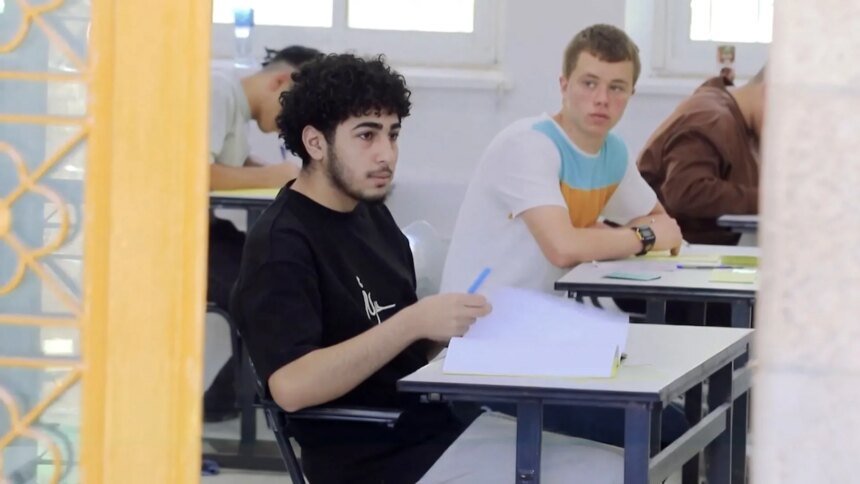
An empty seat, closed books, and a seat card turned into a picture hanging on the waiting wall. This is what the high school exam hall for the year 2026 in Al-Fawwar camp, south of Hebron (south of the West Bank), looks like for student Salah Al-Azza.
Salah was forcibly absent behind the bars of the occupation, leaving behind pending dreams and unanswered questions. His absence opened the wound extending to hundreds of Palestinian students deprived of their right to education.
My guidance is behind bars
Salah’s tragedy is not a passing case, but rather reflects a dark reality documented by official figures issued by the Prisoners’ Affairs Authority and the Ministry of Education.
In terms of numbers, about 350 students from various educational levels (schools and universities) are in occupation prisons, including 74 students from the “Tawjihi” high school stage alone, all of whom were deprived of entering the exam halls and continuing their academic career.
Montaser Nassar says, in a report he prepared for Al Jazeera, that this targeting appears as a systematic and consistent policy, while the spokesman for the Palestinian Prisoners’ Club, Amjad Al-Najjar, confirms that the occupation has continued this approach since 1967 until today.
According to Al-Najjar, the occupation is persecuting school and university students with the aim of “eliminating the future of the Palestinian people,” in flagrant violation of international law that guarantees the right to education even under occupation.
Psychological scars and mothers in “another world”
Regarding the repercussions of these arrests, this forced interruption leaves behind psychological devastation that extends beyond the cell walls to the students’ families and their educational environment.
Psychologist Munira Al-Sariha explains that the sudden arrest of a student at this fateful stage causes severe shock that falls under the category of “post-traumatic symptoms,” which turns into bitter and cruel frustration when the student is liberated in the future to find that his peers who were with him have obtained their results and passed their stage, while his life has been disrupted.

This heavy psychological burden is reflected in the daily groaning in Salah’s house, as his grieving mother describes her condition every exam morning, saying: “From the day the exam begins from 9 o’clock until the end of the appointment, and I am in another world, I pray for my son that God will relieve his distress. May God grant him success, may God make him successful.”
As the arrests continue and hundreds of students remain behind walls, the question remains about the fate of their stolen right to return to school, instead of being excluded from it by force of arms.