

Published On 7/8/2026
“Al-Nakf” is considered one of the most established tribal customs in Yemen, as it is based on collective mobilization to support the tenant and redress grievances, and is based on a system of social obligations that give it strength that goes beyond individual considerations.
“Nakf” is one of the most prominent customs and terminology prevailing in the Yemeni tribal environment, and it means general mobilization and a collective call for victory and fear. With the aim of defending the tribe or one of its members or advocating a cause that affects rights, honor or dignity, responding to this call is considered a tribal and moral duty that must not be neglected.
Declaring annulment does not mean an inevitable entry into war, but rather it amounts to a declaration of general mobilization and a demonstration of strength and solidarity. This mobilization often takes two paths:
Either reconciliation and mediation: This mobilization contributes to pressure to end the dispute through tribal solutions and arbitration.
Or confrontation: This is the last option that is resorted to in the event that mediation and reconciliation efforts fail.
The phrase “tribal struggle” used today in Yemeni affairs represents the highest levels of tribal solidarity and mobilization to protect rights and preserve dignity.
The tribal exodus crisis announced by Sheikh Hamad bin Rashid bin Fadgham Al-Hazmi in the Al-Rayyan region, Al-Jawf Governorate, has re-shed light on the tribe’s status as one of the most important social and political actors in Yemen, after years of declining its role under the influence of the Houthis, and the restructuring of the balance of power in the areas under the group’s control. The crisis broke out against the backdrop of the call for help of a woman, “Mira,” who claimed to be the daughter of former Iraqi President Saddam Hussein. She said that the leader of the group The Houthi Fares Manna seized her house in the capital, Sana’a, and with Sheikh Bin Fadgham’s intervention to seek help from the woman, which he considered a duty dictated by tribal customs in providing relief to the refugee and redressing the grievances, the issue escalated after the sheikh and the woman were detained by the Houthi group, and what was later announced was that they were subjected to coercive measures during detention, before he announced tribal disavowal following his release.
Read also
list of 2 itemsend of list
Although the issue appears on its face to be related to a specific incident, the speed of the Yemeni tribes’ interaction with it and from various governorates of the Republic, the widening scope of political and media interest, and the field reinforcements that accompanied it, reveal a deep and accumulated feeling among the tribes about the Houthis’ violations of the dignity, customs and traditions of Yemeni society, and that the circumstance is ripe for responding to the call for abandonment, which is one of the most deeply entrenched tribal customs in Yemen, as it is based on collective mobilization to support The form of rent and redress of grievances is based on a system of social obligations that give it power that transcends individual considerations.
The importance of the crisis lies in its multiple levels. Geographically, its events are taking place in Al-Jawf Governorate, which represents one of the most important tribal environments in northern Yemen, and close to the Ma’rib Governorate and the Saudi border, which gives it security and political dimensions that go beyond the scope of the governorate, given its timing and geographical location. Temporally and semantically, the crisis is fraught with the extent of the nature of the relationship between the Yemeni tribe and the Houthi group, as well as the extent of its ability to regain its effectiveness in confronting the Houthis’ influence, and the limits of its ability to reshape the equations of influence.

Possible repercussions on the Houthi group
The tribal conflict crisis represents a political and security challenge for the Houthi group, because it arose within one of the most important tribal environments in the areas under its control, and was based on an issue that carries a tribal and social dimension that goes beyond traditional political differences. The sensitivity of the crisis lies in that it represents a situation that tests the group’s ability to continue the provisions of its control that it imposed during the years of war.
The nature of tribal interaction with the issue indicates that its continuation may impose additional challenges on the group in managing the tribal sphere, especially if the current discord turns into a precedent and a reference upon which other tribes rely to express their objections to the group’s policies, or defend its customs. In this case, the group may be forced to allocate greater security and political resources to contain the repercussions, which may affect its internal priorities.
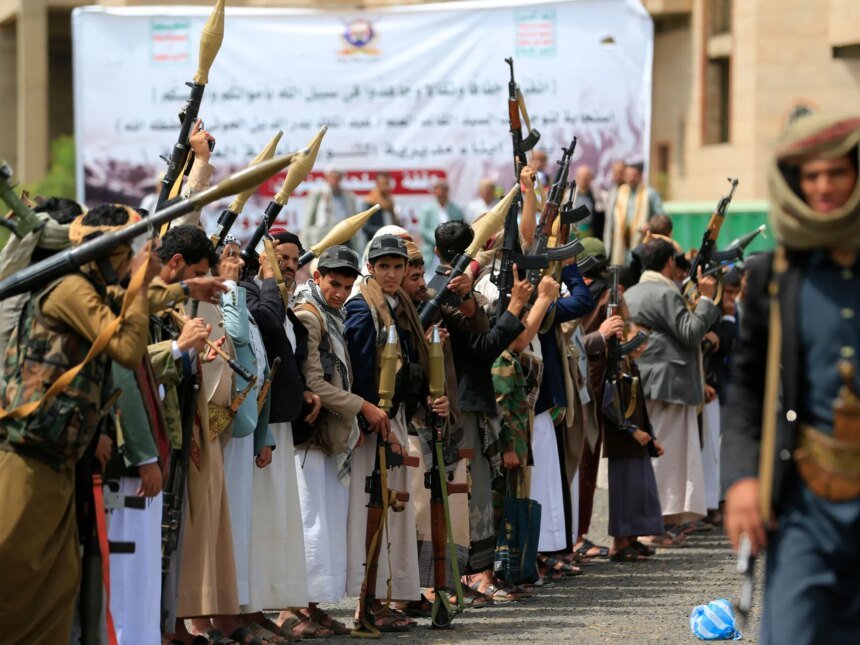
Despite the group’s threats and intimidation, its use of drones to intimidate the tribes gathering with its weapons in the Al-Rayyan region of Al-Jawf Governorate, and the pressure on the legitimate government by launching raids on its camps on some lines of contact in other governorates, as well as the group’s launching of threats towards the Kingdom of Saudi Arabia, and announcing the lifting of combat readiness in all areas of its control, the tribal crowds and their reinforcements are still steadily increasing, which makes the crisis an expected arena for testing the directions of the group’s conflict with the tribes. Yemen and the internationally recognized legitimate government.
Possible repercussions on the Yemeni tribes
The crisis represents a test for the future of the tribal role in the areas controlled by the Houthi group. Its outcomes will reveal the extent to which the tribes are able to restore the independence of their collective decision in the face of the influence of the Houthi group after years of war and the forced transformations that the Houthis imposed on the tribes in the areas under their control. If the struggle succeeds in maintaining its momentum and achieves results that are seen tribally as the fruit of struggle, this will encourage other tribes to reactivate their traditions of rejecting hegemony. Submission, and a move towards greater liberation from the group’s control. This does not necessarily mean the tribes moving into direct confrontation, but rather it may lead to an expansion of their independence in managing their issues, and the restoration of tribal solidarity as one of the mechanisms of societal interaction in the face of the Houthis’ coercion and oppression.
Possible repercussions on the legitimate government
The crisis represents an opportunity for the legitimate government to reactivate its political presence in public discourse, by highlighting it as an indicator of growing tribal objections to the practices of the Houthi group, with a focus on their legal and tribal dimensions without emptying them of their social character. These developments may also give the government an opportunity to overcome the impression that has taken root in public opinion regarding the limited investment in the transformations that the Houthi-controlled areas have witnessed over the past years, if it succeeds in developing its communication with tribal and social forces within an institutional framework that strengthens the state’s presence. He avoids using the issue as merely a circumstantial political card.
At the field level, the crisis may contribute to creating a more appropriate environment to strengthen the government’s presence in Al-Jawf Governorate, if it leads to expanding channels of communication with the tribes, or to building local understandings that enhance its presence in the governorate, without this necessarily meaning the crisis transitions into a military confrontation.
Potential repercussions on Marib and the security environment
It is possible that the repercussions of the crisis will not be limited to Al-Jawf Governorate, but may extend to the security environment surrounding Ma’rib Governorate, given the strategic location of the Al-Rayyan region located on the open desert expanse that connects Al-Jawf to Ma’rib all the way to the Safer region, which includes the most important oil and gas fields and energy facilities in Yemen.
During the years of war, this axis represented one of the most prominent trends of ground attacks launched by the Houthi group towards Marib, driven by the economic importance and financial returns that it aspires to acquire by controlling oil and gas fields and energy facilities and their impact on the balance of the conflict. Therefore, any tribal escalation or security deterioration in this region may be reflected in the security environment surrounding Marib, whether by affecting movement and supply lines, or by imposing additional challenges on one of the most sensitive axes in northern Yemen.
These developments require the legitimate government and the Yemeni army to maintain a high level of security and military preparedness in the desert stretch leading to Safer, thus limiting the chances of exploiting any security vacuum to cause field changes that affect the security of Marib or its vital facilities.

Possible scenarios
The first scenario: containing the crisis while tribal tension continues
This scenario is based on the continuation of tribal mediations, supported by some countries in the region involved in relations with the Houthi group, and their success in preventing the crisis from slipping into open confrontation, and reaching a settlement that provides an acceptable way out for the parties concerned. However, the success of the mediation, if achieved, will not necessarily mean addressing the causes that produced the crisis, but rather it may lead to containing its direct manifestations while the state of tension within tribal circles remains, and dissatisfaction with the Houthi policies continues. Accordingly, the crisis may end on the ground, but it will be It has charted a path to make it a reference in any similar crises in the future that governs the nature of the relationship between the tribes and the Houthi group.
The second scenario: tension escalates and turns into tribal and political pressure
This scenario assumes that the crisis goes beyond its immediate context, becoming a starting point for growing tribal tension and popular dissatisfaction with the Houthi coercive policies, which encourages the repetition of similar patterns of tribal movement in other regions, and enhances the presence of the tribe as a social and political actor capable of expressing its collective interests.
This scenario does not assume the outbreak of a large-scale military confrontation, but rather the emergence of a state of mutual pressure, embodied in growing tribal solidarity, expanding objections to practices, and the rising cost of managing the relationship with the tribes for the Houthi group. In return, this climate may give the legitimate government an opportunity to improve its communication with some tribal components and restore its political presence in the northern governorates under the control of the Houthis, if it is able to deal with these transformations within a vision that strengthens the state’s presence.
Third scenario: The crisis overlaps with paths of military escalation
This scenario is based on the continuation of the crisis coinciding with a broader military escalation in the vicinity of Marib A, which makes the tense tribal environment an additional factor in the conflict equations. With the continued threats of the Houthi group and its military movements, the expansion or continuation of the crisis may lead to the imposition of new security challenges, whether through dispersal of resources, rearranging field priorities, or increasing the fragility of some axes of strategic importance, especially the desert extension linking Al-Jawf and Marib.
Although the chances of this scenario being realized are lower than the previous two scenarios, its repercussions will be the most influential, because it links the tribal crisis with the broader military context, which may reflect on the security of Marib, the movement of the fronts, and the stability of the areas adjacent to the Saudi border.