

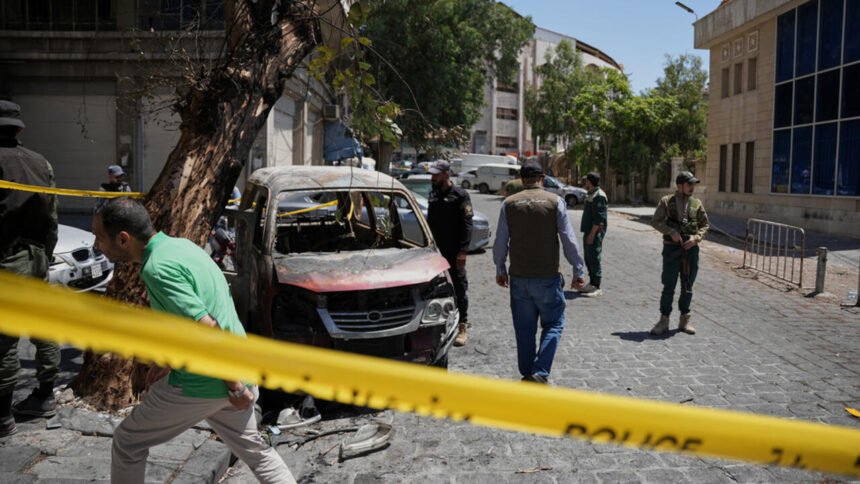
It was a historic visit, the first by a Western head of state, signalling Syria’s emerging integration into the international stage after the isolation, sanctions and brutal violence of the Assad era. But the morning after President Emmanuel Macron landed in Damascus, two homemade bombs exploded near the Four Seasons Hotel where the French delegation had spent the night.
The twin blasts, which injured 18 people, including four Syrian police officers, were a stark reminder of the security challenges confronting President Ahmed al-Sharaa more than a year after his forces ousted former strongman Bashar al-Assad in December 2024.
No group has taken responsibility for the explosions. Syria’s interior ministry said one bomb was placed inside a car parked on the side of a road and the second was planted in a garbage bin. It said they exploded “while preparations were underway” to dismantle them. “These acts of sabotage carried out today… were intended to undermine the French president’s visit,” said Syrian Interior Minister Anas Khattab, who visited the scene.
Shortly after the news broke, Macron said his visit “continues” and asserted that “nothing can smother the aspiration of Syrian women and men to live in a fully sovereign, safe, pluralistic, and united Syria” in a post on X.

At a joint press conference later Tuesday, Sharaa hailed Macron’s “courage” for carrying on with his visit despite the bombings.
‘A serious security setback’
Macron had arrived in Damascus with a business delegation that included heads of some of France’s major corporations in a bid to spotlight Syria’s trade, economic and development issues, including post-conflict reconstruction.

But the bombings represented “a serious security setback” for the Syrian president, according to Adel Bakawan, director of the European Institute for Middle East and North African Studies.
“Ahmed al-Sharaa is striving to convince the world that Syria has once again become relatively stable and safe, and that its main challenge is now economic development, in order to persuade Western companies that they can invest there,” he explained. “But these two explosions in Damascus send exactly the opposite message, serving as a reminder that Syria is neither secure nor stable.”
Tuesday’s bombings came days after an improvised explosive device struck a café near the Palace of Justice in the al-Hijaz area in the heart of Damascus on July 2, killing 10 people and wounding more than 20. It was the deadliest attack in the capital after a June 22 suicide attack in a Greek Orthodox church killed 25 people. A few days later, a little-known Sunni militant group, the Saraya Ansar al-Sunnah, claimed responsibility for the church attack. The Syrian interior ministry said the Islamic State (IS) group was responsible.
Read moreBomb blast in central Damascus cafe kills several
Since February, the IS group has claimed responsibility for several attacks against Syrian security forces, presenting them as the start of a “new phase” in its campaign against the Sharaa government.
Syrian authorities say the attacks are a deliberate attempt to undermine the stabilisation efforts undertaken by Sharaa. “Every time the country experiences a period of stability, malicious parties attempt to destabilise it,” said Damascus Governor Maher Edelbi during his visit to the café targeted in the attack.
‘Malicious parties’ seeking to destabilise Syria
Bringing stability to a country emerging from decades of brutal dictatorship and war is not an easy task and there are several “malicious parties” seeking to destabilise Syria, according to Bakawan.
“The first, and by far the most credible, is that this is the work of the Islamic State,” he said. The attack during Macron’s visit was “neither the first nor the last attack of this kind. Certainly, the international coalition has defeated the Islamic State territorially. But an Islamic State stripped of its territory remains nonetheless extremely dangerous”.
The IS group “generally claims responsibility for this type of operation, either explicitly or implicitly”, said Syrian journalist Bassam Safar. “But we must not rule out the existence of other Islamist factions, distinct from IS group. Some might even be present within the structures of power,” he added, referring to Sharaa’s former jihadist comrades within Hayat Tahrir al-Sham (HTS), which was formally disbanded a month after Assad’s ouster with several factions declaring they would join Syrian state institutions. But some fighters are hostile to Sharaa’s shift from rebel leader to head of state and to Syria’s diplomatic rapprochement with the US, Russia – a former ally of the Assad regime – as well as with Western powers, notably France.
The second hypothesis put forward by Bakawan “concerns the Lebanese Hezbollah”, the Shiite militant movement that supported Assad during the war, and “more broadly, pro-Iranian networks, which have never completely relinquished their influence in Syria”.
Bakawan noted that, “Just a week ago, Iran’s deputy foreign minister [Kazem Gharibabadi], directly threatened France over its involvement in securing the Strait of Hormuz.” Gharibabadi’s warning against “any foreign military deployments” in Hormuz came after France and Britain announced plans to lead an international maritime security effort aimed at restoring safe commercial navigation in a vital waterway that has been effectively blocked since the US and Israel launched the Iran war.
‘Remnants’ of the Assad regime
The Syrian civil war, which lasted more than a decade, drew in regional powers, notably Iran, with its proxy Hezbollah backing the Assad regime. They continue to pose a security threat, according to Safar. “External actors – notably the remnants of militias that cooperated with the Iranian regime and Hezbollah and remain present in Damascus – have a real interest in derailing the process initiated by the new authorities, undermining their legitimacy, and jeopardising this official visit,” he said, referring to Macron’s visit. “Their goal is to convince the international community that this government is incapable of enduring, consolidating its power, and defending the interests of Syrians,” he noted.
Supporters of the ousted Assad regime pose another security threat. “These networks – what are known as the remnants of the former regime – still maintain contacts and a social base, particularly in Damascus,” noted Bakawan.
Dubbed foulouls – a pejorative term referring to the “remnants” – these former regime loyalists have “a clear interest in undermining the French president’s visit, just as they do in destabilising the new Syrian authorities,” said Safar.
Following the July 2 attack on a Damascus café frequented by lawyers and located near the courthouse where former Baathist officers and Assad associates have been on trial, some analysts pointed to the old regime loyalists opposed to Syria’s transition.
In addition to these security threats, the March 2025 massacre of Alawites, a minority group to which the Assad family belongs, in the western coastal region, followed by clashes with Druze fighters in the south of the country have highlighted the government’s difficulties in controlling the entire territory. All of this underscores just how uncertain the prospect of a durably stabilised Syria remains.
This article was translated from the original in French.