

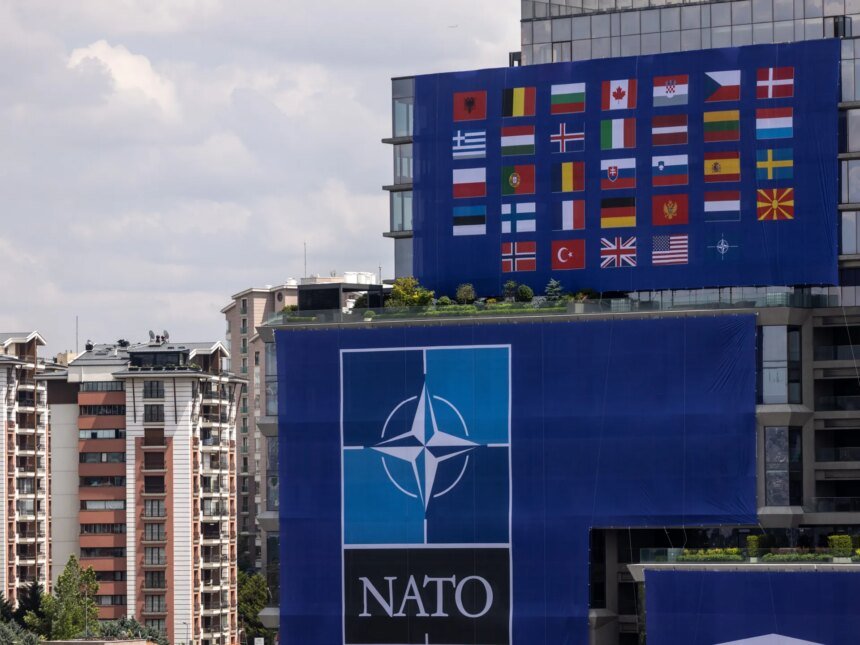
With the launch of the North Atlantic Treaty Organization (NATO) summit on Tuesday in the Turkish capital, Ankara, American and Turkish newspapers are treating the event as more than just a regular meeting of NATO leaders, considering that it may establish a new phase in its history.
While American newspapers talk about the birth of “NATO 3.0” and the redistribution of defense burdens and see Turkey as an increasingly important partner within the alliance, Turkish newspapers focus on Ankara’s role in formulating the summit’s agenda and strengthening its position as an influential actor in the future of NATO.
Read also
list of 2 itemsend of list
In the midst of these transformations, journalistic analyzes revolve around three main questions: Does the Ankara summit inaugurate a new phase in NATO’s history? How did Türkiye strengthen its position within the alliance? Who are the parties and what are the files that will contribute to shaping the features of the alliance’s next phase?

The birth of “NATO 3.0”
NATO Secretary General The Washington Post presents the concept of “NATO 3.0” as a new phase based on rebalancing security responsibilities between the two sides of the Atlantic, with European allies playing a greater role in defense spending and enhancing military capabilities.
Rutte asserts that the alliance “will always remain a transatlantic alliance,” noting that the European allies “have already begun to bear a greater share of the burden,” which, in his words, embodies “NATO 3.0: a stronger Europe within a stronger NATO.”
He adds that NATO countries have begun implementing their commitments to raise defense spending to 5% of GDP by 2035, explaining that European allies and Canada are already allocating about 4% of their GDP to defense and security only one year after the agreement.
The transformation – according to Rutte – is not limited to increasing spending, as he stresses that “money alone does not stop a missile or a tank,” stressing that these investments translate into ready military capabilities and contribute to strengthening the base of defense industries across the Atlantic.
He also confirms that industrial power and military power “go hand in hand,” noting that the alliance is working with the defense industry sector to accelerate the production of munitions, weapons systems and advanced technologies necessary to confront changing threats.
In a Turkish reading of the NATO summit, writer Deniz Kelisoglu believes – in an article in Milliyet newspaper – that the inclusion of the Defense Industries Forum for the first time in the official program of the summit does not merely represent an amendment to the agenda, but rather reflects a “shift in NATO’s mentality,” as the alliance moved from the stage of pledges to the stage of focusing on mechanisms for their implementation.
The author considers that the importance of the Ankara summit does not lie solely in the capital hosting it, as viewing Turkey as a mere “host country” prejudices the role played by Turkey in shaping the alliance’s agenda, managing crises, and contributing to crystallizing the features of its new security structure.
The writer notes that NATO Secretary-General Rutte asked Turkish President Recep Tayyip Erdogan, during his visit to Turkey last April, to help convince US President Donald Trump to attend the summit.
Türkiye is at the heart of the alliance
Ben Hubbard, Istanbul bureau chief of The New York Times, captures this shift in Turkey’s position within NATO, considering that it has moved in recent years from a “controversial member” to an increasingly important partner in its security equations, due to the geopolitical transformations that the world has witnessed.
In an article published by the newspaper, Hubbard explains that Türkiye has the second largest army in the alliance after the United States, controls the maritime entrance to the Black Sea, and also forms a major part of NATO’s southern wing.
The writer adds that the growth of Turkish defense industries has enhanced this role, after its military exports exceeded $10 billion last year, to include various products from artillery shells to drones, noting that Turkish companies are known for producing weapons at a faster pace and at a lower cost compared to many of their Western counterparts.
In a parallel Turkish reading, journalist Hande Firat believes – in an article in Hurriyet newspaper – that the Ankara summit gains additional importance because it coincides with the first bilateral visit by an American president to Turkey in 17 years, considering that the meeting between Trump and Erdogan means reopening major files in the relations between the two countries.
The author says that Washington is forced to reread Türkiye’s position, not only as a “problematic ally,” but also as a regional power and an actor possessing military capabilities.
The Ankara summit – according to Firat – does not represent just a protocol meeting, but rather may constitute a turning point in which Türkiye’s position within the new security structure of NATO is redefined.

Features of the new stage
In parallel with the discussion about the alliance’s security structure, writer Goldiner Sun Umut believes – in an article in Milliyet newspaper – that NATO summits are no longer mere meetings to modernize the security system, but rather have become a geopolitical theater in which leaders are tested and directions for the new phase of the alliance are drawn.
The writer believes that the American President will be at the forefront of the leaders who will determine the summit’s agenda, along with Canadian Prime Minister Mark Carney, who is expected to represent the approach of continuity within the alliance.
Italian Prime Minister Giorgia Meloni is also considered – according to Sun Umut – one of the most prominent balance makers, as she seeks to reconcile ideological clarity with political pragmatism, without Trump’s “provocative” statements overshadowing her presence.
In the same context, Rutte points out that this new phase will translate into practical steps, and the summit will witness the announcement of new defense contracts worth tens of billions of dollars with companies in Europe and North America, in addition to investments in the technologies necessary to confront current and future security challenges.
Rutte summarizes the summit’s bets by saying that the capabilities that NATO is developing not only strengthen economies, strengthen technological superiority, and provide job opportunities on both sides of the Atlantic, but that the Ankara summit will constitute a new station to push this path forward.
Source: Turkish press + New York Times + The Washington Post