


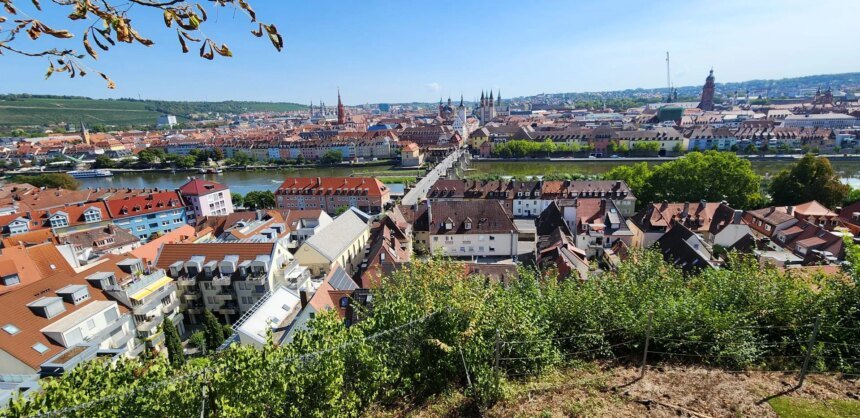
Würzburg – For those looking for quiet travel and small towns in Germany that combine the charm of history and the beauty of architecture, the city of Würzburg, located in the south of the country, remains the appropriate choice, especially with the views of the river and vineyards surrounding the city and overlooking the Main River. Würzburg is also a distinctive destination for lovers of history and Baroque architecture.
Würzburg is located in the north of the state of Bavaria on the banks of the Main River. It is considered one of the most beautiful tourist cities in the Franconia region. It is characterized by a wonderful mix of history, culture and nature. The parts of the city combine the elegance of Baroque architecture with the spirit of a lively university city.
One of the beautiful aspects of the city is its calmness and small area, making it suitable for wandering around its most prominent areas and distinctive places on foot or by bicycle. The visitor can also experience trips across the Main River.

As for the historic city center, its streets are paved with stones, and it contains half-timbered houses, with small squares full of cafes and restaurants, and stores displaying local products and handicrafts, which gives the visitor the atmosphere of ancient European cities during the Middle Ages.
Würzburg is classified as one of the small German cities, with an estimated population of about 130,000, a quarter of whom are students, and this is evident in the streets, where the strong presence of young people catches your attention, a number of whom prefer riding bicycles to other means of public transportation.
The presence of the prestigious University of Würzburg in the city gives the place a young and lively character, with cultural and artistic events held throughout the year. The German city includes the oldest university in the country, which is nearly 4 centuries old, and Würzburg has the first university housing for students and professors in Germany.

Imperial history
Würzburg was the capital of an independent state within the region of Bavaria for 600 years, and its history and political and historical status are linked to the position of Prince Bishop, a title for the person who ruled the region as a whole from the Middle Ages until the beginning of the 19th century, and who combined religious and political power at the same time.
The era of the prince-bishops in Würzburg continued until the year 1803, when the French Emperor Napoleon Bonaparte put an end to many of the city’s political, geographical, and linguistic changes. The residence palace in the city was transformed from a residence for the prince-bishops into a royal rest house for the Emperor of France. Thus, Würzburg ended up as the capital of an independent state and the city became part of the Bavaria region.
In many parts of Würzburg, tourists encounter historical landmarks such as churches, memorials, and residential buildings built in the Baroque style, which is characterized by a Catholic influence and the erection of huge statues, which we do not find, for example, in northern Germany.

The city includes approximately 50 Catholic churches, and one of the most beautiful churches of Würzburg is the Church of the Virgin Mary, which has an orange color on the outside and a distinctive Baroque style and is located in the market square in the center of the city, as well as the Würzburg Cathedral or St. Kilin, the Capelle Church, the Neumünster Church, and the Church of St. Johannes.
Würzburg Cathedral, or St. Kilin’s Church, is famous for its huge wooden door, the inscriptions of which speak about the events of the Last Judgment. The church is one of the largest Romanesque churches in Germany.
Palace of residence
The Residence Palace, or Würzburg Palace, is the most important tourist attraction in the city and dates back to the imperial era of the region. The place is a Baroque architectural masterpiece included in the UNESCO World Heritage List. The palace is distinguished by its spacious gardens, ornate reception halls, and the ceiling of the famous staircase, which is considered one of the largest frescoes in the world and is called the Mural of Nations or the Painting of the Four Continents.
The Residence Palace, which is similar in design to the Palace of Versailles in Paris, is on the UNESCO list as the last palace built in Europe in the Baroque style. The palace combines the French and Austrian architectural style, and what is distinctive about this palace is that it is the only palace in the world that was built to the design of only one architect, according to what the tour guide Markus Schäfer, a son of the city of Würzburg, mentioned to Al Jazeera Net.

The mural of nations on the main staircase of the palace was completed by the Italian artist Giovanni Tiepolo with the help of his sons between 1752 and 1753. It is one of the most prominent examples of Baroque art in Germany and in the world. It is classified as one of the largest frescoes in the world (677 square metres) and also the largest watercolor painting on wet plaster. It was completed on a single ceiling and without supporting columns.
Tiepolo’s mural captures the attention of visitors to the palace, who stay underneath it for a long time to contemplate its details, the beauty of its colors, and the huge area that it extends over. The mural embodies the idea of glorifying the prince-bishop as a patron of the arts and sciences. The idea revolves around that the “sun” (which symbolizes the prince) rises over the four continents that were known in the eighteenth century: Europe, Asia, Africa, and America. Each of the four corners of the mural represents one of the four continents with characters and animals.
This mural survived the fires of World War II. In March 1945, Würzburg was subjected to a British bombing that destroyed 90% of the historic city and destroyed the palace. However, the ceiling of the main staircase and the Tiepolo mural survived the destruction thanks to the solidity of the concrete construction in that area of the palace.

One of the most beautiful halls of the Residence Palace is the Hall of Mirrors, which includes complex glass panels based on the art of Rococo in Europe. Many shapes are painted in reverse on the glass, with a predominance of yellow over the drawings. When the visitor stands in the middle of the hall, the mirrors reflect on each other to create an optical illusion of the hall extending to infinity. This technique was used to dazzle the guests.
There is also the White Hall, which includes delicate plaster sculptures on the walls and ceiling. There is also the Imperial Hall, which is distinguished by its oval opening and huge red marble columns inlaid with gold.
The palace also includes the throne room or the grand reception hall in the prince-bishop’s suite, which is dominated by red velvet and gold, and has huge crystal chandeliers on its ceiling and luxurious gilded furniture.
After you finish visiting the palace, do not miss the opportunity to wander around the spacious and lush garden surrounding the palace, which was built in the French style. It has walking paths, fountains, and a beautiful arrangement of green space and seating places.

Bridge of Kings
A visitor to Würzburg cannot miss visiting the Kings Bridge or the Old Main Bridge, as it is a famous historical bridge that connects the two banks of the Main River, and is ideal for taking pictures, especially at sunset.
The stone bridge dates back to the Middle Ages, and is lined on both sides with 12 statues embodying the figures of kings and saints associated with the history of the city and the Bavaria region as a whole. The place is forbidden to cars and is intended exclusively for pedestrians and cyclists, and is a popular meeting point for tourists and locals alike.
There are shops selling local wine near the bridge, as one of the most famous customs of the city’s people is drinking coffee and wine on the bridge in the open air while exchanging conversations, and enjoying a walk in a central area that gives a wonderful view of the place.
The bridge gives a wonderful view of the city of Würzburg, the old castle, and the vineyards spread around the city. The bridge connects across the Main River between the historic town of Würzburg and the famous Marienberg Castle, which is located on the hill opposite the city.

Marienberg Castle
The castle is located on a high hill on the western bank of the Main River, and can be seen from various parts of the city. Many tourists prefer to go up to the castle on foot via pedestrian paths that begin immediately after crossing the Old Main Bridge.
Upon arriving at Marienberg Castle, a panoramic view of the entire city and the vineyards spread around it opens before the visitor. The area surrounding the castle extends over a large area and is suitable for lovers of walking and photography.
The castle was the historical residence of the prince-bishops for more than 500 years, who ruled the city and the Franconia region.

The castle’s architecture embodies a mixture of Gothic, Renaissance, and Baroque. The castle includes several buildings, including the Church of the Virgin Mary, watchtowers, and the Well House, in addition to the princely garden.
During Al Jazeera Net’s visit to the city, the castle was closed due to ongoing renovation and maintenance work, but the Franconian Museum located inside the castle was open to visitors. It includes a variety of exhibits covering the history and culture of the Franconia region, such as paintings, weapons, furniture, clothing, and handicrafts, providing a comprehensive look at life in different eras.
The museum, which was established in 1947, is considered one of the most prominent museums of history and art in the Bavaria region and Germany as a whole. It includes paintings, statues and handicrafts from the Franconia region, including the largest collection of statues by the famous German sculptor Tilman Riemenschneider, who lived in the thirteenth century (more than 80 works of art by this artist). The museum also contains collectibles of wood and stone, some of which are more than 3 thousand years old.
Hidden place
The Roentgen Memorial Building, the university laboratory in which the German scientist Wilhelm Roentgen discovered X-rays (X-rays) on November 8, 1895, remains one of the most important pieces of evidence that changed the course of medicine and physics in the world.
With this invention, Röntgen won the first Nobel Prize in Physics in 1901. The building includes the original office room and laboratory, which were meticulously preserved and restored to look exactly as they were in 1895. The building also contains tools and devices that Röntgen used in his experiments, such as vacuum glass tubes and electrical coils.

The place is a great destination for science enthusiasts and is often overlooked by tourists, so it is rarely crowded. Just be sure to know the lab’s opening and closing times so you don’t arrive too late like what happened to me.
The laboratory-turned-museum is located in a quiet location on a main street not far from the city’s train station.
House of the future
The city includes a community hub that makes sustainable consumption easy and practical by offering opportunities to buy, rent, repair and exchange various consumer and non-consumer goods, all under one roof.
The center, which is like a clothing and goods store, offers products produced in places close to the city using clean energy. It has a wing for clothes and shoes, another for food, and a third for repairing electronic devices. The center includes approximately two thousand products that can be purchased or rented.
Matthias Pepper, supervisor of the Future House Center, told Al Jazeera Net that 5 volunteers and 4 employees are working on this community project, and over the life of the center – which is more than three years – the shop has repaired hundreds of devices.

The project embodies the concept of the “circular economy” in a practical way, which aims to reduce waste, save money for the consumer, and facilitate his task by providing options for selling, renting, exchanging, and repairing broken devices instead of throwing them away.
The path of romance
One of the prominent tourist attractions in the city of Würzburg is that it is the starting station on the “Romance Route,” which is the most famous and oldest tourist and cultural trail in Germany. This trail was established in 1950 after World War II, with the aim of rebuilding the tourism sector, attracting visitors, and drawing a new image of Germany that combines charming nature and ancient history.
This road starts from the Residence Palace, where there is a sign stating that the place is the beginning of the Romance Route. This route ends at the city of Füssen and the famous Neuschwanstein Palace in the Alps near the German-Austrian border. The Romance Route extends over a distance of approximately 460 km.
It was called the Road of Romance not to indicate the relationship between lovers, but rather to refer to the “Romantic Era” in the nineteenth century, which was characterized by a love of pristine nature, nostalgia for the Middle Ages, legendary stories, and mysterious castles, which is exactly what the traveler feels on this road.

The Romance Road passes through more than 28 historical cities and towns, and it is a famous area in Germany and Europe for those who love to explore places on foot, bicycle, or car. There are brown directional signs along the highway that say “Romance Road” in German to guide motorists.
There is also a parallel path designated for bicycles, equipped with green directional signs, that passes through fields and farms away from the hustle and bustle of cars and cities. There are also designated pedestrian paths linking the towns through the forests and the charming landscapes of southern Germany.