


In the World Cup, teams do not only bring their own shirts and tactics, but they also bring with them a long history of dishes, customs and tastes. In the second part of this series, we continue the journey through the national teams’ tables, and approach some of the countries of Groups D, E, and F in the 2026 World Cup.
America.. BBQ and “black smoke kitchen”
American cuisine is difficult to reduce to limited dishes, as it has been shaped by expanding geography, waves of immigration, and changing politics over the decades. However, barbecue, or American-style barbecue, remains one of the mainstays of the table there.
Read also
list of 1 itemend of list
In his book “Black Smoke,” researcher Adrian Miller documents the crucial role that Africans played in the history of barbecue; African and European cooking techniques merged with indigenous traditions to create one of the most important rituals of food culture in the United States.
In addition to barbecue, the “burger” stands out as an essential popular dish, despite its roots linked to the “Hamburg steak,” which German immigrants brought to America in the 19th century, and the same applies to the “hot dog.” As for “fried chicken” or fried chicken in the American style, it is said that the technique of frying it arrived with Scottish immigrants, while Africans added spices to it.

Paraguay.. “soup” turned into a national dish
Paraguay’s most prominent national dish is soba Paraguayan, and contrary to what the name suggests, it is not a soup, but rather a salty cake made of cornmeal, cheese, milk and onions.
Behind the dish is a funny story; It is said that the presidential palace chef made a mistake in the ingredients of the soup so that it turned into a cake, and when it was served on the table, the president was impressed by its taste, and it later became the country’s national dish.
If you want a real soup, there is “Pira Caldo”, a soup based on fish, vegetables and cheese, which appeared in the wake of the Triple Alliance War with the scarcity of food resources. On Paraguayan tables, the drink “Terrere” is also prepared, which is made from the mate herb, with ice, herbs and lemon added to it, along with “Chiba” bread, which is made from cassava flour, cheese and eggs.

Australia…a table the size of a continent
Australia is a country the size of a continent, and its cuisine carries British influences and diverse migration waves alongside its Aboriginal heritage. Under the name “Bush Tucker”, nearly 5,000 species of plants, animals and insects that indigenous people have depended on for thousands of years, from kangaroo meat and barramundi to honey ants and some species of worms, come together in a complete diet.
In Australia, kangaroo meat can be eaten in a variety of ways, whether slices, burgers or sausages, as a source of low-fat protein. In the dessert corner, there are “Anzac” biscuits made from coconut, which were born during World War I from ingredients that were not easily damaged so that soldiers could carry them with them.

Türkiye…an Ottoman legacy with the taste of kebab and borek
During the prosperity of the Ottoman Empire and the expansion of its geographical influence, ingredients and flavors from multiple lands flowed into its cuisine, giving birth to one of the richest and most diverse cuisines in the world.
One of the most prominent Turkish dishes is “kebab” in its various types, such as Adana kebab, Urfa, doner, shish, and Iskender kebab, each of which has a special method of presentation and flavour. “Burek” is also prepared, which is made from stuffed dough sheets.
As for “Turkish coffee”, it is not just a drink, but rather an entire cultural practice that UNESCO included in 2013 on the list of intangible cultural heritage.

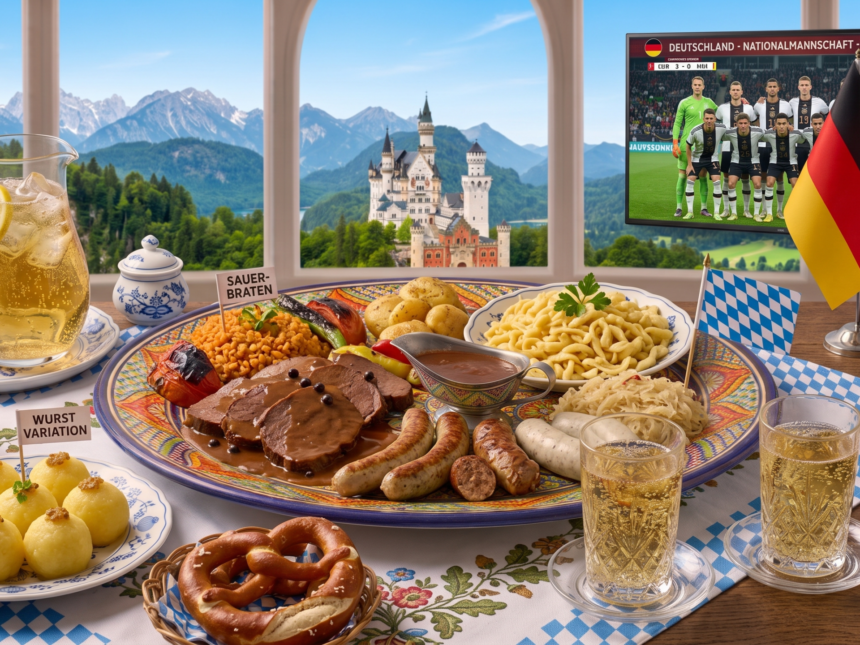
Germany…bread, sausages and slow cooking
According to German sources, German cuisine includes more than 3,000 types of bread. UNESCO included what is known as “bread culture” or “Brotkultur” on the list of intangible cultural heritage in 2014.
One of the most famous baked goods is the pretzel, which is a bread made from kneaded dough that is baked and covered with coarse salt. On the table are prepared sausages or “brat forrest” with a huge variety of more than 1000 different types of sausages.
Among the slow-cooked dishes stands out “Saur Braten”, which is meat marinated in vinegar or wine with spices several days before cooking, then slowly cooked and served with a rich sauce and potato dumplings. Potatoes here are an essential ingredient, appearing in many recipes such as “Kartoffel Pover” and “Kartoffelen Pratt.”
Netherlands…sea food and winter
Dutch cuisine is mainly based on potatoes, fish and dairy products. A popular dish is “Biter Ballen”, which are fried balls made from a thick mixture of beef stock, butter and flour, covered in breadcrumbs and fried until golden and crispy.
The “Stampot” dish is one of the most popular winter dishes. It consists of mashed potatoes with vegetables such as cabbage, spinach, carrots and onions, and is served with smoked sausage or meat.

One cannot talk about Dutch cuisine without mentioning herring, which is served with diced onions and pickles. The Netherlands is also famous for its different types of cheese, such as Gouda, Edam, and Leiden, and its flavors vary with the ingredients added to it, such as cumin, caraway seeds, or sweet flavors.
In the dessert section comes the “Stoop Waffle”, which is a traditional biscuit consisting of two layers of waffles with a rich caramel filling. It is placed over a cup of hot coffee or tea until the filling melts a little before eating it.
Japan.. “Washoku” and the philosophy of balance
Japanese cuisine is known as “Washoku,” and it was included by UNESCO on the Intangible Cultural Heritage List in 2013. This cuisine is based on the idea of balance and celebrating nature, by organizing the table according to the five colors (red, yellow, green, black, and white), and the five tastes (sweet, salty, sour, bitter, and “umami” or delicious taste).
“Sushi” is the most famous Japanese dish, and it consists of seasoned rice with seafood and herbs, in an apparently simple composition, but it relies on high precision in choosing the ingredients, the size of the pieces, and the temperature of the rice.
Also on the table is miso soup made from soybean paste dissolved in fish broth with tofu and seaweed, as well as udon, a type of thick noodles made from wheat flour, served in hot broth or with vegetables and meat.

Tunisia.. Harissa is at the top of the table
In 2022, UNESCO included the skills and practices associated with harissa on its List of Intangible Cultural Heritage. “Tunisian harissa” consists of hot red pepper, garlic, oil, vinegar or spices, and is used to season stews and meat. It is also sometimes served as a side dish, to be one of the pillars of Tunisian cuisine that blends Mediterranean, Arab and Berber flavors.
A notable dish is Tunisian brik, which is thin, crispy dough sheets stuffed with eggs, tuna and parsley, and fried in oil. As for “al-Bellabi,” it is a hot chickpea soup served with pieces of bread, garlic, cumin, harissa, and olive oil, and it is considered one of the popular dishes spread in the winter.
“Alloush fi al-Qalla” is a special way of cooking lamb in a clay pot that is cooked slowly over charcoal or in the oven, to gradually absorb the flavors. As for “Marmite de Pecheur” in French, or “Fisherman’s Marmita,” it is a seafood dish that reflects the influence of French cuisine. It is a rich soup that combines fresh fish and seafood slowly cooked in tomato broth with Tunisian spices and olive oil.

In the World Cup, every squad and every team has a story on the field, but there are other stories on the table as well. Dishes that travel across history and geography, and smells that seem to be competing parallel to the World Cup competitions.