

Published On 7/6/2026
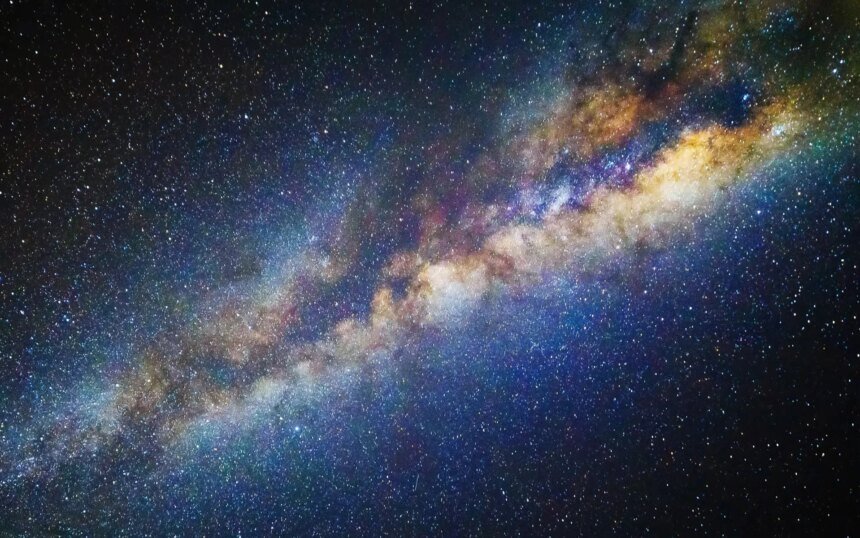
Drawing an accurate map of the Milky Way has always been one of the most difficult challenges in astronomy, because the Earth is located within the galactic disk itself, so scientists cannot image it in its entirety as they do with distant galaxies.
For decades, astronomers have relied on models of galactic rotation and the movement of gas clouds to estimate the distances between its spiral arms, but these methods still carry a degree of uncertainty, especially in the outer regions where the influence of dark matter increases.
Read also
list of 2 itemsend of list
Today, an international team of researchers has come up with a new engineering method that allows for more accurate measurements, and its results were published in the journal Astronomy & Astrophysics, revealing that parts of the Milky Way are located at greater distances than scientists had thought for years.
Light echoes map the galaxy
The study relied on a rare astronomical phenomenon represented by gamma ray explosions, which are the most violent explosions known in the universe, as they release enormous energy within seconds that exceeds what the sun releases in its entire lifetime. When the X-rays from these explosions cross our galaxy, some of them collide with dust grains scattered within the spiral arms.

This scattered light does not reach the Earth directly, but rather takes a longer path, appearing late in the form of light rings that gradually expand around the explosion site when monitored by space telescopes.
Through the speed of expansion of these rings, scientists were able to calculate distances accurately based on geometry only, without the need for assumptions related to the speed of the galaxy’s rotation.
Dr. Beatrice Vaia, one of the study participants, said: “It is a very direct method based on geometry alone to measure the distances to the spiral arms of the Milky Way with great accuracy.”
The explosion of 2022 becomes a cosmic measuring instrument
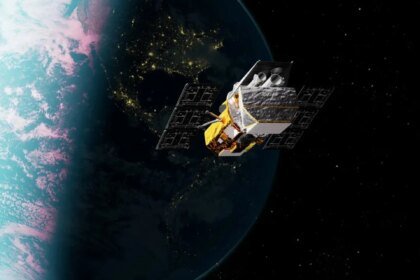
The researchers took advantage of data recorded by the European Space Agency’s XMM Newton Observatory, in addition to NASA’s Chandra X-ray Observatory, relying in particular on an extremely bright gamma-ray burst observed in 2022.

That explosion produced several expanding rings of X-rays, allowing researchers to study dust clouds located at distances of up to tens of thousands of light-years from Earth. This technology was able to transform a cosmic explosion that lasted a few seconds into an extremely precise measuring instrument that reveals the true structure of our galaxy.
This method also has the advantage of being independent of traditional models of galactic rotation, and therefore remains reliable even in outer regions that are difficult to measure with usual methods.
The Milky Way is larger than ancient maps depicted
The new measurements show that the outer arm of the Gear-Centauri is located approximately 62 thousand light-years from Earth, with a margin of error not exceeding about 1%, and it is one of the most accurate measurements made so far for this distant region.
The study also confirmed the validity of the known distance of Perseus’s arm, which gave scientists great confidence in the new approach. But the real surprise was that two of the galaxy’s farthest arms were located at distances approximately 10% greater than what maps based on galactic rotation models had indicated.
These results indicate that scientists may have underestimated for decades the true size of the outer parts of the Milky Way, which requires reviewing many of the models used to understand the structure of the galaxy, its mass distribution, and the influence of dark matter in it.
The beginning of a new era for galactic mapping
The importance of the study is not limited to modifying the locations of some spiral arms, but also opens the door to reconstructing a more accurate three-dimensional map of the entire Milky Way. The researchers believe that future, more sensitive observatories will be able to monitor more echoes of gamma ray bursts in different directions, allowing the distances of large parts of the galaxy to be measured directly, instead of relying on theoretical estimates.

The study explained that improving the galactic map will help scientists understand how stars form, the structure of the galactic disk, the distribution of dark matter, and the history of the evolution of our cosmic environment over billions of years.
Every time a person invents a new way to measure the universe, he discovers that the limits of his knowledge were narrower than the breadth of reality. Science not only changes the maps of the sky, but it also changes our view of our place in this universe, and confirms that every new discovery is not the end of the journey of knowledge, but rather the beginning of a broader path towards understanding the secrets of existence.