

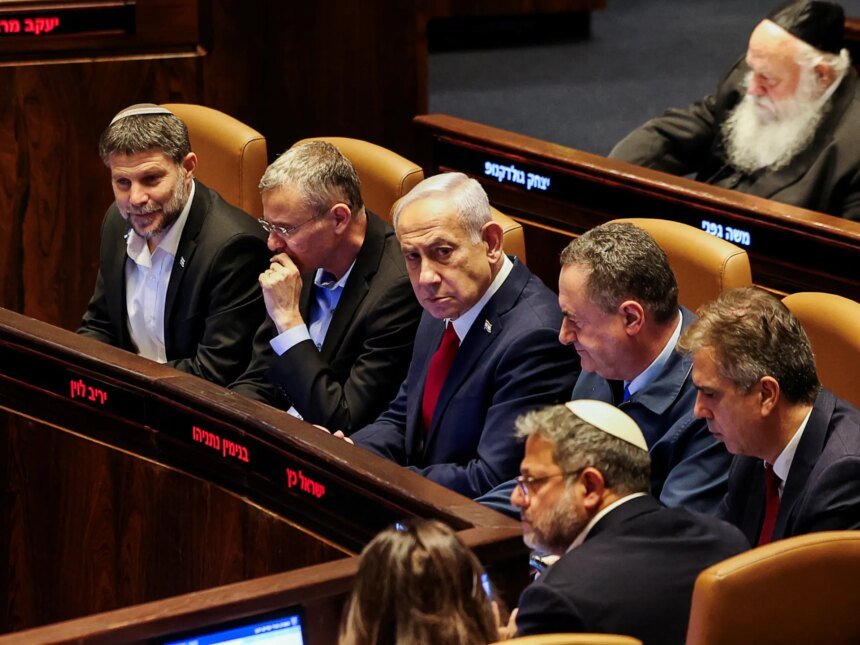
As the end of the summer session of the Knesset approaches on July 14, Israel enters a crucial week to determine the fate of the Knesset and the date of early elections, likely to be held between September 8 and October 20, and the remaining days turn into an intense bargaining arena between Prime Minister Benjamin Netanyahu, the Haredim, Likud, and the opposition to pass crucial laws before the parliamentary window closes.
The draft law to dissolve the Knesset was approved in the first reading, with the election date being finally set in the second and third readings, with the original date of October 27 remaining in place if the dissolution process is not completed.
Read also
list of 2 itemsend of list
A worrying draw
In fact, the government coalition is not going through its best condition, as the proposed laws, such as exempting the Haredim from conscription and the political investigation committee into the events of October 7, are no longer merely ideological files, but rather tools to buy loyalty.
Netanyahu is paying heavy political prices to the ultra-Orthodox parties for passing their legislation, while the leaders of these parties refuse to provide firm guarantees to remain in his bloc after the upcoming elections.
The most prominent thing in the recent opinion polls is the decline of Likud’s monopoly on the lead. The Channel 12 poll, which was published by Dafna Liel on July 6, 2026, showed that Likud, led by Benjamin Netanyahu, tied with the Yashar Party, led by Gadi Eisenkot, with 23 seats each.

Despite this decline, the map of alliances remains deadlocked, as Netanyahu’s coalition ranges at 52-53 seats, while the opposition alone is unable to form a stable majority.
Narrow window
Approaching the end of the summer session gives the crisis a practical meaning, as every law that is not passed now may turn into a postponed paper until after the elections, and every law that passes may become part of a deal to remain within the bloc.
Therefore, the government is racing to pass what can be passed before the Knesset is dissolved, especially the Haredi laws related to preventing the arrest of conscription evaders, the Basic Law for the Study of the Torah, in addition to the Political Investigation Committee Law on October 7th.
At this moment, the legislation does not appear to be merely ideological files, but rather tools for managing loyalty. Netanyahu wants the Haredim to commit to remaining in his bloc after the elections, and the Haredim want legislative costs before going to the polls. As for the opposition, it is dealing with the last weeks as an attempt by the coalition to close sensitive files before the balance of power changes.
Restricted Netanyahu
This equation shows that Netanyahu is still strong, but he has become more restricted. He needs the Haredim, he needs the Likud, he needs the far-right parties, and at the same time he needs to prevent the birth of an alternative right that he does not lead. Therefore, his battle within Likud seemed an essential part of the battle for survival.

According to Anna Barsky in Maariv, Likud institutions are moving toward a formula that gives Netanyahu 10 guaranteed seats on the party’s list, including 9 seats up to 30th place. This formula maintains the primaries in formality, but gives the party leader broad ability to engineer the next list, cordon off his internal opponents, and prevent the recurrence of the rebellion of figures such as Yuli Edelstein.
Another Likud
Edelstein’s departure from Likud after more than two decades reflects a deeper rift within the right. Channel 12 reports indicate contacts between Edelstein, Ayelet Shaked, and Gilad Erdan, along with other names such as Ofer Venter, Hili Trooper, and Yoaz Hendel. These moves do not yet create a clear alternative to governance, but they confirm that the question of “a right without Netanyahu” has moved from the margins to the center of the scene.
In this context, Avigdor Lieberman’s statements in Maariv come as an attempt to separate Likud from Netanyahu. He announced his willingness to sit with Likud in a future government, on the condition that Netanyahu is not part of it, considering him primarily responsible for the October 7 disaster, and awaiting his accountability before a government investigation committee.
The Haredim are waiting
The relationship with the ultra-Orthodox parties reveals another aspect of Netanyahu’s decline in control. Eli Hirschman reported on Channel 12 that Netanyahu asked the leaders of Shas and Degel HaTorah for a commitment to remain in his bloc after the elections, in exchange for pushing important laws for them.

But the response was not reassuring to him. Aryeh Deri considered passing laws a prerequisite for continued cooperation, while Moshe Gafni was more decisive when he explained that Rabbi Landau’s directives say that “there is currently no coalition,” and that passing laws does not guarantee automatic support for Netanyahu after the elections. Here the prime minister’s dilemma appears: he pays political prices to the Haredim before the elections, without guaranteeing their loyalty afterward.
Sporadic opposition
On the other hand, the opposition does not appear to be united, despite its agreement to bring down Netanyahu. Yair Lapid speaks of a “plan to steal the elections,” and Yair Golan warns against disobeying the will of the voters, while Benny Gantz is trying to present himself as a third way through a broad Zionist government that does not depend on the Arab parties nor on the Haredim and extremists.
As for Eisenkot, he is advancing quietly from a military-political position that gives him the image of a responsible alternative, especially in light of the centrality of the October 7 issue. However, his rise does not solve the governance dilemma. The Zionist opposition alone does not have a sufficient majority, and any reliance on Arab parties remains an effective propaganda weapon in the hands of Netanyahu and the right.
A fiery judiciary
The electoral crisis coincides with an open constitutional crisis. Five former presidents of the Supreme Court warned, in a statement reported by Gilad Morag in Maariv, that the government’s decision not to respect the Supreme Court’s ruling regarding the Second Broadcasting Authority Council puts Israel on the path to “chaos.” They described disobeying court orders as “the final nail in the coffin of democracy.”

On the other hand, Bezalel Smotrich holds the government’s legal advisor, Gali Beharav Meara, responsible for the crisis, and accuses her of obstructing the elected government and spreading chaos. Thus, the judicial battle turns into an electoral axis: the opposition says that the government is destroying the rules of the game, and the coalition says that the judiciary prevents it from ruling.
Seventh investigation
The October 7th file makes the scene more heated. The Knesset approved in the first reading, with a majority of 59 supporters and no opposition after the boycott, a draft law for a political commission to investigate the events of October 7th. The formula allows the committee to work with only three members if the opposition boycotts it, which practically means the possibility of it working in a coalition.
Therefore, Lieberman described it as a “cover-up committee,” and Lapid, Eisenkot, and Bennett pledged to form a government investigation committee into the next government. What is certain is that Israel enters the end of the summer session of the Knesset without a clear majority and without a final decided electoral date.