In one of the neighborhoods of the city of Bahri, south of the capital, Khartoum, Muhammad Saad Ibrahim returned to his home after three years of displacement due to war, to find that the electricity network in the neighborhood had collapsed due to the destruction that affected transformers and internal supply lines.
This reality prompted him to install an integrated solar energy system, which became the radical solution to the problem of unstable electrical current for him.
Read also
list of 4 itemsend of list
Speaking to Al Jazeera Net, Muhammad says that finding a solution to the crisis of power stability has become an urgent necessity, especially with the presence of medical cases within the family that require the permanent availability of electricity to operate medical devices or store medicines.
In the neighborhood itself, the matter was not limited to Muhammad’s experience, as many residents decided to install solar panels on the roofs of their homes, and these panels became part of the daily landscape that characterizes the area.
With the increasing number of homes relying on this technology, relying on solar energy has become a major means for the neighborhood’s residents to secure their basic electricity needs away from the main grid.

Renewable energy sources
In light of the continuing crisis of long power outages and transformer breakdowns, a number of residents have turned to using renewable energy sources, primarily solar energy, as a means of securing their basic electricity needs.
In the capital, Khartoum, the duration of the outage in some neighborhoods reaches about 12 hours a day, while in other states it extends to 16 hours, which doubles the residents’ suffering and disrupts their daily lives.
Despite the efforts made to restart power stations and redistribute lines damaged by the war, the crisis of power stability still exists. The electricity infrastructure was subjected to widespread destruction as a result of the war raging in the country between the army and the Rapid Support Forces.
In the official context, Abdullah Ahmed Muhammad, director of the Sudanese Electricity Company, explained in previous statements to Al Jazeera Net that the national grid suffers from instability and a clear inability to meet the increasing demand, which has caused long and recurring outages in most states of Sudan.
He added that the great pressure on the remaining transformers, in addition to the expansion of supply lines to cover new areas, has exacerbated the current crisis, as the network is operating beyond its capacity without sufficient maintenance.

Wide spread
At the Tuti Island water station in central Khartoum, the people of the area established a solar energy project to operate the main station. Omar Kabbashi, the project manager, said that the idea came as a result of the high costs of the operational fuel that the station depends on due to power outages, adding that the project came to provide a practical alternative in light of the continuous and recurring outages.
Kabashi explained in his interview with Al Jazeera Net that the cost of constructing this project amounted to about 40 thousand dollars, and it contains 180 solar panels with a capacity of 710 watts per panel.
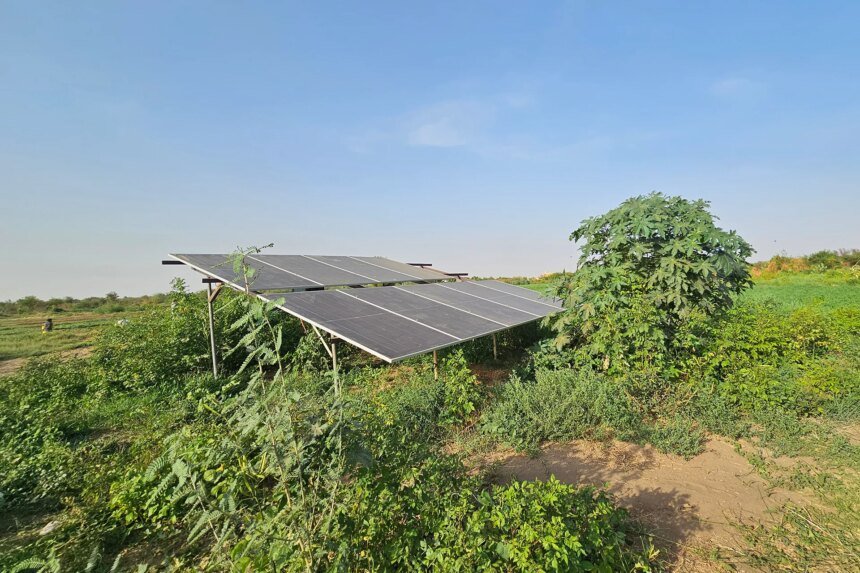
In the same context, dozens of farms in the city of Khartoum have resorted to using solar energy for irrigation operations, as solar panels have spread over large areas of agricultural land to operate pumps.

Low operating cost
Murtada Othman Abbas, one of the farmers, said that they turned to this option because of the low operational costs, explaining that the cost is paid only the first time when installing the system, without the need to pay additional amounts later.
Speaking to Al Jazeera Net, Abbas added that their reliance on solar energy made them unaffected by the ongoing power outages, as the pumps operate regularly throughout the daylight hours thanks to the panels spread on the outskirts of the fields.
He explained that this transformation gave farmers stability in irrigation operations, as crops were no longer threatened by damage due to the interruption of electricity.
As the electricity crisis worsened, solar energy spread more widely within Sudan, as solar panels became a common sight on rooftops, on farms, and in hospitals.
The prices of solar systems in Sudan range between 5 million to 10 million Sudanese pounds, depending on the capacity and production capacity of the system. The amount of approximately five million pounds is equivalent to about one thousand US dollars, which makes the initial installation cost relatively high for many families.

Solar energy is a strategic choice
Economist Muhammad Al-Nayer explained in an interview with Al Jazeera Net that the residential sector in Sudan, along with other sectors, is moving towards solar energy. It came as a result of the widespread destruction that occurred in the electricity sector, despite the efforts made by the competent authorities to restore stability.
Al-Nayer pointed out that they had advised before the outbreak of the war on the necessity of facilitating the procedures for introducing solar energy, and enabling the residential sector to obtain its systems through financing, in a way that would contribute to bridging the electricity gap in the country.
He indicated that Sudan was producing about 4,000 megawatts, while consumption was about 5,000 megawatts, meaning a deficit of nearly a thousand megawatts.
Al-Nayer explained that this deficit could have been reduced through expansion of solar energy instead of establishing huge plants costing billions of dollars.
He added that the housing and commercial sectors had already turned to solar energy after the war, but the matter required the state to facilitate procedures and fundamentally reduce costs.
Al-Nair stressed the need to move towards modern systems, which allow the consumer to sell his surplus production to the national grid and obtain the electricity he needs, which would greatly serve the electricity sector and enhance its stability.