



Gold Price Today: Gold has rewarded investors like few other assets over the past four years.
From around $1,620 an ounce in late 2022 to nearly $5,595 at its peak in 2026, the yellow metal has staged one of its strongest rallies in recent history. In India, the gains have been even more dramatic. A weakening rupee amplified the global surge, pushing domestic gold prices from roughly Rs 50,000-52,000 per 10 grams to as high as Rs 1.72 lakh earlier this year.
Even after a recent correction, gold continues to trade around Rs 1.4 lakh per 10 grams — a gain that has left many investors asking the same question: Should you continue buying, hold your investments, or finally book profits?
According to Arun Patel, Founder & Partner at Arunasset Investment Services, the answer isn’t as straightforward as “buy” or “sell”. Instead, investors should focus on portfolio balance rather than trying to predict gold’s next move.
Don’t Chase Gold’s Rally. Rebalance Your Portfolio Instead
Patel believes investors shouldn’t look at gold as an asset to exit simply because prices have surged. Instead, they should ask whether gold now occupies a larger share of their portfolio than originally intended.
“If gold was supposed to make up around 10 per cent of your portfolio but has grown to nearly 20 per cent because of the rally, it makes sense to book partial profits and rebalance,” Patel explains.
He stresses that gold is fundamentally a hedge, not a return-maximising asset. Its job is to protect wealth during uncertain times-not necessarily to outperform every year.
That distinction becomes especially important after such an extraordinary rally.
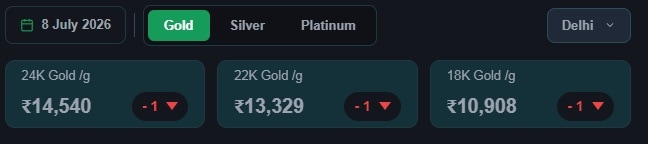
Gold price in Delhi on July 8. (Credit: GoodReturns)
Why Gold May Not Keep Rising At The Same Pace
While global uncertainty, geopolitical tensions, inflation concerns and currency weakness continue to support gold prices, Patel cautions against expecting another explosive run anytime soon.
History suggests gold rarely moves in a straight line.
After peaking in 2011, gold spent several years underperforming. A similar pattern emerged after the Covid-era rally in 2020, when prices corrected roughly 20-22 per cent before beginning the current bull run.
Interestingly, the present cycle has already witnessed a sizeable correction.
Domestic gold prices have fallen from around Rs 1.72 lakh per 10 grams in January 2026 to nearly Rs 1.41 lakh, an 18 per cent decline.
Based on previous market cycles, Patel believes there is a high probability-around 80 per cent-that gold could remain in a phase of consolidation or witness further corrections over the next 12 to 18 months.
That doesn’t necessarily mean investors should sell.
It simply means expectations for quick gains should be tempered.
How Much Gold Should Your Portfolio Have?
One of the biggest mistakes investors make is treating gold as either an all-or-nothing investment. Patel says the ideal allocation depends entirely on an individual’s financial goals and risk appetite.
Growth-oriented investors with a long investment horizon and significant equity exposure may need only 5-10 per cent of their portfolio in gold.
Those seeking lower volatility or greater capital protection may consider raising that allocation to around 10-15 per cent. Anything substantially higher, however, may not be optimal.
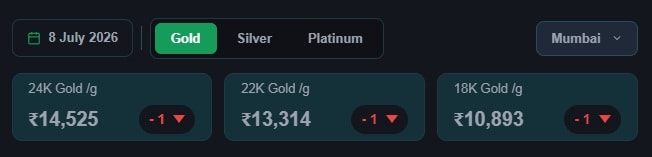
Gold price in Mumbai on July 8. (Credit: GoodReturns)
Unlike businesses or stocks, gold doesn’t generate earnings, dividends or cash flows. Its value lies in preserving purchasing power and cushioning portfolios during periods of financial stress.
Why Gold Still Deserves A Place In Every Portfolio
Despite warning against chasing prices, Patel remains firmly in favour of maintaining some gold exposure. He points to several structural factors supporting gold’s long-term relevance.
- Persistent inflation.
- Rising government debt across major economies.
- Currency depreciation.
- Geopolitical conflicts.
- Financial market uncertainty.
During such periods, investors often flock to gold because it carries no credit risk, isn’t tied to any government’s balance sheet, and remains globally liquid.
“This is exactly why gold functions as portfolio insurance,” Patel says. It protects wealth when other financial assets come under pressure.
Physical Gold, Gold ETFs Or Sovereign Gold Bonds?
Choosing how to invest in gold is just as important as deciding how much to own. According to Patel, Gold ETFs currently offer the most efficient investment route for most investors.
They provide transparent pricing, easy liquidity and simplify portfolio rebalancing without the storage concerns associated with physical gold.
Physical gold, while ideal for jewellery or emergency holdings, comes with several investment drawbacks. Investors must pay GST, incur making charges, worry about purity and storage, and often receive lower resale values.
Sovereign Gold Bonds (SGBs), Patel notes, were historically the most attractive long-term option because they combined gold price appreciation with an annual 2.5% interest payment and favourable tax treatment at maturity.
However, they require investors to stay invested for long periods and fresh issuances are currently unavailable.
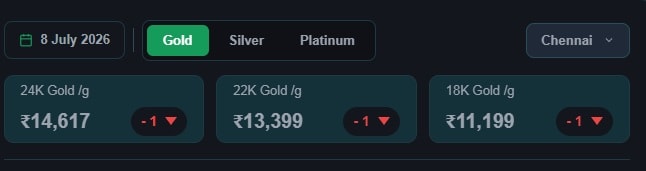
Gold price in Chennai on July 8. (Credit: GoodReturns)
Can Gold Continue To Beat Equities?
Gold’s stellar performance over the past four years has inevitably sparked comparisons with stocks. Patel believes investors should avoid viewing the two as competitors.
Each serves a different purpose. Equities remain the superior long-term wealth creator because companies grow earnings over time. Gold, on the other hand, acts as a stabiliser.
Over long investment horizons-such as the two decades leading up to September 2025-Indian equity total return indices have comfortably outperformed gold.
“The distinction is simple,” Patel says. “Equities compound wealth. Gold protects it.”