

Published On 7/7/2026
|
Last update: 19:11 (Mecca time)
Researcher at Al Jazeera Center for Studies, Dr. Shafiq Shuqair, suggested that Israel is the most likely party behind the two bombings that rocked the capital, Damascus, on Tuesday, coinciding with the visit of French President Emmanuel Macron.
Choucair based this weighting on an equation that states that the search for the perpetrator passes through the gate of “the one most affected” and “the one with the interest in slowing down Syrian progress.” From this standpoint, he saw that Israel tops the list of parties that are not served by Damascus’s strong return to the regional forefront.
In an intervention on Al Jazeera, Choucair explained that Syria realizes at the current stage that it is paying a double price for its growing regional role, and he considered that Macron’s visit represents the last link in the “trinity of international relations” after normalization with Washington and Ankara, which completes the Western cover for Syria’s political return to the world.
Choucair addressed the economic dimensions of this Syrian rise, pointing out that Damascus’s success in becoming a bridge for economic corridors between the East and the West – as the Syrian leadership aspires – will constitute an existential threat to the Israeli project based on monopolizing its position as a regional crossing. He stressed that this competition makes Israel the most motivated party to obstruct any Syrian stability.
In the same context, Choucair relatively ruled out that Iran was the hidden driver of these bombings at the present time, and explained this by the fact that Tehran is preoccupied with greater concerns, in addition to the fact that the Syrian openness to Lebanon did not exclude any political component, which reduces the intensity of direct Iranian hostility towards the new Syrian path.
On the other hand, the researcher did not ignore the possibility of the involvement of an internal party in the bombings, acknowledging that the “completely unstable” Syria remains a fertile environment for any security breach. However, the striking thing that determined his likelihood of Tel Aviv’s involvement was the coincidence of the bombings with a path that Macron would have taken, which gives the regional reading its greatest weight, and excludes the hypotheses of individual action or local revenge.
Connected explosions
Shuqair linked today’s bombings to the Al-Nasr Street bombing five days ago, describing them as two episodes in a connected path aimed at proving that Syria is not ready to assume its regional responsibilities.
He pointed out that this path began at the beginning of this year, and coincided with clear threats from ISIS, but he stressed that its repetition in conjunction with major diplomatic events places it in the category of systematic operations.
In clear contrast to other hypotheses about who caused the bombings, Shuqair pointed out that the general regional atmosphere does not help such violations, as Turkey’s hosting of the North Atlantic Treaty Organization (NATO) summit, which coincided with the French visit, reflects implicit American and European approval to strengthen the Syrian role to reduce the cost to the West.
This contradiction between the “frayed” internal environment and the supportive international will made Choucair believe that any intentional violation could only come from a party that has a vested interest in thwarting this Western-Turkish consensus, which is Israel.
Choucair admitted that the direct damage from the two bombings was limited and possible, and the evidence for this is that President Macron completed his visit without significant impact, but the deeper political message – according to his estimation – was directed to the international parties sponsoring Syria’s return, that the security cost of rehabilitating Damascus may be exorbitant.
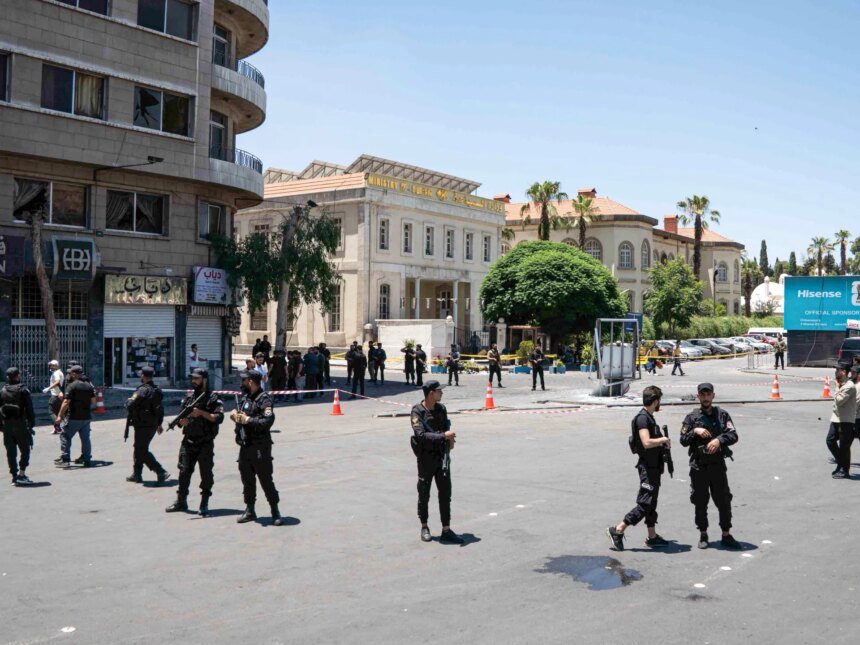
The center of the Syrian capital, Damascus, witnessed the explosion of two improvised explosive devices near the Four Seasons Hotel, the site designated for the French President to stay as part of his official visit to the country.
The Syrian Ministry of Interior announced that the two explosions occurred outside the direct security zone designated to protect the French President, and did not pose any threat to the safety of the diplomatic delegation.
The targeting area is located on Shukri Al-Quwatli Street, which is one of the vital streets in Damascus, specifically in the area opposite the Ministry of Tourism building, and next to Al-Jalaa Park and Al-Bustan Hotel.
The incident occurred at the beginning of what is known as the Victoria Bridge, which is a vehicle bridge built over the course of the Barada River near the ancient Sulaymaniyah Hospice, the Damascus National Museum, and the Semiramis Hotel, and it is about 500 meters from Marjeh Square in the center of the capital.
Field reports stated that the convoy of French President Emmanuel Macron left his hotel residence heading to the People’s Palace about 5 minutes ago, and crossed the Umayyad Square towards the Mezzeh Highway 3 minutes before the first explosion occurred, as French presidential sources (Elysee) confirmed that Macron did not hear the sound of the two explosions.