Al Jazeera correspondents

Published On 7/7/2026
|
Last update: 17:17 (Mecca time)
Karak – In the early hours of dawn, the eighty-year-old woman, Asriya Tarawneh, was wearing her uniform and carrying her tools, heading towards the beehives before the entire village woke up.
These scenes were not just a daily ritual for a woman working in beekeeping, but rather the beginning of a story that spanned decades, creating one of the oldest family experiences in this field in the Karak Governorate in southern Jordan, and establishing a profession that had almost remained exclusive to men before it turned into a legacy passed down through generations.
The grandmother did not expect that the grandchildren, who were watching her as she moved between the cells with caution and confidence, would continue the same path years later, and that the career that began with simple passion would turn into a family story that went beyond the borders of Karak, leading to international competitions that raised Jordan’s name in global forums.

The first beekeeper in southern Jordan
The Al-Shamaeen family said, in an interview with Al Jazeera Net during a visit to their home in Karak, that the beginnings go back to 1986, when grandmother Asriya Al-Tarawneh decided to enter the world of beekeeping, becoming one of the first known beekeepers in the southern region.
At that time, the profession was not widespread, and it relied more on inherited experience than on academic training or modern techniques, but the grandmother was able to build a special relationship with bees and pass on her knowledge to her children and grandchildren through daily practice.

Knowledge that has been passed down between generations
Education did not take place inside training halls or workshops, but rather in the middle of the fields, between the trees, and in front of the cells. There, the children learned how to approach bees without fear, how to distinguish between flowering seasons, and realize the importance of preserving the hive as an integrated ecosystem, not just a means of producing honey.
The family explains that the grandmother believed that bees needed patience more than they needed strength, so she made sure to teach every little detail herself. From how to deal with the hive to how to extract honey without harming the bees, this is knowledge that later became the foundation on which the family’s experience was built.
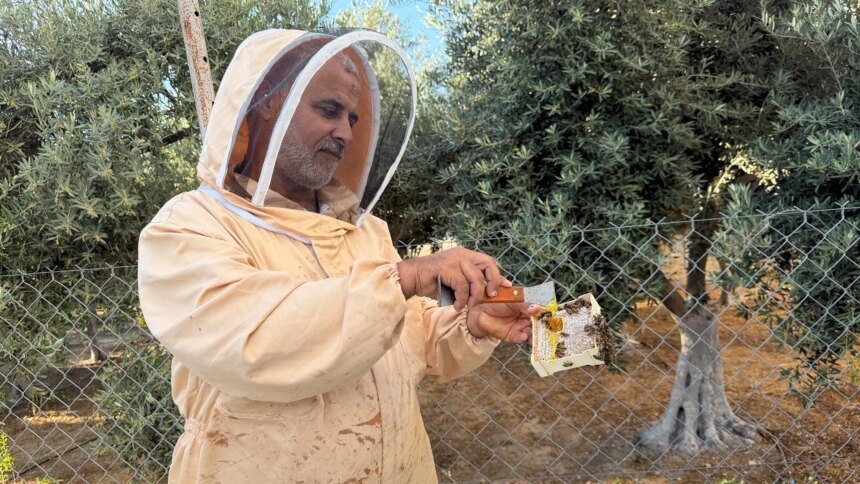
As she grew older, the modern woman, Tarawneh, was no longer able to speak at length or appear in the media, contenting herself with continuing what she had cultivated for decades. She handed the baton to her son, Mukhaled Al-Shama’in, and her grandson, engineer Hammam Al-Shama’in, who today tell the story of a family legacy that still pulsates among the beehives.

A family career and an environmental mission
As the years passed, responsibility passed to the son, Mukhled Al-Shamaeen, who not only maintained what his mother had founded, but worked to develop and expand the project, while adhering to the essence of the profession based on producing natural honey and benefiting from the plant diversity that characterizes the Jordanian environment.
Beekeeping in Jordan is gaining importance beyond honey production, as bees are an essential pillar in pollinating trees and agricultural crops, which directly affects food security and agricultural production. This profession also benefits from the environmental diversity that the Kingdom enjoys, as beehives move between regions according to the flowering seasons, which gives Jordanian honey different characteristics according to the plants that the bees feed on.
Official data indicate that Jordan produces multiple types of honey that differ in color, taste, smell, and characteristics depending on natural pastures, while the self-sufficiency rate of local honey still hovers around a quarter of the volume of consumption, which makes developing this sector a priority for those working in it.

From grandmother’s experience to engineer’s tools
With the entry of the third generation of the family, a new phase of the development of the profession began. Engineer Hammam Mukhled Al-Shamaeen joined the project in 2014, bringing his engineering background, which helped him introduce more advanced methods in managing apiaries and improving the quality of production, without severing the connection to the foundations laid by his grandmother decades ago.
Despite the family’s subsequent attendance in international competitions, those in charge of the project confirm that the awards were not a goal in and of themselves, but rather came as a result of long years of maintaining the quality of the product and adhering to correct practices in beekeeping.

Apiaries train children and compete in international competitions
One of the most notable aspects of the experience is the keenness to transfer knowledge to new generations. In 2023, the family launched a project to train children and young people in the basics of beekeeping, in an attempt to preserve the profession from extinction and reconnect new generations with nature and the agricultural environment.
It did not take long for the results of this initiative to emerge. A number of participating children were able to achieve advanced positions in international competitions, the most recent of which was achieving third place globally in the “Little Beekeeper” competition, which was held in the Russian capital, Moscow. The family believes that this achievement reflects the importance of investing in transferring knowledge, not just confining it within the family.

A legacy that goes beyond names
The story of Al-Shama’in remains an example of what traditional professions can do when they become part of a family’s identity. It is not just the story of apiaries, but rather the story of a woman who started working in a time when beekeeping was a difficult and rare profession for women, and then a family that believed that the true legacy is not inherited by name alone, but rather by experience, work, patience, and the education of subsequent generations.
At a time when many traditional professions face the risk of decline, Al-Shamaeen’s experience appears to be evidence that preserving heritage does not mean freezing it, but rather developing it in keeping with the times while preserving its original spirit. From a beehive established by grandmother Asriya Tarawneh in Karak about four decades ago, a journey began that is still ongoing, confirming that some stories may begin with a spoonful of honey, but they end with a family legacy passed down to children and grandchildren.