

South Lebanon- Young Khalil bends over the sign of a destroyed store, carefully picks up the shards of glass, and sweeps the floor with a calculated movement, as if he is trying not to awaken the memory of the place again. He raises his head from time to time to wipe the sweat from his forehead, then returns to the same rhythm, without interruption, in a scene that summarizes a very sensitive relationship between man and what remains of his city.
The scene may seem, From one end of the commercial street, Simple on the surface, but it carries the weight of what the war left behind In Nabatieh, which I had just emerged from a different time: shop facades pierced by Israeli raids, broken glass shining under the sun as if it were the remains of a moment of explosion that had not yet completely left the place, and rubble scattered on the sidewalks as if it still retained the heat of the first strike, testimony to a time that had not yet calmed down.
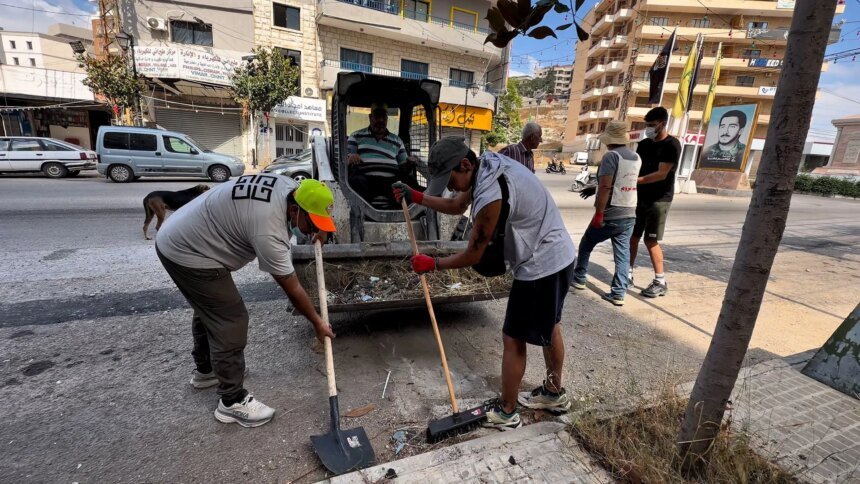
In the midst of this heavy scene, another day begins, unlike the one before it. The sounds of shovels and brooms replace the silence, and many feet move between the alleys as if they are trying to rearrange the place again. Dozens of volunteers arrive one by one, carrying simple tools: gloves, shovels, brooms, and large black bags, but what they actually carry is much more than that. An attempt to open a path to life within a city that has not yet left the shadow of war.

Reorder
Close to the young man Khalil, Habib Al-Sayyad wipes his dust-stained hands, then points to the picture stretching out in front of him as if he is trying to explain what goes beyond the limits of the act itself. He works as a volunteer within the “Popular Solidarity” Foundation, and tells Al Jazeera Net that what is happening here is not an emergency mission but rather an extension of a path that began during the war, when the Foundation ran a shelter center in the Ma’rouf Saad School in Sidon, and received about 650 displaced families.
He added: “When the war ended, we felt that the role had not ended. The goal was not only to provide relief to people during displacement, but to accompany them on their way back, and to rearrange what had been destroyed in their lives.”
In the same place, groups of volunteers come from different backgrounds: university students, lawyers, engineers, workers, and women. They are not united by one appearance, but by one action that is repeated in a calm rhythm: removing rubble and opening roads.
Here the work does not appear merely as a logistical task, but rather as an attitude towards the city, and towards the idea of it remaining viable.

Attributing people
Between the narrow alleys of the old market, huge cement blocks that were once part of entire buildings are piled up, and a team is working to dismantle them manually, stone by stone, while the shattered glass fragments are transferred to special bags. With each piece that is lifted, a new level of destruction is revealed, but in return a small margin of movement also opens up, as if the place is slowly regaining its ability to breathe after a long interruption.
Nevin Hashisho, one of the participating volunteers, said in an interview with Al Jazeera Net that this work is not a new beginning as much as it is a direct continuation of a role that began during the war. An organization she belongs to was running a shelter center for displaced people in Sidon, but today it is moving to a stage that it describes as “supporting people in their places of return.”
She continues: “We consider that confronting aggression does not end with the end of the war. It extends beyond it, to rebuilding what was destroyed, and to standing by the people in all possible ways.”
Nearby, Ibrahim Jumaa is participating in removing rubble in front of a store. He points out that what they are doing is “a moral duty before it is voluntary work,” adding that the residents of southern Lebanon are “planted in their land like seedlings that cannot be uprooted.” He stressed: “The least we can do is to be by their side and alleviate the effects of the destruction left by the aggression.”
As for Ali Hashisho, he describes the moment of his arrival in Nabatieh as something close to a shock. The city’s commercial center, which for decades had been the center of economic life, seemed like a vast void of memory: collapsed buildings, closed shops, and a street that had lost its first features.
He told Al Jazeera Net: “We saw buildings of 10 floors completely destroyed, and destroyed institutions, but in return we saw people smiling and encouraging us to continue. This alone was enough for us to continue.”
As time passes, the landscape begins to gradually change. The piles of rubble recede from the sidewalks, narrow paths open to pedestrians, and some facades reappear, albeit partially. Nothing is complete yet, but the rhythm of the city itself is changing.
Even the residents who pass among the volunteers participate in their own way: a fleeting glance of gratitude, a silent nod, or a short pause in front of what is happening, as if to make sure that the city has not been left alone in facing its heavy effects.

Return of the city
After this work, Nabatieh appears less harsh than it did in the morning, not because the destruction has receded or disappeared, but because movement has begun to crowd its emptiness. Between a stone being lifted and another being moved, the features of another city take shape and are slowly being reformulated, as if it is trying to restore itself from between the cracks.
In Nabatieh, volunteers do not deal with what is happening as a reconstruction project in the traditional sense, but rather as a small, accumulated daily action that reconnects what was cut off between the people and their place, and what was destroyed and what is still recoverable. Here, the mission does not seem technical as much as it is a redefinition of the relationship with the city itself.

Among the dust and rubble, signs of recovery are quietly progressing: a broom sweeping glass off the sidewalk, a hand removing a stone from a store entrance, and steps reopening corridors that were closed by the explosion. Simple details, but taken together, they depict a different beginning for a city trying to stand up again on its land.
Nabatieh was not far from the path of military escalation during the recent war, as it was subjected to a series of Israeli raids that targeted residential neighborhoods and public facilities. These strikes had a severe impact on the urban and economic fabric, and led to almost complete paralysis in its commercial center, which once constituted the beating heart of daily movement.