Published On 5/7/2026
|
Last update: 13:58 (Mecca time)
Since man raised his eyes to the sky thousands of years ago, the natural darkness of the night has been his first window to understanding the universe, and from it astronomy was born and planets, galaxies, and stars were discovered. Even with the development of giant telescopes, dark skies remained an indispensable condition for observing faint objects coming from the depths of the universe.
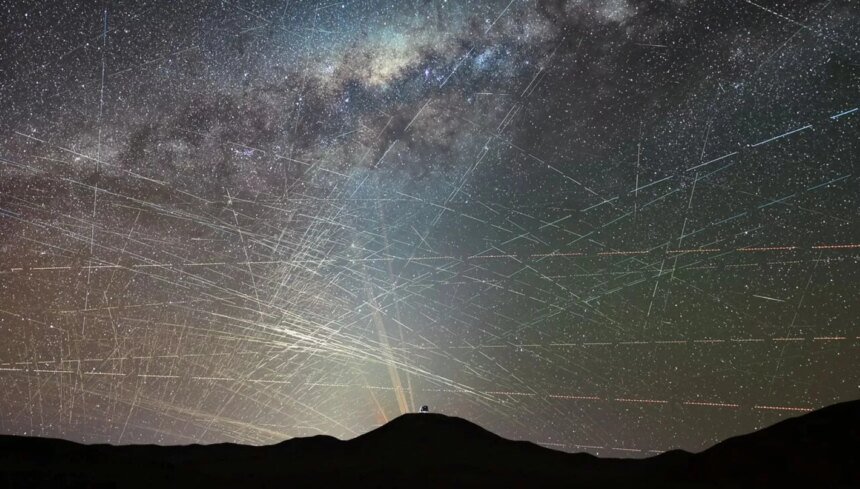
But a new scientific study warns that this human heritage may face an unprecedented threat, not because of a natural phenomenon, but rather as a result of a commercial project that proposes launching huge numbers of light-reflecting satellites (Reflect Orbital).

The study was published in the journal Astronomy & Astrophysics and was led by Olivier Hainaut, director of operations at the European Southern Observatory, who warned that the potential impact goes beyond the appearance of satellite lines in telescope images, to increase the brightness of the sky itself, which may make much astronomical observation impossible.
Read also
list of 2 itemsend of list
Moons reflect sunlight…but at a high scientific price
The study dealt with a project that proposes deploying large numbers of satellites equipped with highly reflective surfaces, with the aim of directing sunlight to specific areas on Earth to provide lighting at night or for other commercial purposes.
Although the project may have future applications, astronomers believe that the reflection of light from these satellites will raise the level of artificial lighting in the night sky, reducing the contrast that telescopes rely on to discover distant galaxies, faint stars, and Earth-like planets.

Olivier Hainaut said: “We may reach a point where there is no point in operating the telescopes, because all the data will be contaminated… all of it, 100%.”
Researchers confirm that even a slight increase in sky brightness is sufficient to hide light signals that traveled millions or billions of light-years before they reached Earth.
Every increase in light means a loss in science
The researchers explain that modern telescopes collect very small amounts of light coming from distant objects, so any increase in background light means the need to lengthen the exposure time to obtain the same data.
Hino explains the relationship simply: “If light pollution increases by 10%, all exposure times must be increased by 10%. If light pollution is doubled by 100%, all observation times must be doubled.”
This means that observatories will be able to study a smaller number of targets during one night, which will significantly reduce their scientific production, and will affect research on black holes, dark matter, habitable exoplanets, and even the study of the first galaxies that formed after the Big Bang.
The researchers also point out that computer programs capable of removing satellite effects from images cannot handle the increased brightness of the entire sky.
Moons may become brighter than Venus
One of the most dangerous results of the study is that the proposed satellites will not be similar to traditional communications satellites, but rather will be specially designed to reflect the largest possible amount of sunlight. “These satellites will make astronomical observations almost impossible, as they are very bright,” warns Heino.

He added: “Even outside the beam of reflected light, the artificial satellite will appear brighter than Venus, the brightest object in the sky after the moon.”
He pointed out that if about 50,000 space mirrors were launched, observers anywhere on Earth might see hundreds and perhaps thousands of these bright objects in the sky at the same time.
On the other hand, Hino explained that some current satellite operators have already taken engineering measures to reduce light reflection, such as tilting reflective surfaces away from the ground and minimizing visible areas, but he believes that satellites designed primarily to reflect light represent a completely different challenge.
The issue goes beyond astronomy to humanity’s right to a natural sky
Scientists believe that the issue no longer concerns astronomers alone, but has become an issue that affects society as a whole. “It would be catastrophic for astronomy, and it is difficult to imagine a way to mitigate its effects on this scale,” said Robert Massey, deputy executive director of the Royal Astronomical Society.
He added: “I am also worried about the public. People did not agree to change the shape of the sky above their heads.”

Massey pointed out that the US Federal Communications Commission’s approval of such projects may open the door to granting commercial companies the power to change the view of the sky, even though activities that change the environment on Earth are subject to strict laws.
He also pointed out that the Outer Space Treaty was drawn up at a time when no one could have imagined the enormous role that private companies would play in space, which requires a review of current legal frameworks.
Today, the world faces a question that goes beyond technology: How do we balance commercial innovation with protecting a universal heritage shared by all human beings? Space exploration should not be at the expense of the ability to contemplate it, because preserving the night sky is not a defense of astronomy alone, but rather of man’s permanent window into the universe.