

Published On 7/6/2026
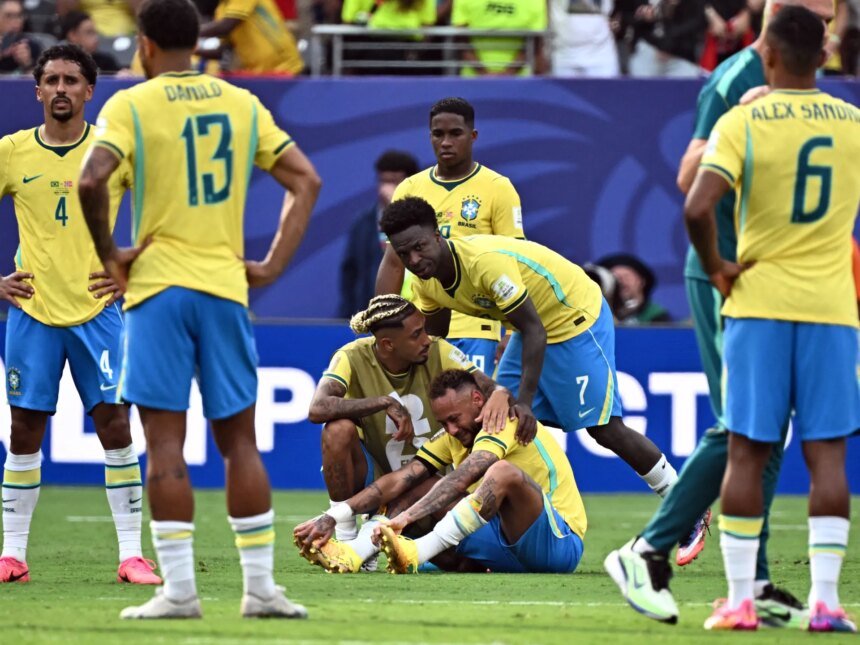
The Brazilian team’s exit from the World Cup finals at the hands of its Norwegian counterpart, with a score of 1-2, constituted a historic shock and a heavy surprise, embodying the fastest elimination of the “Seleção” in the history of its World Cup participations since the 1990 edition. On the other hand, the “Vikings” succeeded in continuing their historic march and passing to the quarter-finals, in a match that went against expectations, after both sides abandoned their identity and usual style in previous matches.
The technical reading of the confrontation indicates that the tactical decisions of the Brazilian team were what shaped the general scenario of the match. The Norwegian team would not have had this percentage of possession had it not been for the categorical refusal of the Brazilian players to keep the ball, which makes analyzing the Seleção’s performance the primary entry point to understanding the course of the match.
Read also
list of 2 itemsend of list
On the other hand, Norwegian coach Stal Solbakken is credited with his great flexibility in dealing with the “complicated and confusing” situation imposed by Italian Carlo Ancelotti, to get the match through to safety and emerge victorious.
Summary of the Brazil vs. Norway match
How did Ancelotti’s tactics topple Brazil?
Carlo Ancelotti surprised the observers by giving full possession to the Norwegian team, based on a technical reading that the competitor is not good at building the game from the back and defending on the front lines, but rather its main danger lies in set-pieces and quick attacking transitions. The numbers support this vision, as the Norwegian team entered the match with a possession rate of exactly 50% in its previous matches.
Brazil’s strategy was to sit back and wait for the Norwegian players to make passing errors, and then punish them with quick counters. Indeed, this scenario was achieved accurately, but the Brazilian attackers were completely unable to translate opportunities into goals.

Norway could have refused to dominate the ball and repeat the same tactic, which would have turned the match into a state of “exchanging negative roles” with each side wanting to push the other to control the match. But Norway accepted the challenge and rushed offensively, even though this method did not represent its strong point.
This situation forced Norway to rely on a series of longer passes than they were accustomed to, which resulted in unforced errors that posed a serious threat to their goal, but the trio of Bruno Guimarães, Vinicius Junior, and Indrik were free to waste those opportunities. Based on the data of the first half, Ancelotti’s strategy was logical and successful in its tactical aspect, had it not been for the lack of offensive effectiveness.
Collapse of the Brazilian system
The main turning point in the match lay in the substitutions made by Ancelotti during the second half, which had completely opposite results. In a plan originally built on retreat and defence, Ancelotti ended the match by placing the attacking duo, Indrik and Vinicius Junior, in defensive wing positions, roles that do not suit their capabilities, as well as representing a sharp decline in defensive efficiency compared to the departing duo, Ryan and Gabriel Martinelli.
This structural flaw gave Norwegian winger Andreas Schilderup wide spaces, as he easily passed Indrik on the corridor before setting up the first goal for his colleague Erling Haaland. This coincided with two successive lapses in positioning by substitute goalkeeper Ederson immediately after his arrival. The first was his incorrect exit from his position, which allowed Norwegian center back Torbjörn Hegem to advance the ball across the left front, while the second lapse was his decision not to retreat to cover and create a defensive position in which Brazil had a numerical superiority (three against two) facing Schilderup, David Müller and Wolff.
As Schilderup passed Endrik, the situation turned into a confrontation (two against one); The Benfica winger took advantage of the quick start of defender Wolff as a distraction for the Brazilian defence, at a time when captain Danilo was isolated between two attackers, sending Schilderup an accurate cross that Haaland rose to, converting it with his head into the net.
Disastrous changes
In the offensive aspect, Neymar’s presence was not directly harmful to the Brazilian national team, and although he clearly appeared physically unprepared and lacking his usual fitness – something familiar to followers of the Brazilian League – he was able to score the goal to reduce the difference and save face from a penalty kick. However, his involvement caused Martinelli to leave and move Endrek (the Lyon striker) to the right wing, knowing that Endrek had previously missed the most dangerous opportunities of the match in open play, but he showed clear danger and distinctive movement in the few minutes in which he occupied the position of the outright striker.

In complete contrast, Norwegian coach Stal Solbakken’s substitutions were extremely effective. Substitute Schilderup created both of Haaland’s goals, while his other substitute, Oscar Pope, added skill depth and additional speed from the right front, reflecting the success of the 58-year-old coach in keeping up with the reality of imposing possession on him and adapting his tools to serve this style.
The digital data and tactical charts for the match reinforce what was documented on the field of Norwegian superiority and Brazilian deficit. The match’s statistics show the depth of the Seleção’s offensive crisis and lack of effectiveness, as its players took 14 shots, only 4 of which came between the goalposts and the crossbar, and they created 5 major scoring chances, bringing the expected goals rate to 2.7, which is a numerical indicator that proves the accuracy of Ancelotti’s strategy in reaching the Norwegian goal, and at the same time confirms that the attackers missed a victory that was within reach.
Lines clash… Haaland vs. Magalhaes
The match was practically decided with Norway prevailing with two clean goals scored by Erling Haaland. Before the starting whistle blew, the English fans focused on the special bilateral confrontation between Haaland and defender Gabriel Magalhaes, as an extension of the traditional conflict between them in the English Premier League in the Manchester City and Arsenal shirts, and this confrontation met expectations.
The Norwegian striker succeeded in winning a direct overhead kick in front of the Samba defender to score the first goal that changed the course of the match. This superiority was not alone, as in the first half, Haaland succeeded in escaping Magalhaes’ control and set up a ball for his fellow national team captain, Martin Odegaard, but the latter’s shot was brilliantly blocked by goalkeeper Alisson.

Haaland’s qualitative superiority appeared in his bilateral struggle with Magalhaes. Although the Brazilian defender excelled in the total percentage of ground and physical tackles by 57% compared to 40% for Haaland, the latter imposed absolute dominance in high balls with a success rate of 100%, extracting 4 volleys.
Niland.. the impenetrable dam
While Haaland led the attack line efficiently, veteran goalkeeper Orian Nyland secured the back lines and thwarted Brazilian attempts. Statistics indicate that he succeeded in preventing (0.76) goals, which is an excellent percentage for a goalkeeper who did not score a clean sheet.
The former Aston Villa goalkeeper distinguished himself by saving a penalty kick taken by Bruno Guimarães, while he was unable to prevent Neymar’s penalty kick. He also valiantly saved his goal against a dangerous shot from Vinicius Junior in the first half. With this performance, Neyland imposed himself as a new obstacle to the ambitions of the Brazilians, joining in their memories under the category of tough opponents the Croatian Dominik Livakovic in the 2022 World Cup, and the Belgian Thibaut Courtois in the 2018 edition.