Recent satellite images, analyzed by the Al Jazeera Network’s open source unit, revealed features of a “logistical war” taking place in Russian control sites in southern and eastern Ukraine, all the way to the vicinity of the Crimean Peninsula.
Data monitored in late June 2026 shows that Ukraine continues to dismember Russian supply lines by targeting strategic bridges, matched by an accelerated Russian engineering alert to establish parallel crossings, dirt barriers, and temporary bridges.
Read also
list of 3 itemsend of list
New bridges
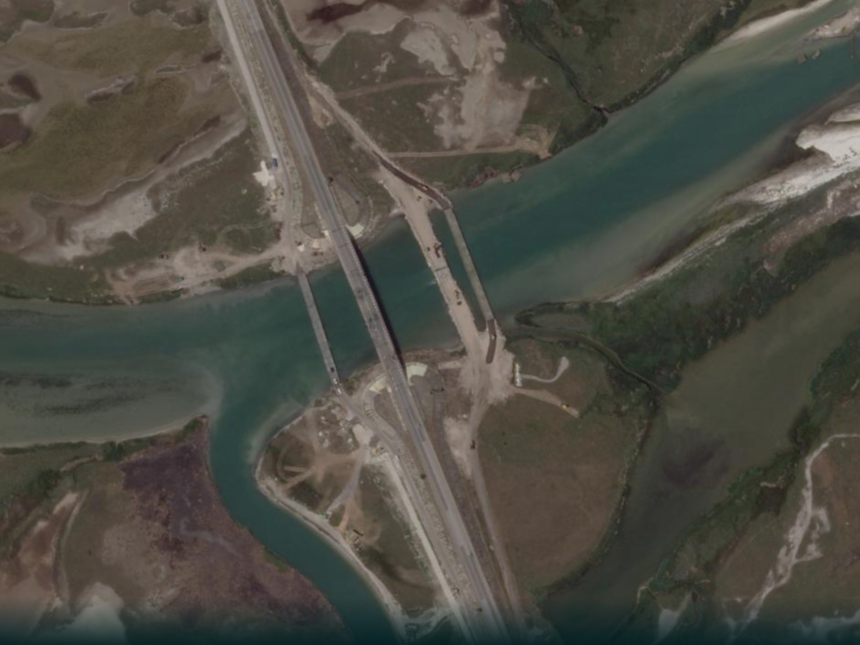
To deal with ongoing threats, recent Russian moves have focused on creating a network of temporary bridges and crossings, and satellite images show Russia’s rapid movement. In the southeastern sector of Kherson Province, recent satellite images taken on June 29 recorded the completion of the construction of a newly constructed temporary bridge over the “Northern Crimean Canal,” on which the Russian authorities had begun work early last June.
Russian engineering efforts were not limited to Kherson Province alone. Rather, recent satellite images, taken by the American company Planet, documented an engineering rush towards the Henichesk Strait, where Russian forces created more than one new bridge over the waterway to secure an alternative land corridor to the previously targeted bridge.
The General Staff of the Ukrainian Armed Forces announced the targeting of the main bridge on the night of June 20, justifying that Russian forces were using the bridge to provide military logistical support between the Crimean Peninsula and Russian military groups in the southern direction.
Tightening the screws
This current Russian engineering alert comes as a direct attempt to circumvent the results of a broader fire siege, which was documented by the Al Jazeera Network’s open source unit through a previous map that covered the first half of last June.
During this time, the geographical distribution of the Ukrainian strikes was tracked, which targeted about 30 vital sites for the supply arteries and energy infrastructure in the Russian interior and the areas of control. Satellite images showed that the axes leading to Crimea were subjected to tremendous pressure after the main “Chongar” land bridge was temporarily taken out of service following concentrated strikes, and the targeting of other bridges near “Priobrazhenka”, “Mirno” and “Novoazovsk”.
This systematic destruction of bypass options is what explains the current Russian path to establishing alternative crossings over canals and water straits, despite the targeting of suicide planes.

Targeting the Crimean corridors
In the same context, the General Staff of the Ukrainian Armed Forces announced the implementation of a series of strikes to reduce Russia’s military and economic potential, as it confirmed in an official statement that during the day and night of June 30, defense units targeted the car bridge in the Azovsky district of Zaporozhye province, and the railway bridge in the area of the town of “Ichki” in the Crimean peninsula, justifying that the Russian army depends on them to transport soldiers, weapons and ammunition.
This came after a previous wave of strikes on June 28 and the night of June 29, which targeted a car bridge near Novoazovsk in Donetsk Province and two railway bridges in Luhansk, in addition to its prior targeting on the night of June 20 of a car bridge over the Henichesk Strait to cut off land logistics.
In the same context, Ukrainian Defense Intelligence confirmed that the special “Primari” unit continues its work to disable military installations and disarm the Crimean Peninsula.
The unit broadcast scenes documenting the destruction of supply lines and large transport trucks, in addition to launching strikes targeting oil freight trains on railway lines.
On the other hand, and in response to the damage to supply routes due to successive Ukrainian attacks, the Russian authorities in the Crimean Peninsula announced strict and comprehensive measures restricting transport movement across the strategic Crimean Bridge, completely stopping fuel sales to individuals and companies while tightening the ban on the crossing of fuel trucks.
In this regard, Al Jazeera’s correspondent, Zaur Shog, monitored developments in the situation on the ground, stressing that a severe fuel crisis was hitting Crimea following Ukraine’s targeting of land supply lines, which complicated the supply operations of Russian forces deployed on the southern fronts.
Since Russia took control and annexed Crimea in 2014, the peninsula has turned into a major base for Russian military operations in southern Ukraine.
With the outbreak of the large-scale Russian-Ukrainian war in February 2022, Moscow relied on a network of land supply routes extending through the areas it controls in Donetsk, Zaporozhye, and Kherson, along with the Crimean Bridge, to transport troops, equipment, and supplies to the Crimean and southern fronts.
On the other hand, Ukraine intensified the targeting of bridges, railway lines and logistical infrastructure with the aim of disrupting the Russian supply and forcing Russian forces to establish alternative routes and crossings.