There are critical books that merely explain, and others aspire to redraw the map of their reader. The new book by Jordanian critic and academic Dr. Khalil Al-Sheikh about the late poet Mahmoud Darwish belongs to the second category, but with patience and not looking for noise.
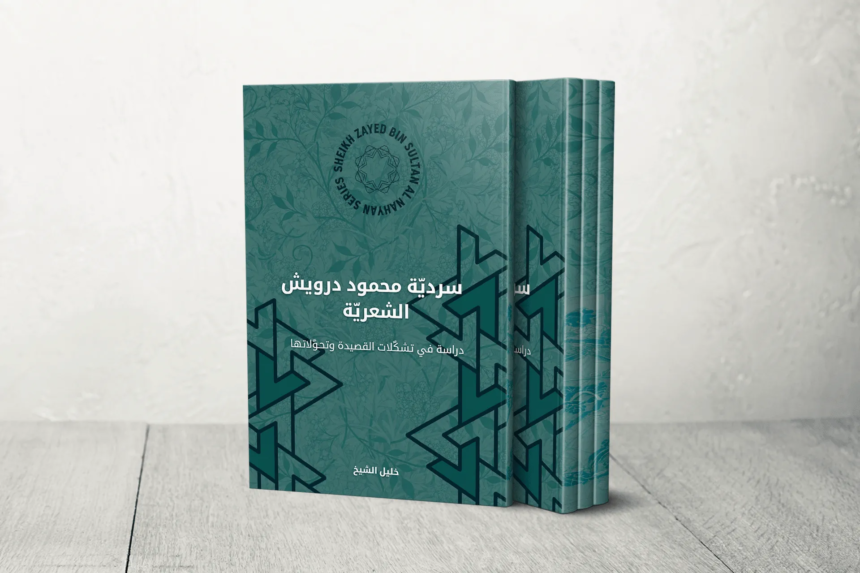
The recently published book, “Mahmoud Darwish’s Poetic Narrative: A Study of the Poem’s Formations and Transformations,” in five hundred and twelve pages, constitutes something like an autobiography of an entire long poem, which grew from the collection “Birds Without Wings” (1960) to the collection “I Don’t Want This Poem to End,” which was published a year after the poet’s death.
Read also
list of 2 itemsend of list
Between these two extremes, study expands and branches with diligent effort and patient work, but it does not get lost. The author holds one thread that he does not let go of, which is that Darwish’s poetry, in essence, is not a collection of accumulated collections, but rather an evolving narrative, and each poem in it gives birth to the next, and each collection is a prelude to what comes after it.
It is noteworthy that this book was issued by the American University of Beirut Publishing House as part of the Sheikh Zayed bin Sultan Al Nahyan Series for Arabic and Islamic Studies and Texts. What is striking about this book is that it is published at a moment when it seems to me that the demand for Darwish has reached a kind of saturation. The poet, who became a symbol, then an icon, then a fortified legend in some readings, is restored every few years in a symposium or celebration, and is restored as a poster more than a text.
But Khalil Al-Sheikh deals with this legacy with rare care. He does not seek to deify Darwish, nor to remove his aura. He explicitly says in his introduction that “the legends of creative people are the creation of collective consciousness, and no single study can advance or undermine them,” so the author frees himself from the pressure of the situation to devote himself to what is more difficult, which is reading the poem as a poem, and not as a political document or a national statement.
This methodological displacement is key to the book. Mainstream readings of Darwish often fall into the trap of what the critic Sheikh calls the “documentary view,” which mixes poetry with the Palestinian historical narrative, reading “The Olive Leaves” as a statement of a catastrophe, “A Lover from Palestine” as a statement of identity, and “The Mural” as an obituary for the self. But the Sheikh critic calmly rejects this reduction, and returns the poem to its original laboratory, which is language, structure, metaphor, and the formation of meaning and its transformations. For him, poetry is read from the inside, from its aesthetic texture, before asking about its external significance. When he reaches significance, he reaches it using his critical tools, not his ideological emotion.

Major narratives in Darwish’s poetry
The study is organized into six chapters that together constitute what can be called the “major narratives” in Darwish’s poetry: the narrative of formation, the narrative of exit, the narrative of the past in the present, the narratives of the characters, the narrative of the self and the other, and the narrative of departure.
This division is highly functional, as it gives the study its ability to trace the internal growth of Darwish’s poem and the transformation of its metaphors and vision. It also captures the deep structures upon which Darwish was building his project without naming them, and reveals how what sometimes appeared to be diversity or dispersion in his experience, was in fact a controlled internal development. The olive in “The Olive Leaves,” for example, is not just a rural symbol, but the beginning of a whole dictionary that would later develop to include green, coffee, thyme, the Nile, the sea, papyrus, and Mesopotamia. All of these vocabulary, according to the sheikh, are elements in a “poetic dictionary of the Palestinian narrative,” which establishes a complete imagination and not a political discourse. This is one of the most profound observations of the book, which is that Darwish was not writing the Palestinian poem, but rather he was constructing its language.
In the third chapter, where the Sheikh addresses “the narrative of the past in the present,” the book’s deepest ability to analyze is evident. Here he studies Darwish’s controversy with the Arab poetic heritage – with Imru’ al-Qais, Al-Mutanabbi, Abu Firas Al-Hamdani, Al-Mu’allaqat, Al-Talliyya, and Al-Andalus – not as a martyrdom but as a reshaping of the Arab poetic memory from the position of the displaced Palestinian. It reveals how Imru’ al-Qais, in particular, was the most present character in Darwish’s consciousness, due to his ability to combine the poetic and the political, and the comedy and tragedy that his character entailed.
When Darwish wrote “Eleven Planets at the End of the Andalusian Scene,” the Sheikh says, he was writing two parallel moments in time: the moment of the fall of Andalusia and the moment of the Palestinian departure. Perhaps one of the brightest things that the book captures – and the Sheikh places it at the heart of his introduction as a key note – is that Darwish first wrote the famous line: “This peace will leave us a handful of dust,” and then modified it to read: “This departure will leave us a handful of dust.” This is a small modification of one word, but – as the sheikh himself notes – it makes departure an idol of death and annihilation, and transforms the poem from a political reaction to the Oslo moment into an existential meditation on the recurring metaphysics of Arab departure. This type of precise discovery is what distinguishes the critic who reads the text from the inside.
Cultural portraits
Perhaps the most beautiful thing about the chapter “Narratives of Characters” is that it brings back consideration to a project that was almost lost in the noise of political readings of Darwish. It is the project of elegies, or what the Sheikh calls “Narratives of Characters.” Ten figures were mentioned by Darwish in his collections: Ibrahim Marzouk, Rashid Hussein, Izz al-Din al-Qalq, Wael Zuaiter, Amal Dunqul, Yiannis Ritsos, Emile Habibi, Nizar Qabbani, Salim Barakat, and Edward Said.
If the text itself devotes an analytical chapter to Majid Abu Sharar in comparing the structure of his elegy with the structure of Izz al-Din al-Qalq’s elegy, then the actual number becomes eleven.
The sheikh reads these poems as a complex structure, based on temporal and spatial transitions, combining innocence and experience, and establishing an individual and collective poetic memory at the same time. For Darwish, every character is a small story that feeds into the bigger story, and every elegy is a promise not to forget. When the sheikh says that “the poet’s self embraces these selves to build a story that connects to the collective narrative,” he pinpoints what distinguishes Darwish from other mourners in contemporary Arabic poetry, as he does not cry for the dead, but rather hosts him in his poem to complete his narrative project through it.
Here the book expands from criticizing texts to studying the characters that Darwish eulogized or wrote about, thus revealing the cultural dimension of the book. The poem “Tabaq”, in which Darwish depicted the character of Edward Said, is not read by the sheikh as a traditional lament, but rather as a poetic formation of the concept of antiquity according to Said himself, where the meaning of the term in Arabic rhetoric (combining something with its opposite) meets the concept of musical contrapunto that Said employed in analyzing culture, identity, and post-colonialism.
The sheikh traces how Darwish built this character on interwoven dualities: the duality of place: “I am from there, I am from here, and I am not there and I am not here,” the duality of the name between the English “Edward” and the Arab “Saeed,” the duality of the two languages, and Saeed walking on the wind as the opposite of Christ walking on the water. As for his eulogy for Nizar Qabbani, the sheikh goes beyond the reductive view that promoted the superficiality of Nizar’s poetry, to rehabilitate his role in developing the poetic sentence and linking it to the common and the everyday, and denies the “donguan” characteristic that stuck to him, indicating that his poetry deals with women as producers of meaning, not as its subject.
The most famous Palestinian voice layers
In this book, critic Khalil Al-Sheikh takes us on a journey that resembles an archaeological excavation into the layers of the most famous Palestinian voice in the modern era. It is more like a deconstructive cultural reading that seeks to understand how the rural boy, Ibn al-Birwa, expelled from the geography of the place, turned into a metaphorical architect that crosses cultures and borders.
The Sheikh starts from an intelligent central hypothesis. He does not deal with Darwish’s poetry as sentimental outbursts or separate poems, but rather as a cohesive “grand narrative,” which began from a simple, direct, rhetorical horizon in the sixties of the last century through collections such as “Olive Leaves” and “A Lover from Palestine,” ending with a highly structured, complex, and aesthetically metaphysical horizon at the beginning of the millennium in “The Mural,” “Like an Almond Blossom or Beyond,” and “The Dice Player.”
The main advantage of Al-Sheikh’s book lies in his ability to trace the context of cultural confrontation. In 1948, the Palestinian land fell, and with it the identity was seized and the language and place were changed through a false and superior narrative by force. Here, the young Darwish stands out as one of those “birds without wings” who found themselves writing in Arabic in a country that was being Judaized, and the young man was influenced by the Marxist and partisan consciousness at the time.
But the critical reading that the Sheikh provides brilliantly demonstrates how Darwish was gradually able to nationalize his tools and expand the circle of reception. The Darwish poem, as the book deconstructs it, liberated Palestine from “direct politics and ideology” to move it to a universal human horizon. Where the olive tree, coffee, and the mother’s handkerchief are transformed from local symbols into mythical elements that meet the civilizations of the Nile Valley and Mesopotamia.
The geography of exit and the transnational metaphor
The book devotes interesting spaces to tracing the impact of the exodus (from Haifa to Cairo, then Beirut, then European exile) in Darwish’s poetic dictionary. The sea and the river in this cultural criticism are not a geographical luxury; The river, as the sheikh says, expresses “continuous transformation or becoming,” while the sea is, as stated in the chapter “The Sea/Beirut,” a place of birth, resurrection, transformations, and fertility, combining life and death, as was demonstrated in his epic “Praise of the High Shadow” during the siege of Beirut.
Khalil Al-Sheikh shines in “Chapter Three” (the narrative of the past in the present) when he reviews how Darwish entered into controversy and acculturation with the Arab heritage and human symbols. Here we see Darwish wearing the “Mask of Majnun Layla” or “Jamil Buthaina,” but he does not talk about platonic love, but rather rebuilds the language of love and poetry and adapts the erotic and Sufi production (inspired by the Kama Sutra and Tawq al-Hamamah by Ibn Hazm) to serve the modern text. It also highlights his amazing identification with the late kings of Andalusia (Abu Abdullah al-Saghir) as a mirror of the failures of the Palestinian and Arab present.
Critical prose that is flowing and rigorous
As for the style of the Sheikh himself, it is what makes this book more than an academic study. University Arabic criticism often falls into the traps of terminology, and the studied text is drowned in a crowd of structural, semiotic, and deconstructive concepts, until the critic becomes louder than the poet. However, the Sheikh critic, on the other hand, writes flowing critical prose, where the concept is not presented but rather dissolved in the text, and where the example is led to its conclusion without forcing the reader into the mediocrity of the table and numbering. This flowing critical prose, which carries as much poetry as it does rigor, is what allows the book to be read from outside the university without losing its depth within it. This is a rare ability in contemporary Arab criticism, which is accustomed to either journalistic simplification or academic complexity, without finding the third way.
In the sixth and final chapter, where the Sheikh reads the “narrative of departure” in “The Mural” and “The Dice Player,” the book reaches its analytical climax. Darwish, as the sheikh reminds us, wrote “The Dice Player” before his surgery in a Houston hospital, in which he counted the coincidences that could have caused him to die.
This poem, according to the sheikh, is not only a self-elegy, but a metaphysical confession that all of life is a series of intertwined coincidences, and that the poet who fought for meaning for a long time discovers, in the end, that meaning itself may be another throw of the dice. Here, the Sheikh analyzes how Darwish’s poem moved from heroism to marginality, from the loud voice to a whisper, and from the “ego” that records its identity card to the “ego” that questions its existence. This inner journey, from identity card to dice player, is perhaps the most important thing that Darwish teaches us, which is that a great poet does not write the same poem twice, and that true beauty lies in the ability to transform without losing oneself.
The secret of Darwish’s greatness
It is noteworthy that the book does not deal with Darwish’s experience as a single homogeneous mass, and insists on the idea of continuous transformation. The author traces the poem’s transition from direct lyricism to composition, from clarity to ambiguity, from collective heroism to individual fragility, and from the “poem of the issue” to the “poem of the human being.” This is one of the most distinctive points in the book, which goes beyond some Arab studies that continued to deal with Darwish as if he were an established poet. If some Arab critics – Subhi Hadidi and Faisal Darraj among the most prominent – have tracked Darwish’s transformations before the Sheikh, what distinguishes this study is that it frames the transformation within the structure of six major narratives, giving the chapters a rare methodological unity in Arabic writing about him, as Khalil Al-Sheikh shows that the secret of Darwish’s greatness lies in his ability to constantly transcend his previous voice, and reinvent his language and his position within the poem.
One of the most important achievements of the book is also that it restores consideration to the idea of narrative within poetry itself. Modern Arabic poetry has often been read as a purely lyrical structure, while Khalil Al-Sheikh proves that Darwish’s poem was constructing, from the beginning, a major story that was fragmented into smaller stories: the story of the land, the mother, the soldier, Rita, the house, the river, departure, and even death itself.
Perhaps most importantly, the author possesses a critical sensitivity that protects him from falling into Darwish’s myths. He does not write a glorifying biography, but rather pursues the tensions, refractions, and contradictions within the experience itself. There is a clear awareness that Darwish was not a poet of certainty, but rather a poet of constant questioning, and a poet of existential anxiety who sometimes hides behind high eloquence. Therefore, his reading of “The Mural” and “The Dice Player” appears to be one of the most profound sections of the book, because it goes to the area of the poet’s confrontation with death, not as a biological event, but as a question of final meaning.
This is an important book because it opens a wide door to rereading Mahmoud Darwish outside the exhausted dualism of “resistance poet” or “universal poet.” The sheikh proposes something more complex, that is, Darwish as a massive Arab narrative project. He is a poet who wrote about Palestine, but he also wrote about modern man trying to carry his memory within a world that is constantly collapsing.
Deeper value
In the end, the deepest value of this book is that it teaches us how to read a great poet without losing the joy of reading him. It brings Darwish back to what he always aspired to, and what he expressed in the later years of his life, which is pure poetry. The one who does not need a document to support him, nor a banner surrounding him. It is poetry that stands tall in its linguistic stature alone, standing tall in the memory of Arabic. Readers listen to it just as languages listen to the springs that created it.
Dr. Al-Sheikh, with this book, provides us with something like a travel guide based on Darwish’s internal maps, which brings us to a new and distinctive way of reading. This, in criticism as well as in poetry, is considered the highest level.