
Fatigue is a common complaint in everyday life, and can often seem like a natural result of lack of sleep, work pressure, or constant stress. But continuing to feel tired without a clear reason may be an indication of a deeper problem, especially if it turns into a chronic condition that affects daily performance, work, study, and social relationships.
According to figures published by the Centers for Disease Control and Prevention in the United States (CDC) on its website on May 10, 2024, chronic fatigue affects the lives of about 3.3 million Americans, and limits their ability to perform their practical, educational, and social tasks normally.
Read also
list of 4 itemsend of list
Chronic fatigue may appear after a viral infection, after severe physical stress, or after major surgeries, and data indicate that it is two to four times more common among women than men.
The relationship of B12 and folic acid to stress
In this context, a recent Japanese study showed that a deficiency of vitamin B12 and folic acid, also known as vitamin B9, may be associated with physical and mental stress, and may be one of the factors associated with chronic fatigue.
The study was conducted at Osaka University on 2,618 adults, and after applying exclusion criteria, 602 participants remained in the final analysis, during the period from April 2018 to March 2020.
The results of the study were published in the journal “Nutrients” on March 17, 2026 under the title: “Associations of Plasma Homocysteine Reflecting Vitamin B12 and Folate Status with Fatigue-Related Outcomes in Healthy Adults.”
The researchers found that people with high homocysteine levels were more likely to feel tired or lack motivation. Homocysteine is an amino acid produced from the breakdown of methionine found in meat, fish, legumes, dairy products, and eggs. It is also a vital indicator that may reflect a deficiency in vitamins B12 and B9.
To understand the dimensions of this relationship, Al Jazeera Net spoke with Professor Dr. Hassan Hassouna, Professor of Nutrition at the National Research Center in Cairo, to explain the causes of common fatigue, the role of vitamin B12 and folic acid in the health of the body, the groups most vulnerable to deficiency, and ways to deal with it medically.
Why has fatigue become a frequent complaint even among young people?
Dr. Hassan Hassouna says that fatigue, whether in adults or youth, is not linked to just one cause, but rather often results from the intersection of several factors, including lack of sleep, malnutrition, psychological stress, and anemia.
He explains that hemoglobin deficiency leads to a decline in the blood’s ability to transport oxygen to the body’s tissues, which is reflected in general weakness and chronic fatigue. Thyroid disorders, whether underactive or overactive, may cause a constant feeling of fatigue.
Hassouna points out that malnutrition is an important cause of feeling lethargic, especially when relying on diets rich in processed carbohydrates, because it may cause sharp rises and falls in blood sugar levels, which affects energy and concentration. Also, a deficiency of vitamins B12 and D may be associated with lethargy and general fatigue.
What is vitamin B12? Why does the body need it?
Hassouna points out that vitamins, according to the World Health Organization, are organic compounds and micronutrients that the body cannot manufacture itself, or cannot produce in sufficient quantities, and therefore must be obtained in small quantities through food.
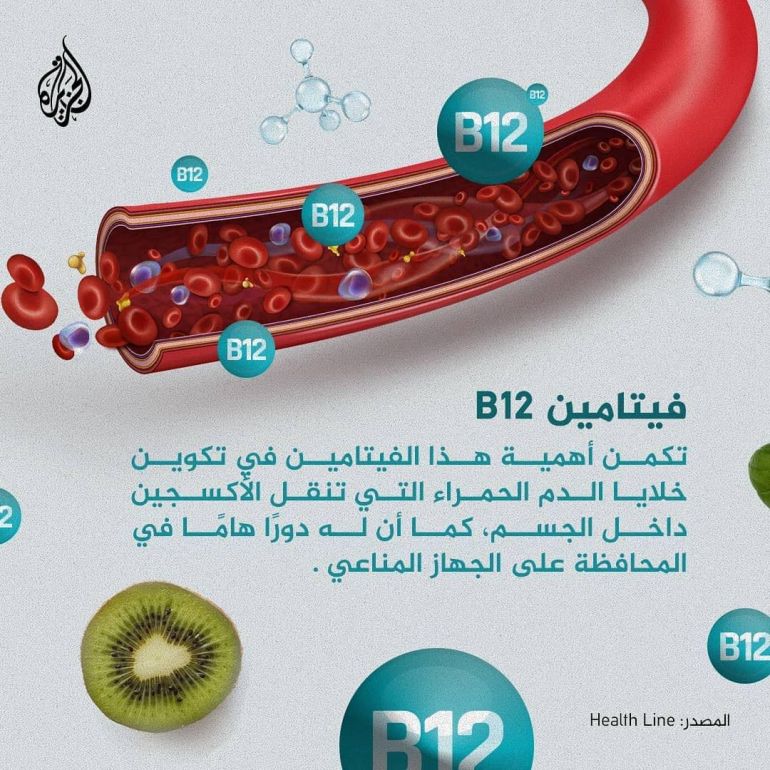
Vitamin B12 is an essential water-soluble vitamin. The body needs it to produce nucleic acids, DNA and RNA, and maintain nerve health. It also works with the rest of the B group vitamins to form red blood cells and support the metabolism of propionate, amino acids, and single-carbon units.
The process of absorbing vitamin B12 requires the presence of what is known as the “intrinsic factor,” which is a protein produced by the stomach that helps the body absorb this vitamin efficiently.
What are the most important sources of vitamin B12?
Vitamin B12 is found in a number of foods, especially those from animal sources, most notably:
- Lean meat and poultry
- Seafood such as salmon, tuna and oysters
- Dairy products such as milk, yogurt, and cheese, in addition to eggs.
- There are suitable alternatives for some groups, such as fortified breakfast cereals, fortified plant milks, and nutritional yeast, but they need special attention among vegetarians and those who follow strict diets that do not include animal products.
Folic acid
Dr. Hassouna explains that folic acid is the synthetic form of vitamin B9, while this vitamin is found naturally in food in the form of “folate.” It is a water-soluble vitamin, which is necessary for the production of new cells, the formation of DNA, and the formation of healthy red blood cells.
Folic acid is very important during pregnancy, because it helps the proper growth of the fetus’s brain and spine. Obtaining sufficient quantities of it before and in the early stages of pregnancy contributes to the prevention of serious birth defects, such as spina bifida, also known as spina bifida.
Folic acid also protects against some types of anemia, as its deficiency may lead to megaloblastic anemia, a condition in which the number of healthy red blood cells necessary to transport oxygen throughout the body decreases.
Folic acid also plays an important role in cell growth, amino acid metabolism, damaged tissue repair, and has a clear effect on the health of the nervous system.
Where is folic acid found in food?
Folate is abundant in dark leafy vegetables, such as spinach, kale, romaine lettuce, and arugula. It is also found in beans, asparagus, legumes, organ meats such as liver and kidney, and fortified grain products.
Hassouna confirms that the relationship between vitamin B12 and folic acid is complementary. One does not work fully efficiently without the other in a number of vital processes within the body.
They both contribute to DNA synthesis, cell division, the proper formation of red blood cells, and maintaining a healthy nervous system. A deficiency of either may lead to megaloblastic anemia.
Vitamin B12 and folic acid are also involved in converting homocysteine into methionine, an amino acid important for protein synthesis and metabolism. Therefore, high homocysteine may be a sign that calls for attention to the condition of these vitamins within the body.
Symptoms that should not be ignored
Vitamin B12 deficiency particularly affects the nervous system, and may cause numbness or tingling in the hands and feet, difficulty walking, balance problems, shortness of breath, and pale skin.
This deficiency is often accompanied by a feeling of extreme fatigue, muscle weakness, and changes in cognitive functions. If left untreated, in some cases it can lead to irreversible nerve damage.
As for folic acid deficiency, it affects the efficiency of oxygen transport within the body due to its relationship to the formation of red blood cells, which may cause fatigue and weakness associated with anemia.
Hassouna points out that a deficiency of vitamin B12 and folic acid may be linked to megaloblastic anemia and pernicious anemia, two conditions that may lead to feelings of chronic fatigue.
Psychological and cognitive symptoms may also appear, such as poor memory, confusion, irritability, depression, poor concentration, and symptoms similar to dementia, in addition to a feeling of tingling and numbness.
Special effect on pregnant women and fetuses
Hassouna warns that vitamin B12 deficiency may have important effects on pregnant women, as it may increase the risk of miscarriage, premature birth, and preeclampsia.
As for the fetus, a deficiency may be associated with an increased risk of neural tube defects such as spina bifida, low birth weight, and delayed neurological or cognitive development, effects that may be very serious if not treated in a timely manner.

Who is most at risk of vitamin B12 deficiency?
Vitamin B12 deficiency affects people who do not get sufficient amounts of animal products, or who suffer from diseases that impede the absorption of nutrients.
The most vulnerable groups are:
- Elderly people, as some estimates indicate that the deficiency may affect up to 20% of those over the age of sixty, due to a decrease in the production of stomach acid and intrinsic factor necessary for absorption of the vitamin.
- Vegetarians, especially vegans, because vitamin B12 is found almost exclusively in animal products, which makes them more vulnerable to deficiency if they do not rely on fortified foods or supplements under medical supervision.
- People with autoimmune diseases, most notably pernicious anemia, where the immune system attacks the stomach cells responsible for producing intrinsic factor.
- Gastrointestinal patients, such as those with Crohn’s disease, celiac disease, or gastritis, as these conditions may affect the body’s ability to absorb nutrients.
- People undergoing weight loss surgery, such as gastric bypass surgery, because these procedures may reduce the digestive system’s ability to extract and absorb vitamin B12 from food.
How is vitamin B12 deficiency treated?
Hassouna stresses that treatment for vitamin B12 deficiency depends on the degree of deficiency, the presence of neurological symptoms, the nature of the cause, and whether the problem is only nutritional or related to malabsorption.
In cases of mild or moderate deficiency, a doctor may prescribe oral supplements in daily doses of 1,000 to 2,000 micrograms. These doses are effective in many diet-related conditions, as higher doses allow some absorption barriers to be bypassed through what is known as the “mass effect” mechanism, even in the absence of intrinsic factor.
In cases of severe deficiency, neurological symptoms, or malabsorption, the doctor may resort to intramuscular injections, often in the form of hydroxycobalamin or cyanocobalamin.
Treatment usually begins with several weekly doses, then gradually reduces to monthly maintenance doses, according to the doctor’s assessment and the patient’s response.
There are also nasal preparations of cyanocobalamin, such as sprays or gel, that may be used in some cases to prevent recurrence of the deficiency, according to what the doctor deems appropriate.

When does fatigue become a medical alarm?
Fatigue does not necessarily mean the presence of a serious illness, but it becomes a cause for concern if it is continuous, or accompanied by severe lethargy, poor concentration, mood changes, or neurological symptoms such as numbness, tingling, and disturbance of balance.
Hassouna says that feeling tired may result from various diseases, sleep disorders, breathing problems, unhealthy lifestyle, malnutrition, and weight gain.
It is recommended to maintain a balanced diet, avoid overeating, engage in physical activity, even simple ones, sleep for sufficient hours, and not excessive intake of stimulants and caffeine drinks.
It is also advised not to hesitate to consult a doctor if you constantly feel tired and lethargic, go through a state of depression or frequent mood changes, or suffer from constant forgetfulness and poor concentration.
Fatigue may be a passing symptom, but it may also be a message from the body that there is a deficiency or defect that needs to be examined early, before daily fatigue turns into a chronic burden on health and life.