

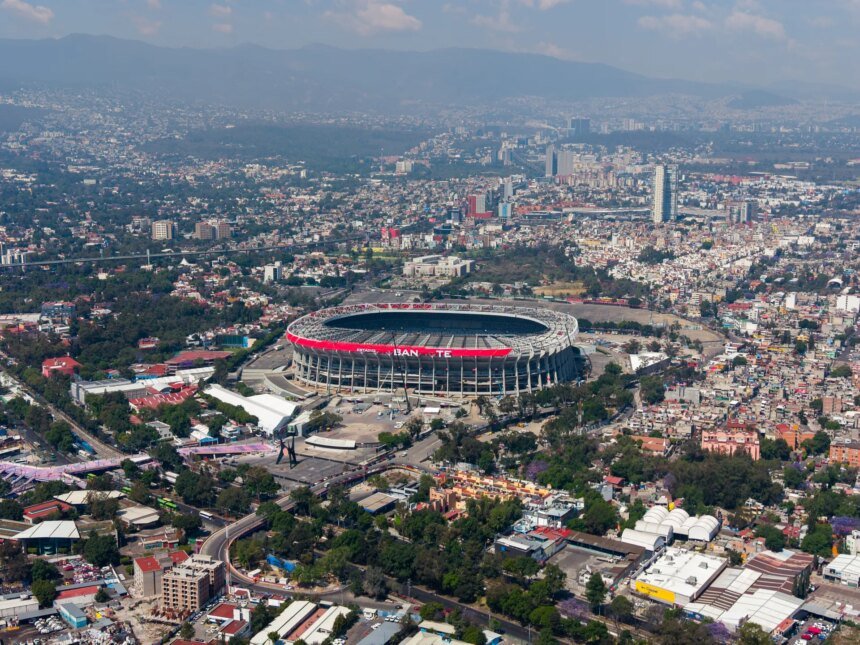
Azteca Stadium is not just a station that will host the match between Mexico and England in the 2026 World Cup final, but rather it is one of the most famous landmarks in world football and the most closely linked to the history of the World Cup.
Since its opening six decades ago, it has become a witness to immortal moments that made the history of the game, before it became in the current version one of the most prominent weapons of the Mexican national team in its quest to continue its journey on its home soil.
Read also
list of 2 itemsend of list
While the English national team enters the match in search of a ticket to the quarter-finals, the hosts are counting on a stadium that they have never experienced losing in the history of their participation in the World Cup, in an unprecedented record at the tournament level.
A name associated with the Aztec civilization
The stadium bears a name inspired by the Aztec civilization, in honor of the historical and cultural heritage of Mexico, and the name “Azteca” has remained with it since its opening, despite more than one attempt to change it.
In January 1997, the Televisa group, which owns the stadium, announced that it would change its name to “Guillermo Canedo Stadium,” in honor of the former president of the Mexican Football Federation and member of the Executive Committee of the International Federation of Association Football (FIFA), Guillermo Canedo de la Barthena. However, the decision was met with widespread public rejection, which prompted the company to back down and keep the name that was associated in the minds of football fans with the history of the World Cup.
The scene was repeated before the 2026 World Cup, when on March 14, 2025, Banorte Bank purchased the naming rights to the stadium to help finance its modernization work, so that its official name became “Banorte Stadium.” However, the fans continued to use the name “Azteca”, while FIFA regulations during the tournament imposed the adoption of the name “Mexico City Stadium”, in compliance with the International Federation’s policy that prohibits the use of brand names for stadiums during official competitions.

The stadium is also known as the “Giant of Santa Ursula”, due to its huge size and the neighborhood in which it is located south of the Mexican capital.
The most famous theater in the history of the World Cup
Not only is Azteca famous for hosting matches, its name has been linked to some of the most memorable and controversial moments in football history.
It is the first stadium to host two World Cup finals, after it hosted the World Cup final in 1970, which saw Brazil crowned under the leadership of Pele, and then the World Cup final in 1986, in which Argentina was crowned, led by Diego Maradona.

With its hosting of the World Cup matches in 2026, the Azteca stadium has become the first stadium in the history of the tournament to host the competitions of three different versions of the World Cup, after hosting ten matches in the 1970 edition, and nine matches in the 1986 edition, before opening its doors again to host the matches of the current edition, including the opening match.
The stadium also includes a number of commemorative plaques that commemorate the most famous moments of the World Cup, most notably the plaque “Match of the Century” between Italy and West Germany in the semi-finals of the 1970 edition, and the plaque “Goal of the Century” scored by Argentine legend Diego Maradona against England in 1986, when he dribbled past half of the English team before scoring in one of the greatest goals in the history of the game.

That goal was not the only shot that was immortalized at the Azteca Stadium in that match, as it also witnessed Maradona scoring his famous goal, “The Hand of God,” when he deposited the ball into the net with his hand in a shot that the referee did not notice, becoming one of the most controversial incidents in the history of the World Cup.
That incident, along with the “Goal of the Century” that came minutes later, still embodies the unique contradiction that was associated with that meeting. In one match, he combined the two most famous goals in the history of the tournament, one due to refereeing controversy, and the other due to technical genius.
The stadium also includes paintings documenting the first goal scored on its grounds, and the first goal in the first night match it hosted, turning its walls into a record documenting the most important milestones that made the history of the World Cup.
A fortress that eluded Mexico’s rivals
If the Azteca represents a piece of football history, for the Mexican national team it has become a real fortress in the World Cup finals.
So far, the Mexican team has played ten matches on the field in the history of the World Cup without suffering any losses, achieving six victories and four draws, becoming the holder of the best record for any team on a single field in the history of the tournament.
This series was divided into three different versions, as the hosts played three matches in the 1970 World Cup, and four matches in the 1986 World Cup, before adding three more matches in the 2026 World Cup, maintaining their unbeaten record.
Numbers that reinforce the Mexican dream
The value of this number increases considering what the Mexican team is offering in the current edition, as it was one of only three teams to achieve the full score in the group stage, along with France and Argentina, and it was also the only team to finish the first round with three victories without conceding a single goal.
The brilliance did not stop there, as the host team continued its strong performances by defeating Ecuador (2-0) in the round of 32, achieving its first victory in the World Cup knockout rounds in more than forty years, continuing to write one of the most prominent stories of the tournament.
A record that challenges the world’s leaders
No team surpasses Mexico in its unbeaten record at a single stadium in World Cup history.
The German national team comes in second place after playing six consecutive matches without defeat at the San Siro Stadium, including five matches on its way to the World Cup title in 1990.
As for the England team, it achieved six consecutive matches without losing at the old Wembley Stadium on its way to the World Cup title in 1966, while the Italian team remained unbeaten in five matches at the Olympic Stadium in Rome in the 1990 World Cup, before leaving the tournament on penalties against Argentina in the semi-finals held in Naples.

Uruguay, Brazil, Germany and France also achieved a series of four consecutive matches without losing in one stadium, at the Centenario stadiums in the 1930 World Cup, Sausalito in the 1962 edition, Lyon in the 1970 edition, and the Stade de France in the 1998 World Cup.
Can Azteca survive England?
Mexico enters the match against England supported by ground staff and the crowd, and with a historical legacy that makes the Azteca one of the most difficult stadiums for its competitors in the World Cup. But these numbers, despite their importance, do not give the owners of the land a preliminary pass, as much as they add a historical dimension to the confrontation.
The English national team will have the opportunity to break the longest streak of unbeatenness in a single stadium in the history of the World Cup, while the Mexican national team hopes to extend its record and write a new chapter of the exceptional relationship that has united it over the decades with a stadium that has transformed from a mere sports facility into one of the most prominent symbols of the World Cup.