

Published on 6/30/2026
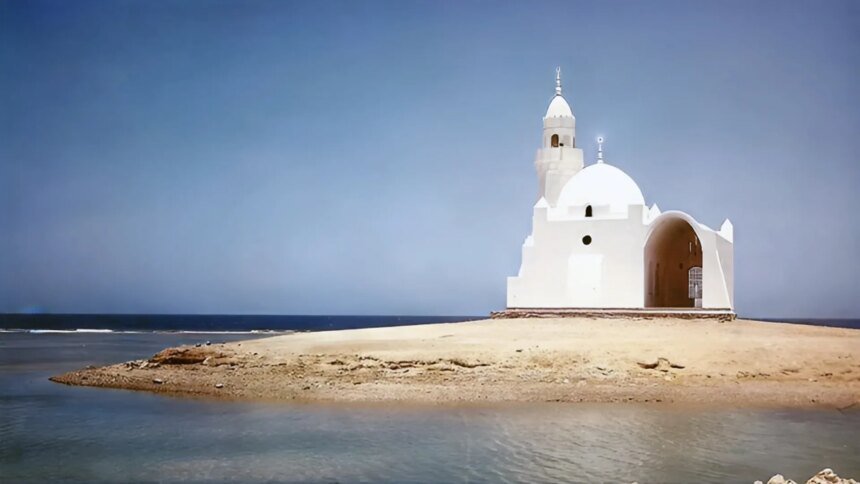
On a winter morning on the Jeddah Corniche, Egyptian engineer Abdel Wahed Al-Wakil stood in front of a breathtaking scene. A municipality car had fallen into a sudden hole, and everyone discovered that the sea had completely eaten away the sand from under the foundations of the Al-Jazeera Mosque, leaving the building flying – as he described it – in the air without support.
The city mayor and engineers rushed, anticipating the collapse of the brick mosque at any moment, but the agent at the time sarcastically attributed the secret of the building’s stability to the angels, in order to avoid revealing the architectural secret that kept the mosque together without a crack.

The genius of the design reflected the ingenuity of the Egyptian architect, which he narrated in detail during an exceptional episode (which you can watch by clicking here) of the “In Detail” program on the “Atheer” platform.
Which later enabled him to win an award from the Environmental Design Magazine in London, in recognition of the excellence of his environmental and architectural studies while designing the Corniche Mosque in 1984, before winning the Aga Khan Award for the mosque itself in 1989.
Al-Wakeel tells his amazing stories with the mosques of Jeddah and Medina, and how architecture was transformed in his hand from mere engineering into an act of faith – as he said -.

Island miracle
The story began with a bold decision; The agent asked the mayor of Jeddah Governorate at the time, Muhammad Saeed Farsi, to build a mosque on a coral island.
While international companies were demanding concrete columns with a depth of 40 meters and a high cost, the agent decided to dispense with cement and iron completely.
Al-Wakil built the Jazira Mosque with a system of load-bearing walls and domes made of bricks and bricks, defying earthquakes and sea humidity.
When the cave dug by the sea under the mosque was discovered, the building remained standing without a single crack, proving to the world that the traditional architecture that the advocates of modernity mocked was stronger than their smooth concrete.
After his success in Jeddah, the agent was transferred to the holiest parts of the earth to renovate and expand the mosques of Medina, starting with the Quba Mosque and the Qiblatayn, all the way to the Miqat of Dhu al-Hulayfa.
Here, the agent tells a remarkable story while working on the Quba Mosque. The agent says: “We saw a skinny old man who insisted on building with us without pay, and when the project security arrested him to discover his identity, he said to us words that I will never forget: Do you think you are building this mosque? Look around you… angels are roaming here and they are the ones who are building.”
The agent was fully aware that these mosques are not just buildings, but rather “the gateway to Islamic architecture,” as he mentioned in the episode.
In cooperation with the Undersecretary of the Ministry of Endowments at the time, Hossam Khashoggi, the Egyptian architect was able to pass his brick-based designs away from the eyes of the bureaucracy that despised the old methods, to create spiritual spaces in which the worshiper feels tranquility and reverence.
The secret is in the craftsmanship
Abdul Wahed Al-Wakil believes that the secret of the soul in the mosques of the city and Jeddah lies in the human hand, his craft, and his manual skill. Since his apprenticeship with the Italian painter Silvio Picchi, who taught him how to see colors, all the way to his greatest teacher, Hassan Fathi, who changed his vision of life after the setback of 1967, Al-Wakil realized that architecture is a moral act.
The agent says bitterly: “When the brain is not working with the hands, it goes crazy.” Therefore, he fought the banks that refuse to lend to those who build with clay and stone, and he fought the “cement law,” which he saw as killing people in the summer heat, which sometimes reached 90 degrees.
This prompted him to follow the old building method using mud and bricks instead of concrete and cement.
The Egyptian architect expresses his belief that the builder’s hand, which touches the stone and places one brick after another, infuses the walls with a blessing that machines do not possess. He continued that what he taught the Pakistani workers benefited them later, so that they too would build in their countries with bricks and in the same style that the agent followed in his architectural designs.
The agent did not care about the Aga Khan’s awards that he won, or about King Charles’ request from him to design the Oxford Islamic Centre, as much as he cared about the human being.
The Egyptian architect has won several other awards, most notably the Aga Khan Award for Architecture for his design of “Halawah House” in Alexandria in 1980, then the King Fahd Award for Research in Islamic Architecture in 1985, the Honorary Fellowship Award from the American Institute of Architects, and the Richard Award for his contributions to classical architecture in 2008.