

Published On 7/3/2026
|
Last update: 17:04 (Mecca time)
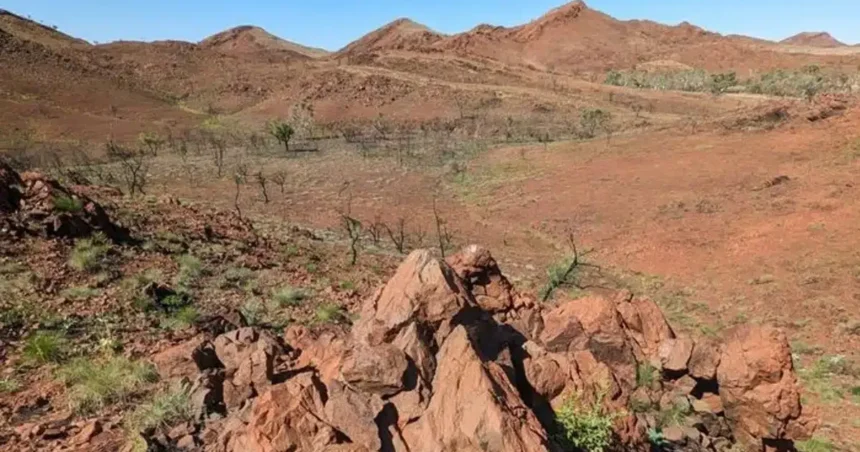
In Western Australia’s Pilbara, within an area known as North Pole Dome, rocks bear signs of ancient impact; Where what is known as “crash cones” were found, which are conical rock structures that usually only form under tremendous pressure, such as the pressure resulting from a meteorite or asteroid colliding with the Earth’s surface.
In a new study published on June 23 in the journal Geology, researchers concluded that the North Pole Dome impact occurred about 3.024 billion years ago, with a margin of error not exceeding 7 million years. If this estimate is correct, the site represents the oldest known impact structure on Earth, and the only one so far confirmed from the Archean era, a very ancient chapter in the planet’s history.

Find a clock inside the rocks
The importance of the discovery lies in the fact that the record of ancient Earth collisions is almost lost; The Moon, for example, still retains traces of a violent meteorite bombardment that occurred at the beginning of the solar system, because its surface does not change much.
As for the Earth, tectonic plates, volcanoes, erosion, and seas have recycled most of its ancient crust, erasing many of the effects of those disasters, according to the study’s lead author, Chris Kirkland, a professor in the School of Earth and Planetary Sciences at Curtin University.
So the researchers had to look for what could be described as an accurate “clock” within the rocks themselves. The team used several minerals that can preserve the age of geological events, including zircon, apatite, calcite, and muscovite.
What is noteworthy is that zircon, an extremely hard mineral that can preserve time for billions of years, appeared in rocks in more than one form: ancient grains dating back more than 3.4 billion years, and younger skeletal forms.
Chris explains in statements to Al Jazeera Net that these structural forms of zircon gave an age of approximately 3024 million years. The researcher explains that it was not formed in a new, ordinary rock, but was recrystallized during hydrothermal activity related to the collision.
He adds: “In simpler terms, the zircon was not the beginning of the story, but it recorded a violent moment that reshaped some minerals within the rocks after the collision.”
The evidence did not come from zircon alone, as apatite, another mineral that grew due to hot fluids within the affected rocks, gave a close age of about 3019 million years. This convergence between the age of zircon and the age of apatite led researchers to believe that the event itself, that is, the collision and the subsequent heat and fluids inside the rocks, is the simplest explanation for these time signals.
Evidence of trauma and its aftermath
The research team also studied a vein of quartz and carbonate that cuts through the fabric of crush cones. Within this quartz, researchers found tiny impact features known as “planar deformation features,” which are microscopic lines that appear when quartz is subjected to very high pressure.
These characteristics – according to the main author of the study – are important signs that help scientists distinguish between rocks that were subjected to a meteorite collision and those that were formed by normal geological processes.
But the story is not without complexity, as the undeformed muscovite mineral inside the vein gave it a much younger age, approximately 1.655 billion years. This means that some fluids and subsequent geological events affected the rocks long after the impact, but they do not represent the age of the impact itself.
Thus, the rocks reveal more than one layer of time: the very ancient moment of impact, then subsequent events that modified some of the minerals without erasing the original evidence.
These results have significance beyond determining the age of a single crater; It gives scientists a rare window into Earth’s early history, and helps understand how meteorite impacts affected the ancient crust, and perhaps in environments that preceded the development of complex life by billions of years. Major impacts not only leave craters, but can alter heat, fluids and rocks, creating new geological environments on the planet’s surface.
A strong result, but it requires caution
However, the researchers set clear limitations to the study; The structural shapes of zircon alone are not conclusive evidence of a collision, because they may also form in some rapidly cooling volcanic or magmatic environments.
So the conclusion is not based on a single mineral or signal, but on several pieces of evidence coming together: crushing cones, impact quartz, zircon age, apatite age, and the absence of a known regional tectonic event at 3.02 billion years ago that could explain the recrystallization of minerals in the same way.
Some zircon grains have also been subjected to lead loss in more recent times, “which is a well-known problem in geological dating, because calculating age depends on measuring the decomposition of uranium into lead within the mineral,” Chris says. If the metal later loses part of the lead, separating the older signals from the later becomes a more complex task.
Therefore, the team treated the results as part of an integrated evidence package, rather than a separate, stand-alone number.
In terms of funding, the study did not mention a direct research grant for the project, but it noted that the John Dale Laiter facility, which was used for geological analyses, is supported by AUSCOPE, the Australian National Collaborative Research Infrastructure Strategy, and the Australian Research Council’s Infrastructure, Equipment and Facilities Program.