

Published On 7/2/2026
Since its launch in 1999, NASA’s Chandra
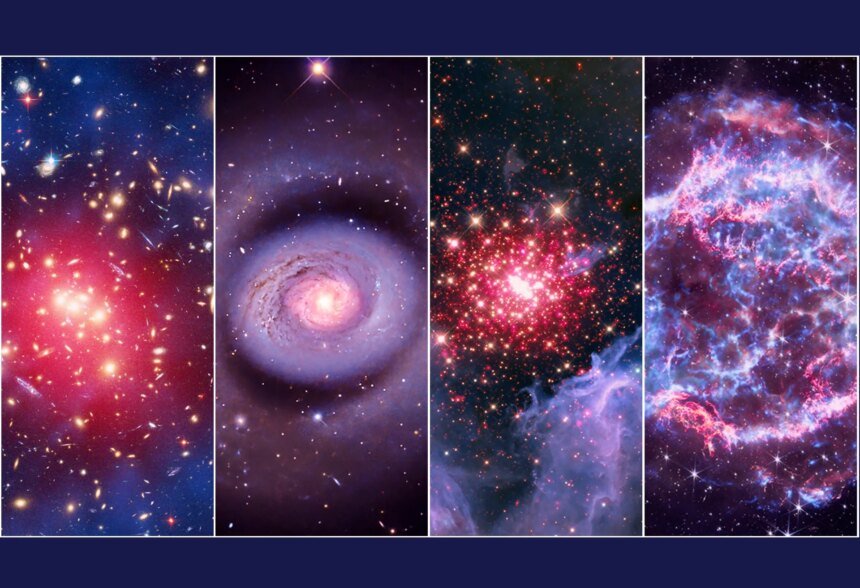
Today, the observatory revealed four new images of amazing cosmic objects, which were not produced based on Chandra alone, but rather were the result of cooperation with the Hubble Telescope, which monitors visible light, and James Webb, who specializes in infrared radiation, to provide scientific views that combine accuracy and beauty, and give researchers a more complete view of the history of stars and galaxies.

The importance of these images does not lie in their striking colors, but rather in that they collect information from different wavelengths, so that each observatory reveals an aspect that other observatories cannot see, thus forming a single image that tells the complete story of the celestial body.
Read also
list of 2 itemsend of list
A galaxy cluster reveals dark matter…and a galaxy that baffles scientists
The first image shows the galaxy cluster ZWCL (ZwCl 0024+1652), located about four billion light-years away in Pisces, where it reveals X-rays emanating from the super-hot gas surrounding galaxies, while Hubble data shows the effect of dark matter through the phenomenon of gravitational lensing, even though it does not emit light that can be directly observed.
Combining these two types of data helps scientists more accurately map the distribution of visible and hidden matter in the universe.

The second image highlights the spiral galaxy “Messier-94” (NGC 4736) in the Seleucid constellation, about 16 million light-years away, and includes a central ring that witnesses the birth of large numbers of new stars.
This galaxy draws the attention of researchers because it appears to be poor in dark matter compared to what is expected, which is a mystery that still prompts astronomers to study its structure and history to understand the reasons for this difference.
A nebula that creates stars… and the remains of an explosion that tell the history of the elements
The third image takes the viewer to the galactic cluster and nebula “3603” (NGC 3603) in the constellation Carida on the Arm of Carina-Sagittarius – one of the arms of the Milky Way – as one of the largest known star factories in our galaxy, located about 20 thousand light-years away.
The image was compiled from X-ray, visible, ultraviolet and infrared data, revealing thousands of young stars surrounded by dense clouds of gas and dust. This region includes some of the largest known stars, which quickly consume their fuel and end their lives in massive explosions that enrich space with heavy elements.

The fourth image shows the remains of the Cassiopeia A supernova, resulting from the explosion of a huge star whose light reached Earth in the seventeenth century, even though the explosion occurred more than ten thousand years ago.
Scientists have combined the Chandra data with infrared observations from the James Webb Telescope, to show the glowing gaseous crust in fine detail that helps understand how the elements that later form new stars and planets spread.
One picture is not enough to understand the universe
These images confirm that understanding the universe requires the cooperation of multiple scientific instruments, as each telescope monitors a different part of the electromagnetic spectrum. X-rays detect very hot gas, Hubble detects stars and visible light, and James Webb penetrates dust clouds to reveal what is hiding behind them.
The Chandra Observatory team also converted scientific data into audio clips, in an innovative experience that makes astronomical information closer to the public, and opens a new door for interaction with scientific data.

Thus, these images reveal that the universe is not just a dazzling spectacle, but a living record of the history of the stars, galaxies, and elements that make up our world. The more space observatories cooperate and their data is integrated, the more man will come a step closer to understanding the universe from which he emerged.
Scientific images are not the end of discovery, but rather the beginning of new questions that push science to broader horizons and confirm that the greatest journeys are still waiting to be undertaken.