Jerusalem- The Israeli security establishment is preparing to expand its military operations in the occupied West Bank, with a special focus on refugee camps, as part of what it describes as “defensive and proactive” operations, ahead of the Jewish holidays that fall at the beginning of next September, under the pretext of the escalation of armed operations and the expansion of popular resistance and field confrontations in the West Bank.
According to Israeli security estimates, the expected escalation will be concentrated in the camps in the northern West Bank, under the pretext of pursuing Palestinian resistance groups and preventing the implementation of operations during the holiday period.
This trend also comes before the Knesset elections scheduled for October 2026, as Benjamin Netanyahu’s government seeks to keep the Palestinian arena at the forefront of the security and political scene to achieve electoral gains.
In this regard, the Israeli government is moving to transfer the weight of its military operations again to the West Bank, after the relative calm witnessed on the Lebanon and Iranian fronts, by strengthening military control and perpetuating the settlement project in the occupied territories, thus consolidating the Israeli presence on the ground.

Türkiye and Iran
In this context, Yedioth Ahronoth newspaper reported that the security establishment intends to strengthen the deployment of army forces in the West Bank in preparation for a broader escalation, based on security estimates that claim the existence of links between Iran and Turkey and the freed Palestinian prisoners and any possible escalation in the region.
In parallel, Israeli reports indicate that the army is planning to reposition its military position in the northern West Bank, through a project that includes the establishment of about 18 new settlements and the establishment of eight military bases, in a step that restores the Israeli military and settlement presence to the region after an absence of nearly two decades.
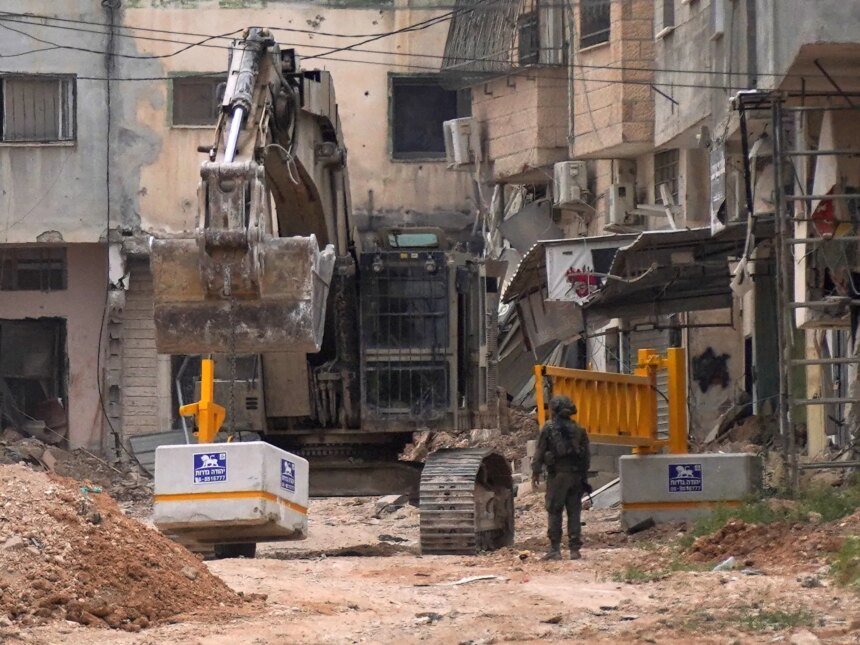
These movements come in light of the ongoing Israeli aggression against the camps in the northern West Bank, which has caused widespread forced displacement.
According to United Nations data, more than 40,000 Palestinians were displaced from the camps in the northern West Bank, including about 27,000 from the Tulkarm and Nur Shams camps, and more than 21,000 from the Jenin camp and its environs, in addition to the demolition of dozens of homes, the destruction of infrastructure, and the cutting of basic services, as part of expanding Israeli military control over the region.
Field changes
In parallel with the military plan, the West Bank, especially its northern regions, is witnessing an unprecedented settlement expansion, within the framework of a long-term project led by the settlement movement with direct support from the Israeli government and the army.
The pace of implementation of this project has accelerated since the formation of the current right-wing government, and then gained greater momentum after the war on Gaza in October 2023, in light of broad field and demographic changes.
This expansion gives settler representatives in the government increased political gains as the Knesset elections approach, while the Israeli army continues to provide security and logistical cover for the settlement project, which has become one of the most prominent priorities of the ruling coalition.
The essence of the project is to rebuild the settlements that were evacuated during the disengagement plan in 2005, in addition to establishing new settlements and outposts deep into the Palestinian territories, areas that have been absent from the Israeli presence for nearly two decades.
According to data, settlers currently control 18 strategic sites, in a move that threatens Palestinian geographical contiguity and the continuity of life in the West Bank and pushes them towards forced migration.
Resolution plan
The plan, which intersects with the “Resolution” program adopted by the Religious Zionism Party headed by Israeli Finance Minister Bezalel Smotrich, indicates the establishment of 18 new settlements, the establishment of eight military bases, in addition to the displacement of tens of thousands of Palestinians, which will consolidate Israeli control over the West Bank and make the settlement project a reality on the ground.
Smotrich had revealed his vision for the West Bank by saying: “We want to bring a million settlers to Judea and Samaria so that Hamas does not control it,” considering that his government is leading a historic transformation in the region.
The Israeli minister said that during his term he oversaw one of the largest geopolitical and demographic changes in the West Bank since 1967, noting that the policies pursued by the government “radically changed the face of the region” and strengthened the Israeli presence on the ground in an unprecedented way.
Smotrich revealed the establishment of 160 new agricultural settlement outposts, in addition to the official approval of more than 100 additional settlements throughout the West Bank, stressing the allocation of billions of shekels from the state budget to develop the infrastructure of the settlements and enhance their spread.
In this context, Haaretz newspaper reported that the Israeli return plan to the northern West Bank includes deploying additional military forces, establishing bases to protect settlements, building new roads, and confiscating more Palestinian lands, in addition to measures that would increase pressure on the Palestinian population.
According to the newspaper, senior Israeli army commanders realize that these steps may lead to a widespread escalation in the West Bank, but the settler leadership views them as “the beginning of salvation,” in an expression that reflects the size of the bet that the settlement movement places on this stage.

The army shifts its weight to the West Bank
According to a military plan revealed by the Israeli Channel 14, which is close to the settlers and the extreme right, the occupation army is preparing for a large redeployment in the West Bank, by strengthening its forces to 26 battalions, compared to 23 battalions deployed in the West Bank since the outbreak of the war on Gaza in October 2023.
The plan includes deploying three additional brigades, namely the Paratroopers Brigade and the Nahal Brigade, in addition to forces from the Home Front Command, which are formations that are mainly active on the Lebanese front and inside Israel.
The transfer of these forces to the West Bank indicates that the military establishment is preparing for a broad field escalation that goes beyond routine security operations and is approaching the pattern of extended military operations.
According to the channel, the Israeli army will focus its efforts during the coming months, especially during the Jewish holidays, on what it described as “eliminating terrorism in Judea and Samaria,” in reference to the West Bank, while giving priority to the refugee camps in the northern West Bank, which the security establishment describes as “centers that have not yet been addressed.”
Israel also intends to deploy two additional battalions in the northern West Bank, in conjunction with settler-led movements to re-settle the Kadim settlement, which was evacuated under the disengagement plan in 2005.
This military deployment reflects a direct connection to the settlement project being implemented, as it is not limited to intensifying operations inside the camps, but also includes establishing new military bases, constructing roads and securing areas designated for settlement expansion, in a way that strengthens the permanent Israeli military presence in the northern West Bank. This is a field transformation that goes beyond the nature of the operations that the region has witnessed during the past years.
Why now?
Israeli military analysts believe that the expansion of operations in the West Bank comes in the wake of the reduction in military activity on the Lebanese front, which allowed the army to redistribute its forces and transfer part of the regular units to the West Bank, in preparation for a broader escalation.
On the other hand, the Israeli security establishment continues to justify these steps through security estimates that talk about attempts led by Iran and Turkey, along with liberated Palestinian prisoners, to support the activity of resistance factions in the West Bank.
In this context, Channel 14 military affairs correspondent, Hillel Biton Rosen, said that the army command, headed by the head of the Operations Division, Major General Itzik Cohen, will lead in the coming months an intensive operational campaign against Palestinian resistance factions in the West Bank, with a special focus on refugee camps, especially during the Jewish holidays.
This escalation comes after statements by Israeli Defense Minister Yisrael Katz, who described the refugee camps in the West Bank as “terrorist camps,” announcing that the security establishment is preparing to expand military operations from the camps in the northern West Bank to other camps and areas throughout the West Bank in the coming weeks.
According to the decision of the political level in Israel, the plan aims to destroy the infrastructure of the resistance factions and thwart alleged armed operations, while the government of Benjamin Netanyahu justifies this policy by saying that “terrorism in Judea and Samaria still poses a serious threat to the citizens of Israel.”
Pretexts and fabrications
In what appears to be a media prelude to justify a possible military escalation in the West Bank, Yedioth Ahronoth newspaper correspondent in the West Bank, Elisha Ben Kimon, reviewed Israeli security estimates claiming that the map of the Palestinian resistance has witnessed major transformations in recent years, and that Iran seeks, in light of the understandings with the United States of America and what Israel describes as a decline in the confrontation on the Lebanese front, to transform the West Bank into the “central front” for the activity of the resistance factions, while claiming that part of the guidance and coordination operations are taking place. From Türkiye.
According to the Israeli security narrative, the army and the General Security Service (Shin Bet) estimate that Tehran is facing difficulties in transferring money and smuggling weapons to the West Bank, as a result of the Israeli military operations in Gaza, the West Bank, and Iran, but according to these estimates, it is trying to rebuild the armed structures, taking advantage of the periods of calm and ceasefire.
The Israeli security services claim that this support is carried out through three main paths, including financing using cryptocurrencies, smuggling weapons and equipment across the eastern border, in addition to remote guidance and transfer of expertise and technical capabilities to resistance groups in the West Bank.
In the same context, Ben Kimon indicated that the Central Command of the Israeli army, in cooperation with the leadership of the Judea and Samaria Division, is leading a campaign targeting the funding sources of the resistance factions, in addition to pursuing what Israel describes as “dual-use” materials.
He pointed out that the army confiscated quantities of agricultural fertilizers during raids in various areas of the West Bank, as part of a security policy that expands the circle of suspicion to include civilian materials that, according to the Israeli narrative, could be used for military purposes.

Redrawing the threat map
The reporter spoke about Israeli fears about the transfer of the use of explosive drones, which were used against Israeli forces on the Lebanese front, to the West Bank.
Security officials were quoted as saying that current estimates do not indicate the presence of active explosive drones in the West Bank, but the army treats any drone it finds as a potential threat and confiscates it as a preventive measure.
In another context, the newspaper attributed to the Israeli security services allegations that a number of liberated Palestinian prisoners who returned to the West Bank as part of prisoner exchange deals constitute one of the most prominent drivers of resistance factions’ activity.
Accordingly, the army and the Shin Bet, according to the newspaper, continue to monitor their movements, carry out field raids into their homes, and issue repeated warnings to them, especially in the governorates and cities of Nablus, Tulkarm, Hebron, Ramallah, and Bethlehem, within the framework of a policy that aims, according to the Israeli narrative, to prevent the re-formation of armed cells.
Although the Yedioth Ahronoth correspondent acknowledged that the scenario of a comprehensive confrontation in the West Bank has not yet been achieved, he described the region as experiencing a state of “high potential for explosion,” noting that the most prominent concern of the Israeli military establishment is the possibility of Palestinians carrying out operations across the line of contact inside Israel, a scenario that the army leadership believes may constitute a spark for a broader wave of escalation.