

Published On 4/7/2026
|
Last update: 23:22 (Mecca time)
While the atmosphere in Washington was buzzing with celebrations marking the 250th anniversary of its independence, Tehran was painting a completely different scene, mixing symbolic sadness with a political show of force.
Iran took advantage of the temporary truce in the war to bid farewell to its late guide, Ali Khamenei, at a time that the American newspaper “Washington Post” considered ideal for sending internal and external messages about the regime’s ability to withstand and the smooth transfer of power.
Read also
list of 2 itemsend of list
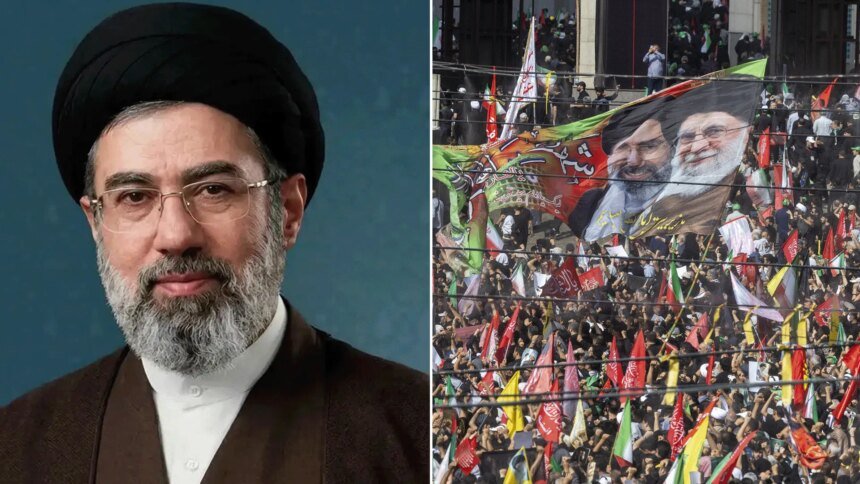
The funeral was not just a religious ritual, but rather turned into a “competence test” for the post-war government. According to a report by the Washington Post, the Iranian regime, which describes itself as a survivor after months of conflict and war, sought through the crowds of millions to flex its organizational muscles.
The authorities’ greatest concern was the need to “avoid the curse of chaos” that has historically haunted Tehran.
Iranian history is burdened with memories of bloody funerals. It caused people to be run over, such as what happened at Khomeini’s funeral in 1989, up to the Kerman stampede disaster at Qassem Soleimani’s funeral in 2020, in which dozens were killed.
Therefore, the success of the organization this time is the first birth certificate for the new government in its ability to control the street under the harshest circumstances.
Tehran received between 15 and 20 million participants, in a funeral that the authorities described as “the largest of its kind in the country’s history,” and it extends for about 4 days inside the capital and about a week in several regions inside and outside the country.
The ceremony began late Thursday evening with Khamenei’s coffin, with his black turban on top, being placed in front of a crowd of weeping supporters, to the sound of chants of pity that echoed in the place, and some of those standing at the coffin threw flowers into the crowd.
The hidden guard
In the midst of this massive funeral, attention turns to the closed rooms, where the name of Mojtaba Khamenei stands out, as the “hidden” guide. The French newspaper “Liberation” described him as being present in the decisions but mysterious or absent from appearance.
He is the man who “never appeared in public” and “whose voice has not been heard since his appointment,” but at the same time he is the man who seems present in all of the country’s fateful decisions.
This mystery surrounding Mojtaba Khamenei opens the door wide to speculation about his health and his ability to lead the country from behind the scenes.

These two newspapers concluded by linking the United States of America’s preoccupation with its national celebrations and providing a space for Iran to catch its breath and declare its survival, in addition to confirming internally before internationally that it succeeded in implementing its internal transition smoothly.
The Iranian regime, which endured for months in a devastating war, wanted to say that it is still capable of mobilizing and organizing, and that the hidden man who is now running the helm has the necessary legitimacy, even if he does not appear in front of the cameras.
Ali Khamenei was killed on February 28 in American and Israeli air strikes that targeted a complex containing his residence in Tehran, on the first day of the war that ignited the region 4 months ago.
His burial ceremony was postponed until Iranian and American negotiators, with Pakistani and Qatari mediation, reached a “memorandum of understanding” in the hope of reaching a final agreement on the main controversial issues within 60 days.