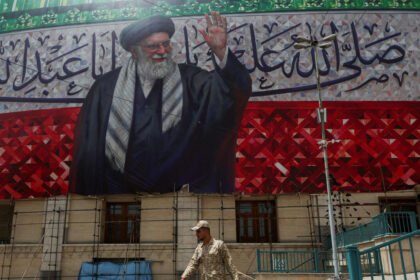


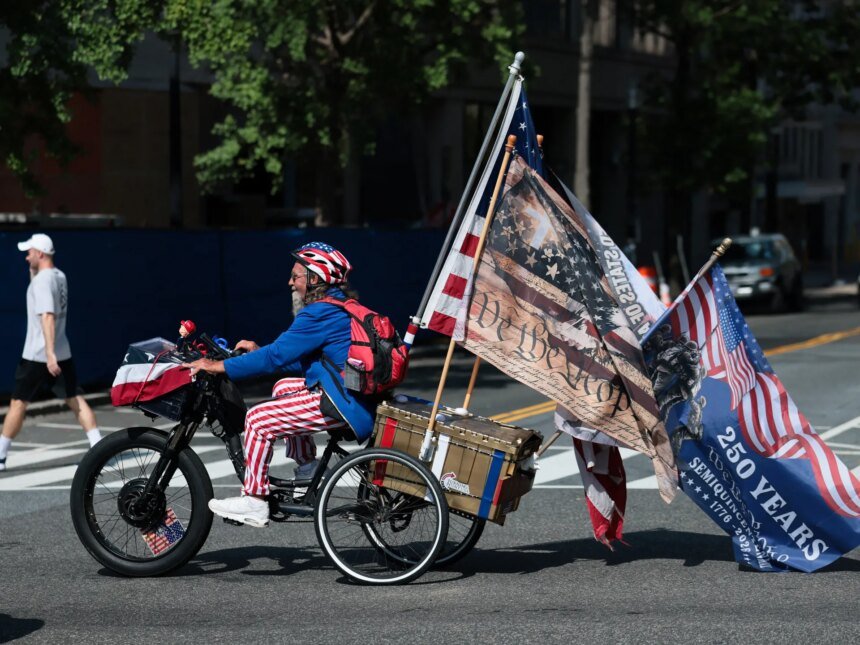
The United States is going through an exceptional historical turning point as it commemorates the 250th anniversary of its Declaration of Independence, an occasion that is usually an opportunity to celebrate achievements and recall the epics of its founding.
But America’s celebrations of Independence Day this year are overshadowed by intense political polarization, relative economic decline, and vertical societal division that affects national identity at its core.
Read also
list of 2 itemsend of list
In a lengthy analytical article published by the British newspaper The Times, opinion columnist Gerard Baker believes that the American mood on the 250th anniversary of independence is the most pessimistic in decades, as the occasion comes amid severe political polarization, a decline in confidence in institutions, and widespread anxiety about the country’s economic and political future.
Baker wonders whether America has exhausted its energy and capabilities after two and a half centuries, reviewing in the title of his article the features of a country that has become “divided, disaffected, and reckless,” as he puts it.
Baker began his reading by recalling a funny conversation that took place years ago during a dinner party hosted by the American ambassador in London in the presence of the late Queen Elizabeth II and Prince Philip.
That evening, the ambassador jokingly referred to the dispute that arose two centuries ago after which the Americans preferred to continue on their independent path, to which the prince responded with harsh sarcasm: “Yes, and how did things go with you after separating from Britain?”
The writer explains that this question, which Americans have always answered with confidence throughout their modern history, has become more urgent today than ever before.
According to the newspaper, a narrative has been ingrained in the minds of Americans, from a young age, that their country began as a rebellious group of colonialists who were viewed with contempt, challenging the greatest imperial power in the world, and then succeeded in overcoming its divisions and the stain of slavery, to become the first country in the world, sitting at the top of an international system that it itself contributed to establishing, through its victory in the world wars and by the strength of the example it provided, as a model of freedom. And prosperity.
Faded celebrations
Baker draws a historical comparison with the bicentennial celebrations in 1976, when America was experiencing a stifling national crisis represented by the Watergate scandal that forced President Richard Nixon to resign, and the humiliating withdrawal from Vietnam, in addition to economic stagnation and inflation.
But that summer of 1976, Americans had a fleeting moment to shake off the feeling that their country was on a downward spiral. Political rivals put aside their differences, if only for a day, and celebrated together.
Today, 50 years after that occasion, the celebrations of this year 2026 appear, in Baker’s opinion, to be dull and divided, as some states led by governors belonging to the Democratic Party have boycotted official events, and the central celebration has turned into an occasion dominated by a political nature associated with President Donald Trump rather than a comprehensive national celebration.
Baker relies on opinion polls that show that only 34% of Americans believe that the country is moving in the right direction, while nearly 60% believe that it is moving in the wrong direction.
Also, more than three-quarters of citizens believe that their children will be in a worse situation than them in the future, while the percentage of those who describe themselves as “extremely proud” of being Americans has decreased to unprecedented levels.
The author links this pessimism to a number of factors, most notably the sharp division over the Trump administration, as his opponents see it as undermining democracy and strengthening executive authority in an unprecedented way, while his supporters argue that his extremism is nothing but a necessary reaction to the left’s attempts to destroy the American heritage through progressive ideologies, open borders, and prioritizing racial and sexual identity over citizenship.
This internal conflict – according to the Times – coincides with terrifying external challenges. Most notable is the rise of China, which threatens American economic and security hegemony, and the successive strategic failures from Afghanistan to Iran, not to mention the fears associated with artificial intelligence and the impact of social media in fragmenting social life.
However, Gerard Baker cautions against hastily writing a death certificate for the American republic, as he rejects the conclusion that the United States has entered a period of terminal decline.
The American constitutional system is still capable of imposing checks and balances, and nothing is more evident than the Supreme Court decisions that invalidated some of Trump’s most prominent executive orders, such as imposing customs duties and trying to end birthright citizenship.
Latent power
The writer believes that reading history deeply reveals invisible sources of strength that give America unparalleled flexibility, stressing that its history is full of more severe crises, but it was able to overcome them.
He explains that the American economy still maintains its global superiority, as it continues to attract investments and capital, and the United States remains the largest share of global assets and financial markets. It also leads innovation in the fields of technology and artificial intelligence, with new giant companies continuing to emerge at a pace unmatched by competing economies.
While Japan and Europe declined and China rose, the United States remains the largest player, as it accounts for about half of global financial assets and 70% of global stock values, which is more than double its share 20 years ago.
Here, Baker cites a quote by Jamie Dimon, CEO of JP Morgan Chase, who described the matter as an intelligence test, saying that if you asked anyone in the world which country he would prefer to put all his money in, he would only choose one country, which is America.
Although the national debt has ballooned to about $40 trillion, productivity and continuous innovation, especially in the fields of artificial intelligence and technology, protect the economy from collapse.
On the political level, Baker acknowledges the decline in American democracy indicators in recent years, based on Freedom House reports, which indicated the expansion of the influence of the executive branch, the decline of the environment supportive of press freedom, and the rise in levels of corruption at a faster rate than in European Union countries.
However, the writer believes that the American constitutional system is still capable of imposing checks and balances, citing the rulings of the Supreme Court that recently invalidated some of Trump’s most prominent decisions, such as imposing tariffs without the approval of Congress and trying to end birthright citizenship, as well as the continuation of Congress, the judiciary, and the media in exercising oversight roles that limit the encroachment of executive power.

Dissenting opinion
In a different and more pessimistic reading, Guardian writer Jamil Smith refuses to consider the Fourth of July as an occasion worthy of celebration, considering that the Declaration of Independence in 1776 was not a true “birth certificate” for a state of freedom and equality, because the United States at that time was still based on the system of slavery.
He believes that the true history of American freedom passed through later stages, most notably the constitutional amendments after the Civil War and the anniversary of Juneteenth (Emancipation Day), which practically ended slavery.
Smith says that the United States is not a finished building, but rather a project that still needs permanent reform, considering that recent Supreme Court decisions reflect this conflict. On the one hand, the court maintained the principle of birthright citizenship, but on the other hand, it made decisions that it believed weakened the constitutional guarantees against corruption and discrimination, and expanded the influence of money in politics. It also criticized its positions regarding transgender people.
The writer emphasizes that reform of the United States is not achieved through celebrations or national speeches, but rather through protecting democracy, expanding civil rights, improving housing conditions, reducing the influence of political money, and preserving historical memory, warning that the undermining of these foundations is taking place gradually through the institutions themselves and not necessarily through a direct coup against the regime.

Politicization of celebration
The news picture is completed by the field report prepared by Sophia Kaye, White House correspondent for the American newspaper Politico, in which she reveals how Donald Trump’s team seized control of the 250th anniversary celebrations.
Kay points out that the celebration Americans see today is not the one that organizers have spent the past decade planning. The bipartisan “America 250” Committee, authorized by Congress, has developed a plan for a non-political civic commemoration that focuses on history and community service. Among its plans was to transform the small town of Medora in North Dakota into a living museum that embodies the experience of President Theodore Roosevelt and attract a quarter of a million visitors. However, the opening took place this week in the presence of Trump and the absence of the committee due to a lack of federal funding.
Politico’s correspondent reveals a severe funding crisis, as the committee was expected to receive $100 million out of $150 million allocated by Congress, but it received only $25 million.
She quotes the head of the “America 250” committee, Rosie Rios, as confirming that the committee’s philosophy was based on the slogan “No politics… but a goal,” and that its civic programs, such as encouraging volunteer work, student trips to historical sites, and community initiatives, are still continuing despite the shrinking financial resources, but the visual and media scene of the celebrations has become the property of Trump.
Kaye also quotes Rocco Vitale, president of the “Perotecnico” company responsible for the fireworks, details of the final show, which was described as the largest in American history, as it includes the launching of 850,000 fireworks shells over a 40-minute period extending more than a mile across Washington, accompanied by a popular patriotic soundtrack.
This transformation made the national celebration seem, in the eyes of many, more like an election rally for Trump than a comprehensive national party, which clearly embodies the depth of polarization that the country is experiencing on its 250th birthday.
The question posed by Gerard Baker at the beginning of his article in The Times newspaper remains strongly present as the United States enters the third quarter of the millennium: Does this stage represent the beginning of the decline of American power, or is it merely a new station in a long history of crises that the American Republic has succeeded in overcoming?