


Published On 7/2/2026
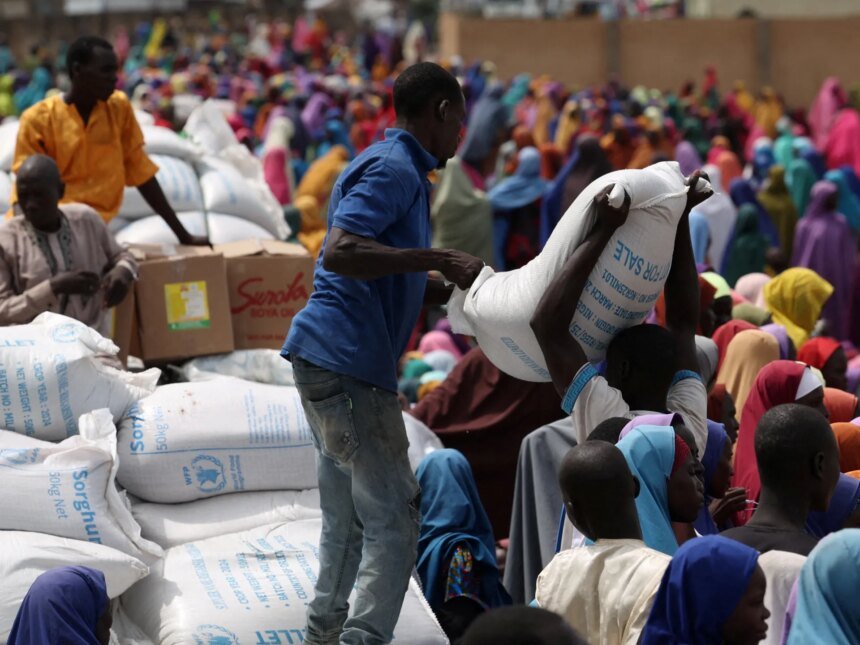
The United Nations World Food Program warned on Thursday that hunger in conflict-affected northern Nigeria has reached levels not seen in the country for nearly 10 years, in light of the widening scope of violence and dwindling international aid.
The program confirmed that more than 17 million people in the country are currently suffering from levels classified as “crisis, emergency, or disaster” in food security.
Nigeria has been facing an armed insurgency concentrated in the northeast since 2009, which has witnessed a noticeable escalation in the pace of violence since 2025, while militant activity has expanded towards the northwest, which is mainly suffering from a separate and overlapping security crisis caused by “bandits.”
In this context, Kindai Samba, Regional Director of the World Food Program for West and Central Africa, said that what is most worrying is how this crisis is expanding, noting that the spread of violence across a much wider geographical area has led to the displacement of people from their agricultural lands, and caused widespread waves of displacement, as well as restricting humanitarian access to those in need.
These developments come in light of simultaneous economic and political challenges, as the aid cuts granted to the country during the era of US President Donald Trump and other Western countries affected the poorest families in Nigeria.
The International Monetary Fund also reported last month that poverty rates had increased during the era of Nigerian President Bola Tinubu, as a result of a package of economic reforms that, although supported by economists, caused record waves of high prices.
The food security crisis is worsening
The World Food Program explained that the food security crisis is worsening faster than expected, as the conflict pushes hunger levels in the northern states, especially in the northeast, to levels not seen in a decade.
In Borno State, a hotbed of conflict, more than 3 million people suffer from “severe food insecurity,” including 10,000 people facing conditions of “catastrophic hunger,” according to the United Nations Programme.
The program indicated that the scope of its operations is shrinking significantly in light of the lack of donations. After providing assistance to 1.3 million people at the height of the dry season in 2025, the program expects that this year it will not be able to reach more than half of this number due to a severe lack of funding.
The numbers show a large gap between the needs and the program’s capabilities, as the total number of food insecure people in the northeast stands at 6.2 million, of whom the program can only feed 740,000, leaving 5.5 million people – the majority of whom are children – without food.
The program stated that the expansion of the conflict has led to a doubling of inaccessible sites, with 15 additional areas becoming partially inaccessible to relief workers, at a time when government control remains limited outside urban centers, leaving vast swaths of rural areas vulnerable to attacks by armed groups.
The program expressed its deep concern that the suspension of food aid is pushing people to adopt desperate coping measures, as local communities have reported cases of individuals joining armed groups in search of food or income, which underscores the security risks resulting from increased hunger and the lack of options for the population.