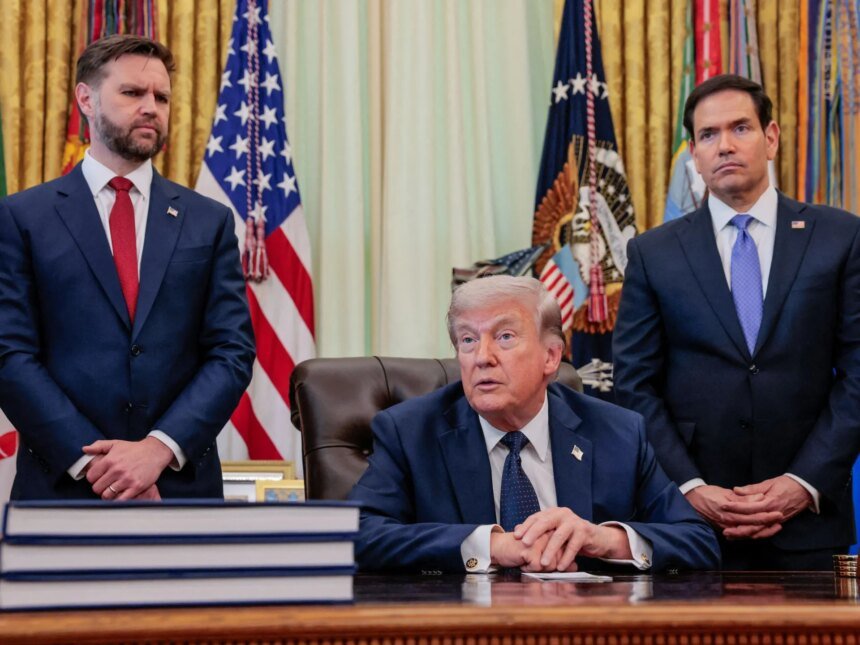
The agreement between Israel and Lebanon under American auspices falls into many calculations, one of which is the ongoing competition within the United States between two major factions that constitute President Donald Trump’s Republican base. They are the Restore American Greatness Again faction, which is represented by US Vice President J.D. Vance, an advocate for halting US military campaigns abroad. The second faction is the traditional Republican movement that derives its traditions from favored Republican leaders to use the stick in their foreign relations and support Israel. This movement is represented by Secretary of State Marco Rubio.
The agreements that each of them sponsored reveal the trends they represent. Vance sponsored the framework memorandum of understanding with Iran, and Rubio sponsored the Israeli-Lebanese agreement, and the two agreements are in conflict and serve each other’s agenda. The memorandum of understanding offers stopping the war with Iran in exchange for stopping Israeli attacks on Lebanon and withdrawing from the occupied territories, but the Lebanese-Israeli agreement is based on stopping Israeli attacks on Lebanon and withdrawing from its south in exchange for disarming Hezbollah.
Read also
list of 2 itemsend of list
The memorandum of understanding between America and Iran does not include the disarmament of Hezbollah. Rather, Iran does not want to disarm it because it is one of the guarantees of the United States and Israel’s commitment to the terms of the agreement with it. This completely contradicts the Lebanese-Israeli agreement, which grants Israel to remain in the occupied Lebanese territories and disarm Hezbollah, in exchange for what the memorandum of understanding with Iran took from it, which is to stop attacks on Lebanon and withdraw from the occupied Lebanese regions in exchange for Iran’s pledge to stop the war with the United States and Israel.

Republican division
Numerous reports conveyed this differentiation between Vance and Rubio in the US role abroad, and explained it as a combination of their personal beliefs and their political investments in part of the Republican base, in preparation for their competition for the Republican Party nomination for one of them in the next presidential elections, in 2028.
An Associated Press report, on April 1, 2026, reported that this distinction between the two parties appeared at a US government meeting during the war on Iran. Rubio made an impassioned defense of the war, but Vance was more circumspect.
President Trump has employed both parties in his foreign and domestic policy. He assigned Vance to negotiate with Iran, and stated that he would take the credit for himself if the agreement succeeded, and that he would hold Vance responsible if it failed.
Vance sponsored the marketing of the agreement internally and externally, and attacked those who opposed it. He criticized leaders in the Israeli government because they were attacking Trump, who concluded the agreement with Iran. He asked them to stop criticizing the only ally who cares about them and defends them. He reminded them of the United States’ thanks for protecting them, and asked them to respect the conflict in American and Israeli interests in some cases.
On the other hand, Rubio remained hidden from the agreement with Iran, neither promoting it nor criticizing Israel.
Trump has used the agreement with Iran to appease the “MAGA” base, which is dissatisfied with the war with Iran and its internal consequences, such as the rise in fuel prices.
The American agreement with Iran has aroused the indignation of the traditional wing of the Republican Party, represented by Lindsey Graham and a number of other Republican representatives, who consider it a loss of America’s prestige, an abandonment of traditional support for the Israeli ally, an evasion of commitment to the evangelical Zionist base that believes that Israel is part of its beliefs, and a retreat from the Republican tradition in foreign policy represented by Theodore Roosevelt, who had a policy of big sticks and foreign interventions to impose American dictates, and for whom Trump expressed his admiration.

Therefore, Trump hired Rubio to reach the agreement between Israel and Lebanon in order to appease this traditional Republican movement and give it a reward that compensates it for the losses of the agreement with Iran.
Trump’s control over the roles of both parties is evident in the Gulf region as well. It is noted that Rubio, who was on the sidelines of the agreement with Iran, was the one who visited some of the Gulf states, namely the UAE, Kuwait, and Bahrain, and held a meeting with the foreign ministers of all the Gulf states to confirm joint cooperation and the American commitment to the security of the Gulf. The meeting issued a statement that included the agreement of the two meetings to consider Iran as a factor of tension and destabilization in the region.
Rubio was keen to rule out the Gulf states’ contribution to Iran’s reconstruction at the present time, and to confirm that the United States would not conclude agreements with Iran that would harm its obligations towards the Gulf states, or bear the costs of those agreements.
Vance, who supervised the framework memorandum of understanding between Iran and America, was supposed to make this visit, because he is responsible for its regional repercussions, but Trump did not assign him to do so, because Vance does not consider Iran a problem, but rather part of the solution, and his statements indicate the involvement of the Gulf states in Iran’s reconstruction projects, investing in them, and preventing Israel from spoiling that.
It is clear from the two parties’ project that Vance sees Israel as the obstacle to America’s future role in the region, while Rubio sees Iran as the obstacle to America’s future role in the region.
Vance’s bet and Rubio’s bet are still in their infancy, and the success of one and the failure of the other will determine the chances of each of them in the upcoming presidential elections, and the direction of the Middle East region in the future. The success of either bet depends on factors that neither Vance nor Rubio have complete control over.
On the one hand, Iran insists that the Lebanon front is part of its agreement with America, and that Israel is obligated, according to the agreement, to stop attacks and withdraw from the occupied Lebanese territories, and that implementing the rest of the provisions of the memorandum of understanding is closely linked to that. But the Lebanese-Israeli agreement separates Lebanon from the Iranian-American agreement, and even contradicts it, and includes the disarmament of Hezbollah as a condition for Israeli withdrawal from the occupied Lebanese territories and the cessation of attacks on Lebanon and Hezbollah forces.
This conflict will determine the success of Vance’s bet or Rubio’s bet. If Iran insists on its demand in Lebanon, stipulated in the Memorandum of Understanding, and refuses to continue negotiating and implementing the rest of the obligations, and returns again to using economic weapons by closing the Strait of Hormuz, or military weapons to force the United States to implement its obligations in the Memorandum of Understanding, and then Trump agrees to that, then he will eliminate the obligations contained in the Lebanese-Israeli agreement, and thus Vance’s chances of running for the Republicans in the upcoming presidential elections will increase, and the pressures on Netanyahu’s government will increase, and his popularity will decline. He may lose the upcoming elections in September, and US-Iranian rapprochement and Gulf-Iranian cooperation will increase.
But, on the other hand, if Rubio and his Republican supporters who support Israel and the Jewish lobby are able to convince Trump to support the Lebanese-Israeli agreement and force Iran to abandon the demand to make Lebanon part of the deal, and tolerate the Iranian escalation, this will enhance Rubio’s chances in the presidential elections in 2028, and extend the life of the traditional Republican wing for another period of time, even if the factors that erode it and diminish its influence and base continue.

In the near term, Trump may prefer to balance between the two main wings of the Republican Party, the Vance wing and the Rubio wing, in order to maintain the greatest degree of cohesion of the Republican Party base in the midterm elections, in November 2026, to maintain his control over Congress, thus protecting himself, his relatives and aides from legal prosecution, and preserving the freedom he enjoys in managing the affairs of the United States of America internally and externally.
This likely possibility may help in understanding Trump’s behavior in the Arab and Islamic region during the remaining period before the midterm elections, and it is the possibility that he will seek to collect the greatest amount of gains from the two agreements, and postpone the payment of due obligations for as long as possible in order to preserve the cohesion of the Republican Party.
Trump may be keen for Iran to continue opening the Strait of Hormuz to export oil so that energy prices remain low in the United States, and thus reduce complaints about the effects of the war.
On the other hand, he will be keen to prolong the calm on the Lebanese front, because it is currently the subject of general consensus. Iran considers it a partial implementation of the memorandum of understanding with Iran, while Netanyahu and his supporters in the United States market it as a great gain for Israel, because it is the beginning of the disarmament of Hezbollah and an acceptance of Lebanese regions remaining under Israeli control.
But this balance remains fragile; Because Iran may demand that the United States force Israel to withdraw completely from the occupied Lebanese territories, otherwise it will close the Strait of Hormuz.
In this case, the United States may try to oblige Israel to withdraw from some areas that it calls “experimental,” and Iran may accept this temporarily, but it will also be temporary.
Fragile balance
Overall, the Trump administration may be more likely to refrain from fully implementing one of the two agreements, because it would conflict with the other agreement, causing a rift within the Republican Party. Selective implementation, postponing the explosion phase until after the midterm elections, while providing incentives to Iran and Israel, will remain the way to maintain this fragile balance for as long as possible.
the study