Published on 6/25/2026
|
Last update: 15:28 (Mecca time)
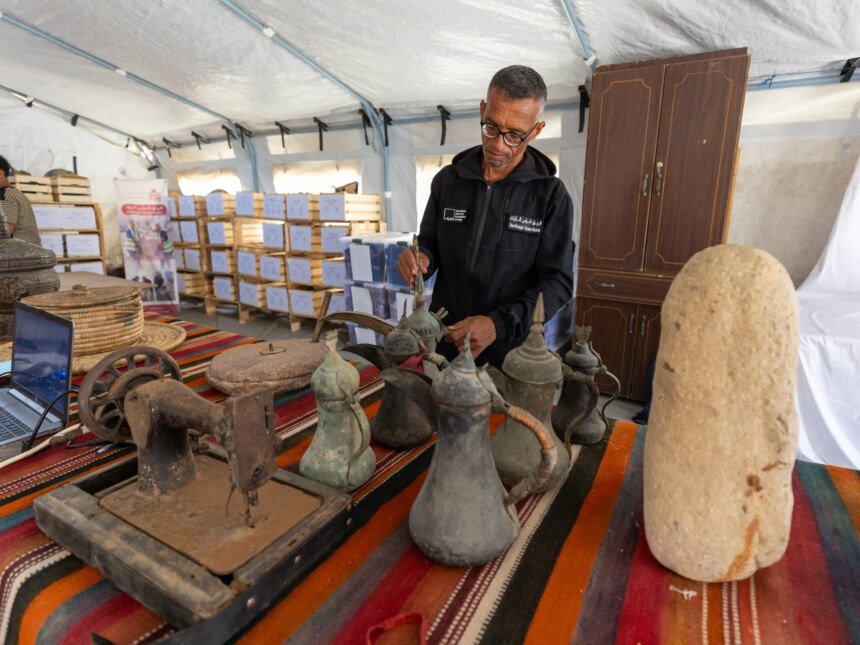
Inside a simple tent near a camp that includes about 900,000 displaced people living in Al-Mawasi, west of Khan Yunis, south of the Gaza Strip, volunteers keep in wooden boxes artifacts they recovered from under the rubble after they survived the Israeli bombing.
These volunteers work as part of the “Heritage Guardians” team of the non-governmental Mayasam Association, which seeks to collect artifacts from the rubble, restore them, document them, and preserve them, in an effort to protect Gaza’s historical memory from extinction.
The Israeli bombing did not only target civilians, hospitals, and infrastructure, but also targeted most of the museums and archaeological sites in the Strip, which prompted this team to launch its initiative and collect the damaged pieces, restore them, and store them temporarily in tents.

Regarding this initiative, the Assistant Coordinator of the Heritage Protection Program at the Mayasim Association, Shaima Al-Natour, says, “We went to these archaeological sites, extracted as many pieces as we could, then archived them and kept them in special boxes.”
She added, “We began to inventory the museum collections in the Gaza Strip, especially those that were bombed and whose holdings were under rubble as a result of the bombing.”
The Israeli bombing destroyed most of the museums and archaeological sites in the Strip, including the Al-Qarara Museum, and led to the loss of about 3,500 museum pieces, according to this spokeswoman.
The Pharaonic, Greek, Roman, Byzantine, Canaanite, and Phoenician civilizations succeeded one another in the Gaza Strip, leading to the Islamic era, which manifested itself in several eras, most notably the Mamluk and Ottoman eras.
These civilizations left a diverse urban and cultural legacy, which added cultural and historical value, and embodied the antiquity of the Gaza Strip and the rootedness of the Palestinian people in it.

Thanks to the “Heritage Guardians” initiative, volunteers were able to locate about 300 pieces still under the rubble, but they cannot reach them because they are located in dangerous areas or within areas to which access is prohibited, according to Al-Natour.
The spokeswoman pointed out that “some citizens find archaeological pieces among the rubble, but without realizing their historical value, which threatens the loss of more heritage collectibles.”

Al-Natour says, “These tents do not protect the artifacts as required, but they give them a chance to survive until a day comes when the museums can be restored and the heritage preserved in safe places.”
Since October 8, 2023, Israel has destroyed about 208 archaeological and heritage sites out of 325 sites in the Strip, according to the latest statistics published by the government media office in Gaza at the end of 2025.
Israel has been waging a genocidal war on the Gaza Strip since October 8, 2023, with American support, leaving more than 73,000 Palestinian martyrs and more than 173,000 wounded.