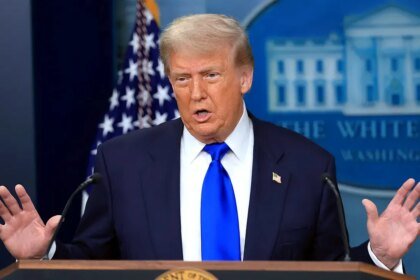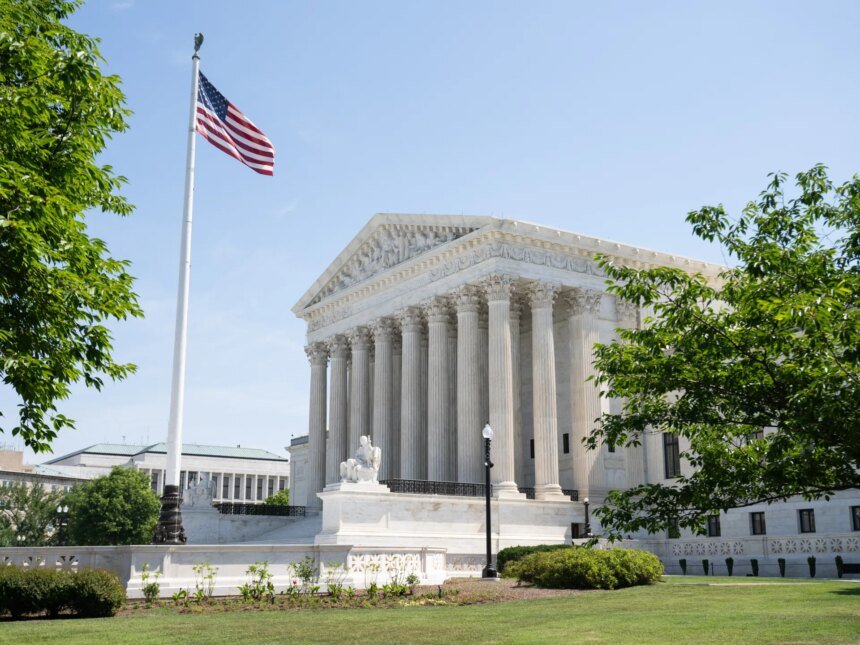
In light of the profound transformations taking place in the political and legal arena in the United States, the US Supreme Court issued landmark judicial decisions that redraw the boundaries of executive authority and grant President Donald Trump broad powers in running the state.
The decisions, which were issued by a conservative majority, were considered among the most influential rulings on the structure of the federal government in decades, as they opened a broad debate about the future of independent agencies, the limits of presidential power, and their repercussions on the economy, immigration, and the American constitutional system.
Read also
list of 2 itemsend of list
Thunderous decisions
The New York Times reported that the US Supreme Court issued 4 prominent rulings that dealt with issues related to the powers of the executive branch, election laws, and the Fourth Amendment to the US Constitution, and each of them came with different majorities.
In the most prominent of these rulings, the court ruled that President Trump has the authority to dismiss the heads of independent federal agencies, such as the Federal Trade Commission, with the sole exception of the Federal Reserve Board (the US central bank).

According to the New York Times, these resounding decisions came through twin rulings issued by a majority of 6 conservative judges versus 3 liberals, according to which the Supreme Court granted the president complete freedom to dismiss the heads of independent government bodies and agencies for any reason, thus breaking decades-old norms to protect these officials from politicization and direct presidential interference.
On the other hand, the court ruled by a majority of 5 to 4 to keep Federal Reserve Board member Lisa Cook in her position temporarily, stressing that the independence of the central bank differs from the rest of the institutions, and that any attempt to dismiss one of its members requires legal procedures that guarantee his right to respond to the accusations directed against him.
The newspaper noted that Trump celebrated the first ruling, describing it in a post on his own platform (Truth Social) as a “major victory” and “a historic and unprecedented ruling regarding the president’s powers,” while the court kept the door open for him to continue his efforts to dismiss Cook if he met the legal requirements.

Controversial dismissal
The pivotal issue – according to a New York Times report – was embodied in the dispute over the dismissal of Rebecca Kelly Slaughter, a Democratic member of the Federal Trade Commission (FTC), who was dismissed by Trump in March 2025 via email, claiming that her service was “not in line with the administration’s priorities,” which prompted her to sue the administration based on the authority’s law, which protects officials from dismissal except in cases of “inability, neglect of duty, or malpractices.”
Chief Justice John Roberts said in the merits of the ruling that “neither Congress nor the courts can impose officials on the president who he cannot work with,” indicating that exercising executive authority requires the president to have the ability to choose officials who implement his policies.
However, the ruling overturned a 91-year-old judicial precedent established by the Supreme Court in 1935 in the “Humphreys Executive” case of 1935, which prevents presidents from dismissing officials of some independent bodies due to political disagreements or differences in orientations.
The New York Times believes that the decision transfers an important amount of influence from Congress to the White House, and may reshape the relationship between the presidency and more than 20 federal agencies concerned with consumer and labor protection, the environment, nuclear safety, and others.

The lie of device independence
The decision received wide support from the conservative movement in the United States, and in this regard, the Wall Street Journal published an analytical article by its editorial board, in which it considered that the Supreme Court had finally succeeded in “ending the lie of independent agencies.”
According to the newspaper, many of these bodies have now exercised broad executive powers, and therefore it is natural for them to be subject to the supervision of the elected president, although at the same time it pointed out the irony of the Federal Reserve Board being an exception to this rule.
The newspaper reported that the court sought, through this exception, to preserve the independence of monetary policy, in light of fears that completely subjecting the central bank to the will of the president would lead to widespread economic turmoil, but it pointed out that this distinction may open the door to new legal disputes regarding the extent of the Federal Reserve’s independence in the future.
The editorial board believes that the conservative majority, with its decision, restored the correct balance of separation of powers that had been eroded by the theory of “rule by experts,” and cited the opinion of conservative Justice Neil Gorsuch, who indicated that the presence of these independent agencies made them an attractive repository for Congress to delegate its legislative powers.
Trump acted after his victory in the 2024 elections as if voters had given him a comprehensive mandate to implement all his agenda, while the primary motivation for voting for him was discontent with inflation.
Trump’s political setbacks
However, the controversy was not limited to the legal dimensions, but rather extended to a broader assessment of the course of Trump’s second presidential term. In an analytical article in the Washington Post, political analyst and fellow at the American Enterprise Institute, Ramesh Ponnuru, wrote that the president, who during his first year seemed to be reshaping state institutions with unprecedented force, is today facing a series of political, judicial and popular setbacks.
The writer points out that the percentage of popular support for the president has declined to about 40%, with mounting dissatisfaction with his performance on the economy, immigration, and Iran issues, in addition to the diminishing chances of the Republican Party to maintain the majority it enjoys in the Senate as the midterm elections approach next November.
Bonoro attributes one of the reasons for this decline to the nature of the American constitutional system itself, which is still capable of curbing executive power despite its expansion.
In this regard, he wrote, saying, “The courts, Congress, and the Constitution are doing what a weak political opposition could not,” indicating that state institutions have proven their ability to resist many of the administration’s policies, whether by dropping prosecutions that were deemed unjustified, limiting some immigration procedures, or preventing the passage of initiatives that did not receive the support of Congress.
He pointed out that Trump acted after his victory in the 2024 elections as if voters had given him a comprehensive mandate to implement all his agenda, while the primary motive for voting for him was dissatisfaction with inflation.
The writer said that since his election victory, Trump has taken several steps that have contributed to increasing inflationary pressures, including waging war on Iran, imposing customs duties, and seeking to lower interest rates by exerting pressure on the Federal Reserve Board, while he has not done much to convince Americans that he is paying attention to the issue that concerns them most, which is the rising costs of living and prices.
Despite this, Bonoro does not rule out that some of Trump’s policies will continue to have a long-term impact, especially in files that were supported by the conservative majority in the judiciary, such as policies to combat racial discrimination in university admissions and employment. However, he believes that the most established reforms are usually those that are achieved through legislation and political consensus, not through executive decisions alone.

The most cruel decision
In parallel with the constitutional debate, the Supreme Court sparked another controversy with its decision related to immigration policies, after it allowed the Trump administration to end the “temporary protection” program for thousands of immigrants, which the British newspaper The Guardian considered a development that threatens more than 1.3 million people with the possibility of deportation to countries that the United States itself still classifies as unsafe.
In an analytical article, researcher Heba Jaweed described the decision as “the most cruel” within a broader strategy pursued by the administration towards immigrants, considering that the court granted the executive authority broad powers to end legal situations that had been stable for years.
She pointed out that the Temporary Protection Program was originally established to protect people who fled wars, natural disasters, and humanitarian crises, and that many of them built their lives and families inside the United States over many years.
The author explained that these groups contribute more than 29 billion dollars to the American economy, in addition to paying about 8 billion dollars in taxes for services and systems that they cannot use because they are not eligible for public assistance.
Jawid believes that the decision – along with other provisions that allowed for tightening asylum procedures on the southern border – reflects a judicial approach that gives the administration greater freedom in drawing up immigration policies, warning that this may lead to a significant reduction in legal immigration, as well as expanding the scope of deportation and detention.
She strongly criticized the statements of the Supreme Court judges, especially Justice Samuel Alito, who considered Trump’s offensive statements against immigrants merely “political views based on racially neutral justifications.”
The author warned that these decisions place hundreds of thousands of people at the mercy of people who openly hate them, calling on Congress to intervene quickly to open paths that grant these people the right to permanent residency instead of leaving their fate to political whims.
As the political and legal debate continues, the United States appears to be entering a new phase that goes beyond a mere dispute over the president’s person or policies, to a deeper discussion regarding the nature of the constitutional system itself, the limits of executive authority, and the role that independent institutions should play in protecting the balance between powers.
Source: Guardian + New York Times + The Washington Post + Wall Street Journal