Published on 6/28/2026
|
Last update: 6/29/2026 13:59 (Mecca time)
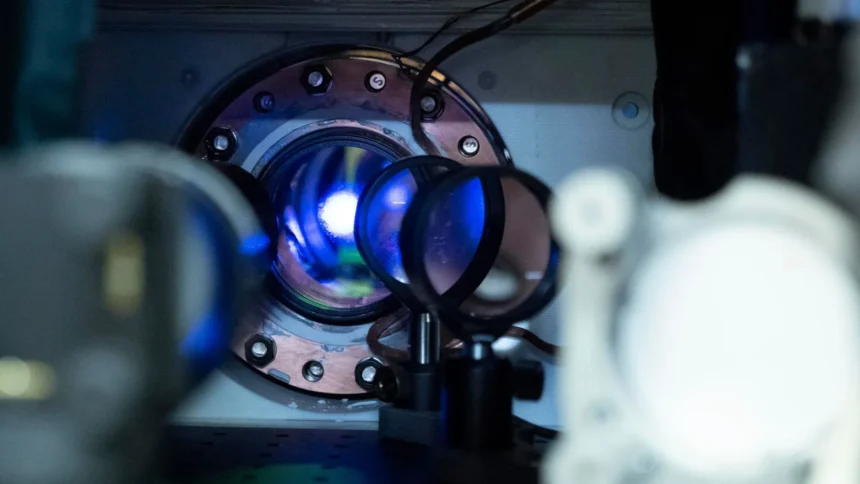
Two research teams from China and Austria have achieved a long-awaited dream by building the first “nuclear clock” in the history of science, which operates with high accuracy.
The currently available technology that scientists rely on at the present time to control navigation and operate high-speed Internet networks with precise regularity that does not allow for any error is atomic clocks, but the new achievement that was announced in two studies recently published as scientific drafts on the “ArXiv” platform and adopted by the Chinese “Tsinghua” University and the “Vienna” Center for Quantum Science and Technology at the Vienna University of Technology heralds a new era of timekeeping that may overthrow the most accurate atomic clocks currently in use, replacing them with nuclear clocks, which will occur. A radical change in navigation techniques and our understanding of the secrets of the universe.

How does a nuclear clock differ from an atomic clock?
Current atomic clocks depend on monitoring the movement of external electrons surrounding the atom, which can be likened to a pendulum clock on the balcony of a house overlooking a busy street. The pendulum works with excellent accuracy as long as the weather is calm, but as soon as a huge truck passes or a sudden wind blows, it will shake and be affected.
In the world of physics, these adverse conditions that may affect accuracy are the “magnetic and electric fields” surrounding us that disturb the external electrons and affect their overall accuracy.
As for the new nuclear clock, what scientists did can be likened to taking a pendulum and placing it inside a giant iron safe underground. This pendulum represents the protons and neutrons stable in the nucleus of the atom. Since the nucleus is completely fortified and isolated in the center of the atom, it is completely unaffected by storms or external interference, which guarantees absolute stability and unprecedented accuracy in measuring time.
Thorium-229.. Champion of achievement
But if the pendulum (protons and neutrons) is hidden and protected in the nucleus of the atom, how can we see it from the outside to calculate time?
Here lies the miracle of the element “thorium-229”, which the researchers used. While the rest of the elements in the periodic table have “solid and dark safes” that require enormous destructive energy to open and see what is inside, thorium-229 is distinguished by the fact that its nucleus has what resembles a “small glass window.” This window allows physicists to direct a very precise laser beam to pass through it, move the internal pendulum and measure its vibrations without compromising the security of the safe or destroying it.
Despite the extreme technical difficulty in controlling this type of laser, the Chinese and European teams were able to overcome the challenge with different and impressive experimental methods. The Chinese team, led by Bichen Huang from Tsinghua University in China, focused on using a more powerful laser, and proved that the watch has amazing stability, as it achieved a very small instability rate (close to one part in 10 trillion) after a full day of continuous operation.
As for the European team, led by Luca Toscani De Cole from the Vienna Center for Quantum Science and Technology, they used a crystal containing a higher concentration of thorium nuclei, and immediately turned the clock to a major physics task, which is the search for “ultra-light dark matter,” which are hypothetical particles that constitute a large portion of the unexplained mass of the universe. Although no sign of dark matter was found, the sensitivity shown by the watch equaled or exceeded the best atomic clocks in the world today.
Applications that change the future
Experts believe that this achievement is not just a tool for knowing time more accurately, but rather a completely new window into the deepest questions in modern physics.
The team hopes that the success of these experiments and their development in the future to become smaller in size will open the door to revolutionary applications, including the development of GPS navigation systems to become accurate to the level of a few centimetres. The new watches can also be used as ultra-sensitive gravity sensors to detect minerals and groundwater with extreme accuracy, and finally test the constants of nature, by verifying whether the physical laws and constants that govern the universe are truly constant or do they change with the passage of time.