Published on 6/29/2026
The European Space Agency (ESA) launched the Euclid telescope in 2023 to study the biggest mysteries of the universe, most notably dark matter and dark energy, by drawing a broad map of the structure of the universe over billions of light-years.
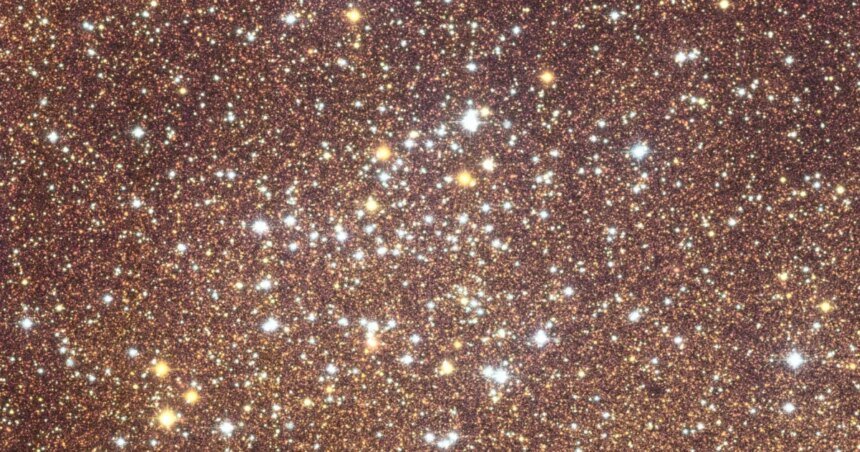
But the European mission proved that it is not limited to the distant depths of the universe, as the telescope succeeded this time in directing its eyes towards “our cosmic neighborhood,” producing the largest and most detailed close-up image of the center of the Milky Way galaxy, revealing more than 60 million stars in a giant mosaic that scientists expect to study for many years.

The central bulge of the galaxy is one of the most crowded areas of the sky with stars, as millions of stars overlap one another when viewed from Earth, making distinguishing them individually a great challenge even for the best observatories.
Read also
list of 2 itemsend of list
However, Euclid’s performance exceeded expectations, even though its original design was not intended to study this type of crowded stellar environment.
26 hours of observation created the largest mosaic of the galactic center
The new image was based on observations conducted during March 2025, as the telescope directed its camera operating in visible light towards the center of the galaxy nine times, with a total observation time of 26 hours, and each shot covered an area of the sky larger than the area of the full moon, before combining them into a single high-resolution mosaic.

According to the European Space Agency, the final image includes more than 60 million stars that can be distinguished individually, which is an important technical achievement because most of these stars appear to overlap when observed by traditional means.
ESA confirmed that the sensitivity and accuracy of the Euclid devices allowed the separation of individual stars while at the same time maintaining the precise measurements necessary for scientific analysis, which turns the image into a long-term scientific reference, and not just a visually stunning snapshot.
A new treasure for exoplanet researchers
Although Euclid’s primary mission is to study the vast universe, the new data will also serve the field of searching for interstellar planets, especially using the microgravitational lensing technique, which relies on a star passing in front of a star farther away from it, and its gravity amplifies the light of the background star, while the presence of a planet orbiting the parent star reveals an additional change in the light.

Jean-Philippe Beaulieu, from the Sorbonne University and initiator of the Galactic Bulge Survey Project on the Euclid mission and one of the leaders of the exoplanet team in the mission consortium, explained: “Over the past twenty years, we have discovered about 300 stellar planets with this technique, all of them using ground-based telescopes directed toward the center of our galaxy. This image includes 51 known planetary systems, and will help in studying many new systems that will be discovered in the future.”
Although the observation period was not sufficient to record a complete gravitational microlensing event, it provided accurate data on the stars and planetary systems present in the region, giving scientists a valuable reference point for comparison in the coming years.
A preparation for future missions
The importance of this data increases with the approaching launch of the “Nancy Grace Roman” telescope of the American Space Agency (NASA), which is expected to begin its space journey after August 30, 2026, as it will also focus on searching for stellar planets using microgravitational lensing technology and in approximately the same region of the galaxy.
Natalia Rictsini, from the Paris Institute of Astrophysics, who led the publication of the Galactic Bulge Survey data, believes that Euclid images will, in the future, allow the movement of stars to be accurately measured over time, which will help confirm the existence of stellar planets and determine their masses.

She adds: “Since Euclid can clearly separate individual stars, the speed of their movement over time can be measured, and this information can be used to confirm the existence of the planet and determine its mass, which is something that cannot be achieved from data taken at just one moment.”
Wealth of the immediate neighbourhood
This picture reveals that the greatest discoveries do not always come from searching the far reaches of the universe, but sometimes from revisiting our cosmic neighborhood with more precise tools.
Among the tens of millions of stars arranged in the heart of our galaxy, new worlds may be hidden, and perhaps answers to questions that have long preoccupied humans: How do planets form? Are we alone in this universe? Thus, Euclid proves once again that every picture taken by science is not just a beautiful scene, but a new page added to the book of human knowledge.