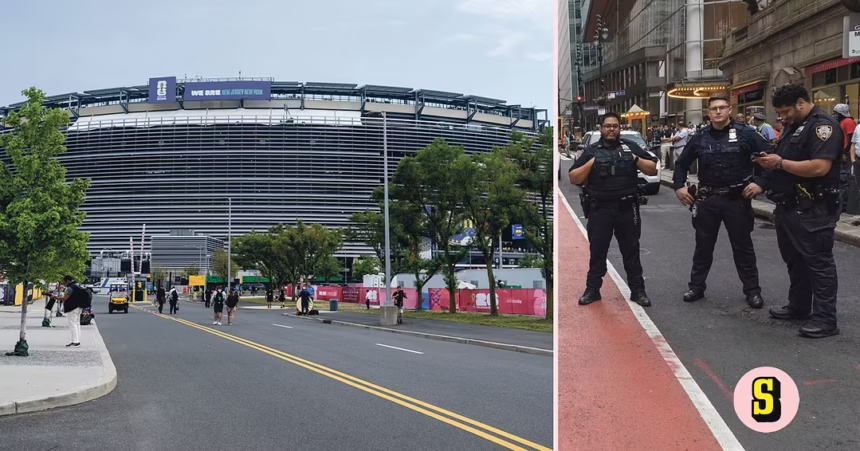


NEW JERSEY. Some fans walk along the freeway, others pay $98 for a train that normally costs one-seventh as much.
Behind the transport criticism surrounding the WC’s final arena hides a conflict between Fifa and New Jersey – about responsibility, logistics and money.
– This is up to Fifa, says Victor Matheson, professor of sports economics.
Going to MetLife Stadium in New Jersey was described in advance as a “Mission impossible”.
But the claim is an exaggeration. Technically speaking, it is entirely possible to get to the arena on foot, although it comes with some risks.
In recent weeks, Americans speeding down the highway have suddenly caught sight of soccer fans from countries like Scotland and Brazil.
– Don’t go to the arena. Plan ahead and travel safely, was the message from New Jersey Governor Mikie Sherrill.
One who didn’t listen was Zealand Shannon, who got a ticket to France’s meeting with Senegal.
– I sat and looked at maps and stuff and thought: “Okay, it actually looks like I’ve found a route that should work”, explains Zealand, who runs a YouTube account with the same name.
He checked how long the route was estimated to take (roughly 6.5 hours) and added a couple of hours to be on the safe side.
– I decided to start from Times Square, which is the heart of New York, says Zealand.
– After living in New York for five years, this felt like something I was comfortable trying to do. I knew the areas I was going to go through, so I just wanted to see if it worked.


Zealand reached MetLife Stadium after an eight-hour walk. Photo: @theoldzealand
Dark on Google Maps
Worth noting is that the walking route from Times Square to MetLife Stadium no longer appears as an option on Google Maps.
It has required major police efforts to get the fans off the roads. Something that is confirmed by a task force sitting slumped in brass chairs outside the arena before Ecuador’s meeting with Germany.
– I understand that you from Europe are used to going to your stadiums. But we can’t have it like that, says one of the policemen.
His colleague nods in agreement and interjects:
– It is far too dangerous. What if someone gets hit?
Zealand, who finally reached the arena with around 43,000 steps in his legs, is careful to point out that he was prepared to abort the experiment.
– If I had encountered any major obstacles, I would not have continued, he says and adds:
– I wasn’t trying to expose myself to any danger and wasn’t going to run across motorways or anything like that. I just wanted to see if it could be done in a way that felt normal – and it turns out it actually worked.

660 percent price increase
So why do even these football supporters take the risk?
The answer is simple: transport costs.
A nearby parking space costs around 225 dollars (approx. 2,480 kroner) per World Cup match, compared to 40-75 dollars during an NFL meeting.
The train to the arena, which connects New York with New Jersey, normally costs around 13 dollars (about 126 kroner) round trip. On match days during the World Cup, a ticket costs 98 dollars (roughly 956 kroner) – an increase of as much as 660 percent, which would actually have been even higher. Add to that the distance is no longer than two miles – a ridiculous cost per kilometer.
Bus – around 20 dollars – is by far the cheapest solution (the price would have been 80 dollars, but even in this case the cost was reduced after massive criticism). The problem so far has been that these tickets quickly sold out.
Personally, I try to take an Uber to the arena five hours before kick-off, which ends up costing just over 50 dollars for a five kilometer journey. Even then, the queues are long.
– But it’s not nearly as dangerous as it will be in an hour or so, announces the driver Carlos, who was born and raised in New York.
As we turn into the dedicated area for Uber cars, a good distance from the arena itself, he points up to the huge sign with the name of the transport company.
– Can you imagine how much money they make from this championship? It must be billions.
Blame Fifa
In the eyes of many, the rulers of New Jersey and New York are the culprits in the drama. After all, it is those who have approved the price increases who are making it difficult for traveling supporters.
Governor Sherrill, who was sworn in in January 2026, rather points the finger at the soccer body, Fifa.
– We inherited an agreement where Fifa does not contribute a single dollar to the transport during the World Cup. Fifa should cover the transport costs… But if they don’t, I’m not going to let New Jersey pay the bill, Sherrill said before the championship.
Danielle Zanzari, an economics professor at Seton Hall University, says this is New Jersey’s only chance to cover the costs of the championship.
“While supporters may be upset about paying around $100 for a train ticket, the price reflects the actual costs of deploying extra trains, security and transporting thousands of people to and from the stadium in a very short period of time,” Zanzari explains.
– Fifa could do more to help cover the costs of transport, security and infrastructure borne by host countries and taxpayers.
Zanzari refers to a research study carried out by Robert Baade and Victor Matheson, who Sportbladet has also spoken to.
– They have estimated that the host cities for the World Cup in 1994 made a total of losses of about 5.5 to 9.3 billion dollars, despite preliminary forecasts of a profit of about 4 billion dollars, she explains.

Does not allow local sponsorship
What Fifa is expected to generate this World Cup in North America and Mexico? About 13-15 billion dollars.
Victor Matheson, professor of sports economics at Holy Cross, believes the real problem is the significant costs incurred by Fifa as part of the arrangement.
– These are quite expensive things that the cities are expected to pay for, says Matheson.
In the group stage, tickets for major games cost between $1,000 and $2,700, prices that only increase in the playoffs. Finals tickets are expected to fetch around $2,000-$6,700 and upwards of $30,000 on the secondary market.
– But Fifa does not share its revenue from ticket sales. They do not share revenue from television rights or sponsorship deals. They have also severely limited the ability for local actors to raise money via sponsorship.
That local sponsorship is not allowed is a rule that differs from many other major sports championships.
– In the Tokyo Olympics, for example, the local organization was able to bring in over two billion dollars in sponsorship, which helped to cover the costs, explains Matheson and points out Fifa’s obsession with sticking to its own sponsors.
– We don’t even say “MetLife Stadium” but “New York Stadium” during the World Cup.
Pieces of tape on 65,000 chairs
Victor Matheson takes an example from another host city, Boston.
An organizer who, incidentally, has also received criticism for his expensive train tickets on match days.
– At Gillette Stadium, an intern went around to all 65,000 seats and put tape over small logos on the seats that had the stadium’s sponsor on them, because Fifa does not want other brands to be seen during the event, says Matheson.
– It makes the event more expensive for the host, because someone has to do all this manually, and shows how strict Fifa is when it comes to commercial rights.
But it doesn’t have to be this way, says the professor.
– In the Women’s World Cup in Australia, train tickets were included in the match ticket. It was a much better arrangement, negotiating free transport for the fans. They didn’t do that in Boston and New York, says Matheson.
– However, some other cities have made it cheaper, Los Angeles for example. But Boston and New York have limited public transportation and try to cover their costs through the train system.
And it is up to Fifa to negotiate such an agreement?
– It works like at all major events. Fifa negotiates with local organizations in each city. There are 16 different local committees for this WC. They write contracts about security, transport, arenas and fan zones, long contracts – sometimes 150 pages. The problem is that these agreements often benefit Fifa more than the host cities.
“They make several mistakes”
When Qatar was the host country in 2022, Qatari authorities invested close to 200 billion dollars in infrastructure, including new metro lines and stadiums.
It costs money to host a World Cup if everything is to work – and Victor Matheson believes that host cities generally underestimate transport and running costs when they apply.
– They make several mistakes. First, they overestimate how big the event actually is. The World Cup final is huge, absolutely. But every match is not a final, says Matheson.
Also, hotels around North America have not been fully booked. In Toronto, 82 percent of the rooms were booked during the second week of June, compared with 83 percent the same time the year before.
A survey by the American Hotel & Lodging Association shows that around 80 percent of hotel owners expect lower bookings than forecasts.
– They miss that many of these fans are not “extra” tourists, but crowd out other tourists. The hotels are as full as usual – it’s just other people staying there, says Victor Matheson.

“Positively surprised”
In addition to Sweden’s round of 16 final against France on Tuesday, the World Cup final will also be played at MetLife Stadium.
Victor Matheson does not think there will be any major problems arranging the decisive match.
– The arena has already had the Super Bowl and also has NFL games with 85,000 people every week, so this is nothing new, says Matheson, but adds:
– The only question is whether Fifa’s requirements make it more complicated than usual. It is not a new situation in terms of capacity, but the issue is rather the logistics around it.
It’s no secret that sports facilities in the US are usually built for transport by car, something that soccer lover Zealand Shannon also points out.
– Well, I’m American, so I’m used to big arenas that are far from the city centre, says Zealand.
– I’ve been lucky enough to go to games in New York, Seattle, Vancouver and Philadelphia so far through my various jobs as a YouTuber and I’d say I’ve been pleasantly surprised by the logistics.
Tip for Swedish fans: “Saves money”
Vancouver and Seattle describe Zealand as “walking friendly” – and are not referring to a challenge like that in New York/New Jersey.
Overall, he sees the championship as a success so far.
– Especially considering the headlines and expectations, because I grew up in a country where public transport is not directly our strong point, he says.
He also has an expert tip for the Swedes who want to get to MetLife Stadium on Tuesday:
– If you just want to get there in a smarter way and still walk the last bit, then you can, for example, take the train up to the George Washington Bridge, walk over the bridge and then there are several different ways to get further.
Once there, you can hopefully get hold of a taxi or possibly find an electric scooter.
– Just to save some money. It is absolutely possible, says Zealand.
– But you’d be pretty stupid to go all the way from Times Square to the stadium as part of your actual plan. The only reason to do it is really if you, like me, want to prove that it actually works.