Published on 6/29/2026
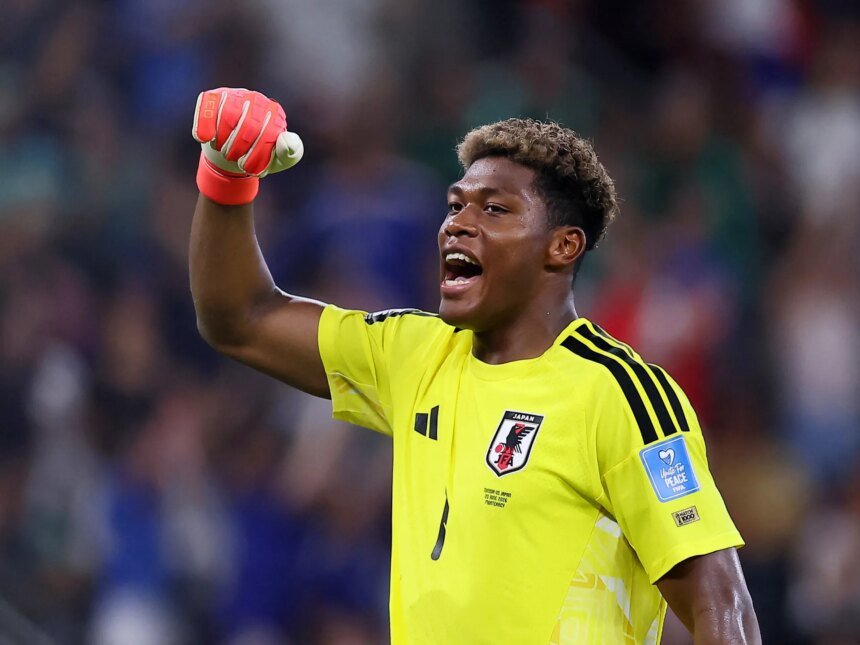
The emergence of Japanese goalkeeper Zion Suzuki and his brilliance in the World Cup finals was not a stroke of luck, but rather a story of struggle characterized by many bold decisions during his professional career, as well as a remarkable personal biography regarding his origins and upbringing.
According to many, Japan found in Suzuki (23 years old) a solution to the goalkeeping dilemma that has dogged the team for many years, and not only that; Rather, his supporters hope that he will help them go far in the current World Cup, despite the difficulty of the task.
Read also
list of 2 itemsend of list
The Japanese team successfully surpassed the group stage by occupying second place in Group E behind the Netherlands, after gaining 5 points from a win and two draws, in which Suzuki played a pivotal role in making many decisive saves, especially in the last match against Sweden.
The “Samurai Warriors” will face Brazil in the round of 32 in the match scheduled for this evening at 20:00 Mecca and Doha time at Houston Stadium.
In this match, Suzuki will face a major challenge, which is to stop the threat of the Brazilian attack led by Vinicius Junior, who scored 4 goals in the group stage, and therefore the Japanese hope to lead them to achieve their first victory in the World Cup knockout rounds.
Who is Suzuki, Japan’s goalkeeper?
Suzuki’s personal features are striking. In addition to the facial features of a Japanese Asian, he has dark skin, which has raised many questions about the secret behind this.
Suzuki was born on August 21, 2002 in the US state of New Jersey, to a Ghanaian father and a Japanese mother, before moving with his family to reside in Japan, his mother’s country, and there he began his football career.

Suzuki rose through the youth ranks of Urawa Red Diamonds, the most popular club in Japan, and in 2019 he became the youngest player in the club’s history to sign a professional contract at the age of 16 years and five months.
A bold decision
Two years after his promotion to the first team, Suzuki decided in 2023 to go professional in Europe for the Belgian club Sint-Truiden, after he refused to move to Manchester United, due to his feeling that he did not gain enough experience to represent a large team of this size.
In the summer of 2024, he joined the Parma team in a deal slightly exceeding 8 million euros (about 8.6 million dollars), becoming the first Japanese goalkeeper to play in the Italian League.
Suzuki’s style of play
Suzuki has great skills when it comes to playing with his feet. Despite his height of 190 cm, he passes the ball accurately and helps his country build the game from the back, in addition to his ability to send long passes when needed in terms of quick movements.

As for the most important thing regarding the goalkeeping position, Suzuki is also adept at dealing with crosses inside his penalty area.
His international career
Because he was born in the United States, the US Soccer Federation tried to convince Suzuki to represent him internationally, but he was clear in his decision to wear the Japanese national team jersey, and he could also represent Ghana.
Suzuki participated with the Japanese national team in the Tokyo 2021 Olympic Games, where he finished the competition in fourth place after losing the match for third and fourth place to Mexico.
On July 21, 2022, Suzuki played his first match with the Japanese national team against Hong Kong in the East Asian Championship, at the invitation of coach Hajime Moriyasu.

Despite this, Suzuki was not on the roster of the team participating in the Qatar 2022 World Cup, which made his call-up to the current World Cup a real launch for his career.
New chapter
Suzuki said in a previous interview, “This tournament is a big chapter in my career. It is the culmination of my efforts. I want to achieve good results with the team and I also aspire to have a good tournament on a personal level.”
In its first World Cup participation, Suzuki conceded 3 times during the three group stage matches. Two goals against the Netherlands and one against Sweden, an experience from which he learned a lot before facing Brazil.
After advancing to the round of 32, Suzuki said, “We learned from the three matches that results will come regardless of the way we play. We know that Brazil is a strong and excellent team, but if we do what we have to do, we can definitely win.”

Regarding what he has presented since the beginning of the tournament until now, he added, “From the first match, I felt that I was able to contribute to building the game. I think I was able to do that. If I was able to present a better version of myself in every match, I think that would help the team.”
Since his first international match until now, Suzuki has appeared with the Japanese national team in 27 matches, in which he conceded 17 goals and scored a clean sheet in 16 of them, according to data from the famous “Transfermarkt” website.