Erik Niva
This is a commenting text. Analysis and positions are the writer’s.


Just recently, they had the entire football world in their hands.
Now they can’t even shoot penalties.
The German success machine no longer exists.
Everywhere you look, you see Paraguayans who don’t know where to go with their ecstasy. They scream, they cry, they thank powers they were just about to stop believing in.
The huge two-meter goalkeeper Orlando Gill points upwards with eyes that cannot take in what he just experienced. But heaven owed him this, football would pay back in the end.
The last time there was a WC, Orlando Gill was destitute.
His young son had become seriously ill, and Gill was too young and too unestablished to bear the financial burden. The responsibility gave him no choice. He sold pretty much everything he owned and had, including all the national team jerseys and medals.
He sold everything except his goalie gloves. And here he is now.
For the first time in history, an opposing goalkeeper has won a penalty shootout against Germany, the national team we just recently still came with certain performance guarantees.
Now both we and them are left with the angry, indignant questions.

Was this all?
So is this what Germany is now? Is this what Europe’s premier footballing nation has been reduced to? Was this all you had?
Pointless pass after pointless pass. Stagnant players to stagnant players. No momentum, no ideas, no breakthrough power.
The rough-hewn centre-backs Antonio Rüdiger and Jonathan Tah as playmakers. Leroy Sané as the only one-on-one threat, a player who hasn’t managed a dribble in 18 months. No patterns, no depth play.
A valiant Paraguay were hard pressed, certainly, but that was a lot because they were allowed to be.
At the start of the tournament, the USA tore the red and whites to pieces with classic high-intensity football, the kind of football that Germany was best at in the world just recently.
Now everything is so desperately static, and it is hard to accept that it has become this way.
Twelve years ago, Germany became world champions at the Maracana, a final triumph that followed FC Bayern and Borussia Dortmund playing out a Champions League final turned drag racing competition.
Since then, they haven’t even reached the round of 16.
I followed Joachim Löw’s world champion team relatively closely, and one thing that always fascinated me was their extreme, pronounced focus on driving the tempo of games, moving the ball.
Early on, Löw told me that it had taken an average of 2.8 seconds for a German national team player to receive the ball and then pass it on when he and Júrgen Klinsmann first took over the team.
After just over two years, that figure was down to 1.9 seconds, and was then pushed further.
After all, nothing came for free. To make the acceleration possible – without the passing percentage crashing through the floor – a well-ingrained, offensive systematic was required. A certain type of predetermined high-intensity runs would automatically produce a certain type of fits, and none of that was negotiable.
Football has changed in the last 15 years. To break down a ten-man defense today, partly different playing patterns are required, but the basic principle remains. Automation and mechanization almost always go faster than inspiration and improvisation.
Of course, Julian Nagelsmann knows all this, but he still believed more in another direction, another path.
Germany has also gone through a Guardiolaisation, for better or for worse. They now foster different types of players than before, and Nagelsmann has made an effort to get as many creative ball geniuses into the eleven as possible.
“Einer mannschaft voller Zehner”, it has been said. A national team full of Number 10 players.
The set-up and arrangement have had their drawbacks. The group stage didn’t pose any major problems for the Germans, but the game did falter. Sluggish, slow, lack of spirit.
Now Julian Nagelsmann had tried to sharpen his possession football by starting with Deniz Undav as a mobile penalty area nine, but the problems lie in the principle itself rather than the individual player choices.
And the principles don’t work.
Seconds after Julio Enciso headed in the Paraguayan lead, Nagelsmann was frantically staring down at the computer screen, looking for the hell knows what.
There were no answers.
Save – terrified
As the game went on, German attempts to play like Spain faded, and instead they were reduced to imitating Stoke.
When no other ideas worked, the posts started pouring in. One of them produced an equalizer by Kai Havertz, another should have meant a winning goal by Jonathan Tah.
Germany has every right to rage over a ridiculous VAR decision, but it’s not really the time to focus there for a team that didn’t really play together for a single goal chance for more than 120 minutes against Paraguay.
When the penalties then moved closer, it was enough to look at the German players to realize that they were not favorites going into that moment, that they did not fill up the shirts of their representatives at that point either.
They were afraid. Or more accurately, they were terrified.
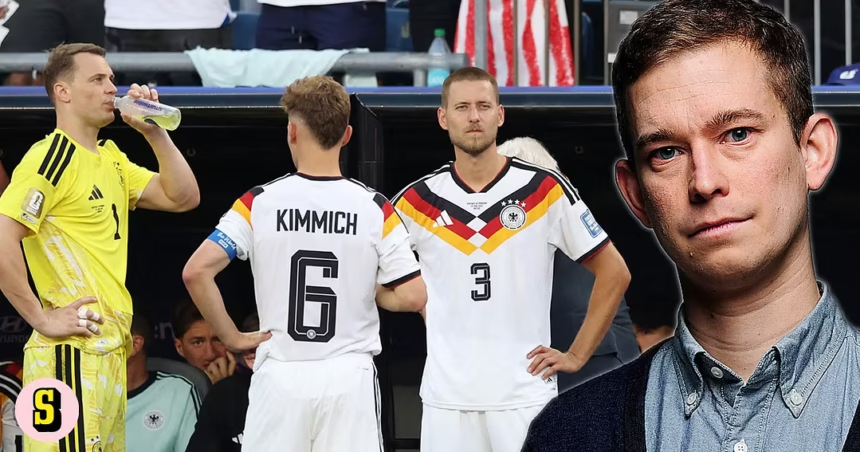
Once upon a time, Manuel Neuer had sorted out the situation solely through aura and charisma, but once upon a time no longer applies.
Neuer looked small and old when Orlando Gill lined up next to him.
Just a few years ago, a pair of goalkeeper gloves was all the Paraguayan owned. Now he clapped his gloves so loudly that it rang in the ears of Kai Havertz and Nick Woltemade, so loudly that the whole world heard.
Paraguay through to the round of 16, Germany into the abyss.
They have both ended up where they deserved.