Published on 6/29/2026
|
Last update: 21:27 (Mecca time)
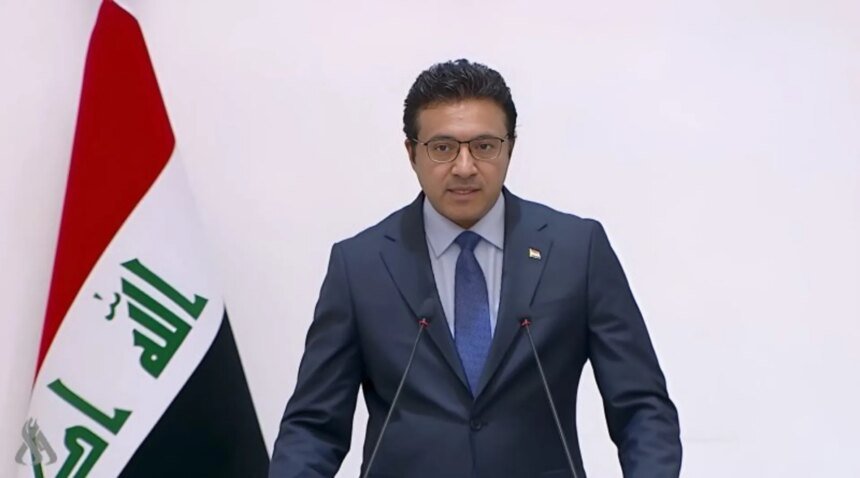
Iraqi government spokesman Haider Al-Aboudi confirmed that the measures taken in the framework of combating corruption are taking a legal and judicial path, noting that a number of those involved are still at large and the competent authorities are continuing to track them down, at a time when investigations are continuing after confessions led to the revelation of names and political and parliamentary figures.
Haider Al-Aboudi said during a press conference on Monday that the confessions made by one of those involved in the file were the “spark” for the start of the operation, explaining that it revealed new details and the involvement of personalities, which led to the lifting of immunity from some representatives by a decision of the Iraqi Council of Representatives, stressing that all measures taken are subject to the constitution and the law and are administered under the supervision of the judiciary.
In the file of recovering funds and wanted persons, the government spokesman explained that Iraq is cooperating with international bodies within the limits of legal powers, noting that the fight against corruption is managed by the state’s executive, legislative and judicial institutions, and that any external cooperation takes place according to the need and requirements of the investigation and under the umbrella of the Iraqi judiciary.
In response to questions about the timing of the anti-corruption campaign and its relationship to the Iraqi Prime Minister’s upcoming visit to Washington, Al-Awadi refused to link the two files, stressing that confronting corruption stems from internal national motives, but at the same time it enhances the image of the Iraqi state and the rule of law before the international community.
Al-Aboudi indicated that there is cooperation with the Kurdistan Regional Government regarding the pursuit of wanted persons, explaining that the competent authorities are following up on the files related to those who left Iraq, and that the procedures for communicating with international bodies, including Interpol, are carried out in accordance with the approved legal contexts.
Weapon confinement
Regarding the trial of those accused in corruption files, he explained that determining whether the trials will be public or secret is the responsibility of the Supreme Judicial Council and the competent courts, but he expressed the government’s aspiration to reach clear and transparent results in this file.
Regarding the file of confiscating weapons in the hands of the state, Al-Aboudi announced that all concerned groups were informed of a specific date to end this file, stressing that September 30 represents an important date with the end of the reasons for the presence of the international coalition in Iraq, and that any weapons outside the framework of the state after this date will be subject to legal treatment.
The Iraqi government spokesman stressed that the state is continuing to implement the principle of arms monopoly in accordance with the constitution, stressing that the next stage will witness legal measures against any party that possesses unregulated weapons outside official institutions.
Regarding the funeral of the late religious authority, the government spokesman revealed that the Islamic Republic of Iran had submitted an official request to the Iraqi government to hold a funeral ceremony for the body, explaining that July 8 had been set as the date for this procedure, and that Iraq had approved the request and coordination was being made to organize the event in accordance with the official procedures followed on such occasions.
As for the salaries of Kurdistan Region employees, Al-Aboudi confirmed the existence of an understanding and agreement between the federal government and the regional government in accordance with legal specifications, stressing that the Federal Ministry of Finance will continue to pay salaries monthly, despite the existence of a gap between the revenues collected from the region and the amounts paid, indicating that the value of the payments is close to one trillion Iraqi dinars (about 763.3 million dollars) per month.
Regarding international loans, Al-Aboudi said that the Iraqi government is not turning to external borrowing at the current stage, and that it is relying on internal solutions in light of the sustainability of oil revenues and the economic cycle, stressing that the priority is managing the available resources.