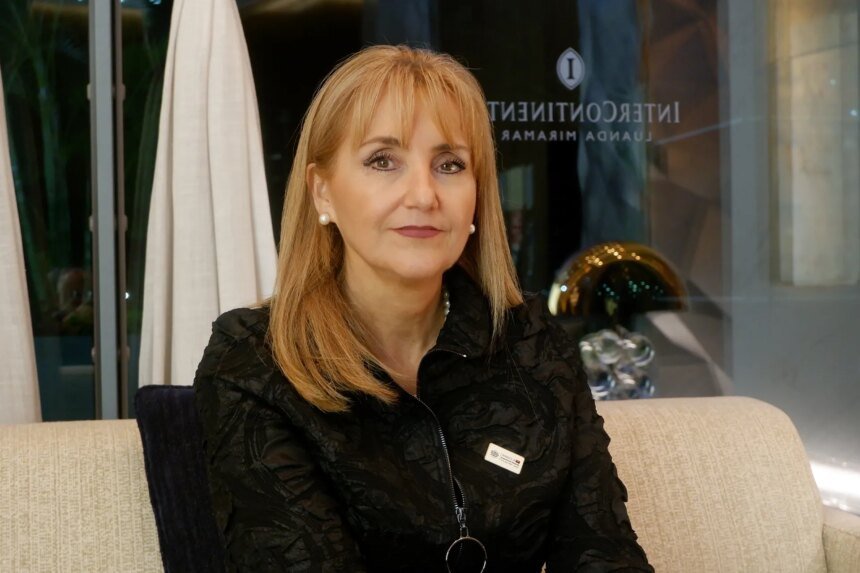
Luanda – Gloria Guevara Manzo, former Mexican Minister of Tourism (2010 – 2012) and President of the World Travel and Tourism Council, says that the global tourism sector is witnessing rapid structural transformations that force countries to adopt flexible strategies to attract investments and develop their infrastructure.
In an interview with Al Jazeera Net, conducted on the sidelines of the Angola Investment Summit 2026, Guevara announced the launch of seven basic principles to classify countries as “investment-ready” destinations, stressing at the same time that artificial intelligence represents a tool for enhancing efficiency and productivity, but it will not replace the human element in a sector that relies primarily on human interaction.
Below is the text of the dialogue:
Tourism investment environment
- Since you participated in the Angola Investment Summit, how can this country employ public-private partnerships and stable regulatory frameworks to transform from an oil-dependent economy into an attractive destination for global tourism investment?
Here in Angola, we have launched seven principles that we believe are very important for a destination to qualify for what we call “investment ready”. These seven principles have been identified based on the opinions and input of world leaders, our members, who are the investors and shape the travel and tourism industry.
We believe that Angola has huge potential, but it is very important to work on the foundations. I was very impressed by the investment in infrastructure that took place in this country, the work on specific plans, and making tourism part of the national priorities. But it is very important to develop tourism not only from top to bottom, but also from bottom to top.
Working from the bottom up means working with the local private sector, with communities, and of course with the global private sector as well.
Having legal stability and specific judicial systems to support long-term investment and foreign capital remains of great importance to foreign investors, as an example of these seven priorities.

Therefore, we believe that Angola needs to continue to do what it is doing, but it is very important in this national plan to involve all stakeholders, because the government cannot do it alone.
This is very clear, as no one has ever done it alone, the hand of the private sector is always needed, because in the end the one who creates jobs is the private sector, and the one who maintains long-term growth is the private sector, because governments help establish and help with the right policies, but here, this cooperation between the public and private sectors is essential. So, Angola must continue to do what it is doing, and it needs to partner with the private sector, both local and international, in order to realize its full potential.
Challenges of African tourism
- What are the obstacles and challenges that Angola and African countries in general face in their tourism model? Is there a need for unified visa policies and improved air connectivity to reshape the continental narrative away from traditional safaris?
Well, as you know, at the World Travel and Tourism Council (WTTC) we do a lot of research related to economic impact. Hence we know that last year, while the global economy grew by 2.8%, the travel and tourism sector grew by 4.1% in terms of GDP, accounting for the total impact ($11.6 trillion and 366 million jobs).
Africa recorded growth of 5%, which is greater than the global average of 4.1%. However, the greatest growth we have seen in the world has come from the Asia-Pacific region.
The Asia-Pacific region has been able to unleash greater potential due to the policies it has implemented, such as visa exemption in many countries, including China as an example; China started with 15 countries and now there are 8 other countries that do not require a visa. They also have regional visas, link mechanisms between different destinations, have the infrastructure, and have implemented seamless and biometric systems.

What we can learn from these destinations that are growing at a faster pace is that there is opportunity to do more. At the World Travel and Tourism Council we have identified 8 priorities, many of which apply to Africa, and perhaps to Angola. For example, there is a need for a regional visa, especially for travelers coming from long distances.
Travelers coming from Mexico, China or India, they don’t want to apply for 5 visas, and they’re not going to come to Africa just to visit one country, because it’s a long flight, a long flight. They usually want to visit 3 or 4 countries; It’s like when you go to Europe, you apply for a Schengen visa and visit 27 countries. You don’t visit all 27 countries in the same trip, but you visit a minimum of 5 or 6 countries.
Likewise here, if they are coming to this part of the world, if they are coming to Angola, why can’t they go to Mozambique or Kenya or South Africa or Namibia? So, there is a huge window of opportunity to do multiple destinations, and the only way is to get a regional visa, or cancel the visa. But a regional visa will allow long-distance travelers to visit multiple destinations.
At the same time, having this multi-visa, you will be able to generate demand within countries or point to point, and that helps because that allows you to have more connectivity within Africa. Today, we have to pass through the North to go to the South, or go to a different continent to travel within Africa, and that should not be the case.
You have to be able to travel from point to point within Africa, connectivity is key, this is something that needs to be developed. So we need to work on visa, we need to work on connectivity, we need to work on seamless experience; The experience should be easier. Why do they ask you for your passport 5 times during your visit to an airport here? It shouldn’t be like that. I traveled from Kenya to Angola and it took me a full day to reach my destination. Why is that? It’s about direct connectivity between destinations.
This experiment faces some challenges. So, I think there are several things that Africa can learn from other regions like Europe, like the Asia-Pacific region
Environmental and legal stability
- Tourists are usually looking for not only stunning landscapes and safaris, but political stability and legal and judicial frameworks are an essential pillar to reassure them and protect their investments. How do you see this aspect, and what are your proposals to enhance it?
Yes, this is part of the seven principles that we launched, and we will work to honor countries that meet these seven principles, as investment-ready destinations, as I was saying.
One of these principles, as I mentioned, is the presence of a strong legal framework and legislative and judicial stability so that foreign investors feel that their money and investments are protected and will not be subject to nationalization that will lose them everything. They need to have that judicial system that protects them and guarantees them that certainty, in order to bring their money into the country.

Therefore, there are several principles, as I said, that we have documented that are very important. “One-stop shop” is another principle, so we can eliminate bureaucracy, and they have a point of reference to help them with paperwork; Because sometimes you may have the required permits at the state level, but then you have the regional level or the local level, like the municipality, that is blocking the projects.
Sustainable tourism drivers
- How can sustainable tourism act as an engine of economic mobility, by channeling wealth directly to women, youth and rural communities?
Sustainability, according to the United Nations, is defined by four components: culture, environment, climate, and social impact. We measure them all at the World Travel and Tourism Council, and it is very important to continue to work with them all and have that balance right.
We can’t have tourism without protecting the environment, and we can’t have tourism without a positive social impact. This balance must be protected; Tourism should benefit travelers, local people, and the planet we live on.
We believe that sustainability is actually one of our top priorities, and we think it’s something that needs to be taken into consideration to maintain that positive cycle, because once the experience becomes negative it reflects on everyone, and when tourism is not good for the locals, it is not good for the tourists either.
Dimensions of tourism diplomacy
- Turning to what might be called “tourism diplomacy,” how do authentic cultural exchanges as soft power contribute to dismantling stereotypes and promoting world peace?
Yes, tourism provides empathy. Because when you travel to another country, you have a better understanding. When you have a better understanding, you put yourself in other people’s shoes, and this creates empathy. When there is empathy, there is better diplomacy, and then of course when there is empathy, there is peace.
So, ultimately, travel changes perceptions. As perceptions change, it creates empathy, and empathy leads to peace. So, definitely, tourism is a soft power that creates better understanding between cultures and removes stereotypes, and removes misconceptions as well.
Technology and the human element
- The world is witnessing a boom in artificial intelligence and robotics technologies. How can these technologies contribute to the dismantling of borders between countries and the development of the tourism sector, and what are the concerns associated with them, especially about the future of human jobs?
Artificial intelligence is very important and so are robotics, in fact it is one of our eight priorities at the World Travel and Tourism Council. We need to look at how AI can help improve the experience.

People use artificial intelligence to plan their trips, to collect information, to maximize returns. At the same time, artificial intelligence on the one hand helps the traveler to improve the experience, and on the other hand it helps the service provider.
For example, artificial intelligence helps airlines reduce food waste. Just by knowing the gender and age of passengers, they can predict what kind of food they will eat and reduce food waste, for example. Artificial intelligence is also helping hotels be more sustainable and more efficient.
So, AI is being used in multiple ways: either to reduce costs, provide efficiency, or improve the experience.
We need to embrace new technologies, but at the same time, we need to protect the privacy and rights of travelers. Artificial intelligence, like any other technology, should serve humans and not the other way around.
We cannot introduce artificial intelligence to humans. While we must use, champion, and embrace AI for the benefit of humans, our experiences, and our productivity, we must be more efficient.
As for people’s fear of losing their jobs, in the tourism sector, our sector has created one out of every three jobs on the planet in the past five years. One in three of all jobs created on the planet in the past five years has been thanks to travel and tourism. This is a huge achievement because our jobs, in our case, are very consumer-oriented and the social interaction associated with them is very important.
I don’t see an AI flying a plane for example, I don’t see an AI serving you your food. So, there is still a need to communicate with local people. People arrive in countries, take a taxi, and talk to the driver to understand the atmosphere, the news, and what is happening in the city. Our sector is very human capital intensive.
As for the new generations, I realize, as you mentioned in your question, that artificial intelligence is replacing some entry-level jobs, and there is a challenge now, especially for the new generations who have just graduated because they are having a difficult time finding jobs in some specific fields.
They need to know how to leverage and adopt AI, so that they can join the same job, and at the same time apply their knowledge that they gained at school or university or whatever they studied, and be able to take those jobs but while they are using technology.
The worst thing they can do is fight the AI and think it’s taking their jobs and try to prevent it. We went through something very similar when the Internet appeared. At first, people were afraid to use it. In fact, those who supported and adopted it were the ones who were able to make a quantum leap and benefit from it, and the same thing is happening now with artificial intelligence.