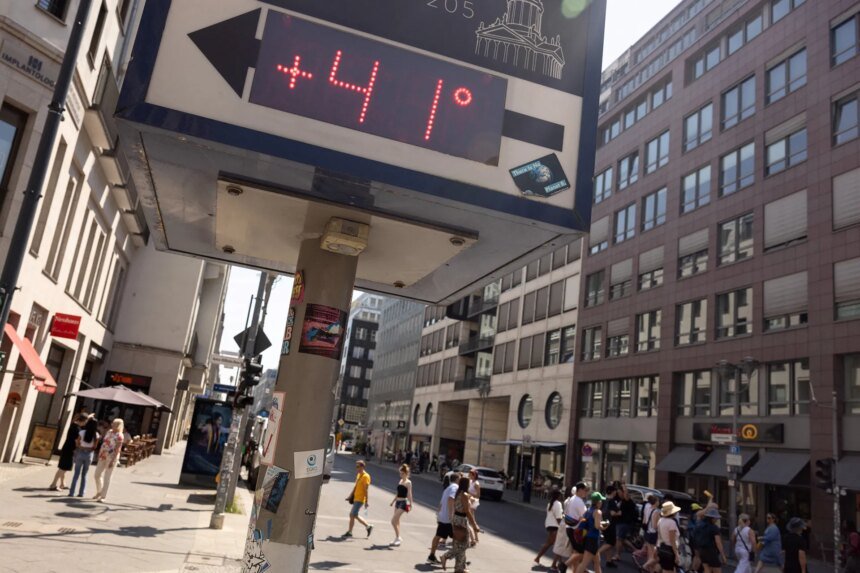
Hundreds of deaths in central Europe due to the ongoing heat wave, and the German media wonders: Why all this stubbornness in refusing to use the best means to reduce the impact of high temperatures, cooling devices?
The relationship of people in Central Europe with the culture of cooling devices is described as a conservative relationship, full of contradictions and stubbornness. Compared to some southern countries such as Spain or Greece, or even with the United States of America, air conditioning devices in the past were not a normal part of the daily lives of people in Germany, Austria, Switzerland, and northern France.
Read also
list of 2 itemsend of list
The reason for this is due to the moderate climate and the nature of architecture and house building, but above all to a belief linked to people’s culture that dealing with heat waves must be through proper ventilation, resorting to shade during peak times, and changing habits instead of relying on artificial cooling.

Wide discussion
But in recent years, in light of record temperatures that reached 41.7 in the past two days in Germany and nearly 1,300 deaths, most of them in France, responsible authorities and the media have begun to engage in a wide debate about the feasibility of using cooling devices and ask: Are we stubborn in using a necessary method to preserve the lives of people, especially the elderly? Or do we risk using appliances that are a symbol of high energy consumption and delay achieving climate goals?
One of the German newspapers that preceded others in trying to answer this question was the conservative newspaper Die Welt, which said in an article entitled “German climate protection heroes want to combat the heat wave” that these “heroes” ignore the use of the best means of preserving human lives, which is the air conditioner, and mocked them by using a common German saying, “Why do we live if suffering is part of life?”
Die Welt begins its criticism of this culture by focusing on the role of the media by saying that the many warnings about heat and advice make people’s minds like “omelettes,” in reference to confusion.
Ridiculous tips
Under the title “How to keep your house cool during the heat,” the newspaper adds, the second television channel (ZDF) teaches us how to ventilate our homes at night, in the morning, and in the evening, and advises us to turn off electrical appliances and to close and darken the windows during the day.”
Die Welt continues by saying that the first television channel (ARD) gives us advice on how to practice swimming and says, “Do not go to the swimming pools early, do not stand in queues, wear appropriate clothes, do not forget to drink sufficient amounts of water, and it is best not to drink alcohol and leave on time.”
She added, “The two channels offer us a complete survival package. With this, all that remains is our advice when and how to breathe. But the two channels forgot an important piece of advice: Buy an air conditioner and do not care about what the Green Party says,” in reference from the article’s author, Anna Schneider, to the environmental party, which considers the use of air conditioners a waste of energy.
Business Insider:
Temperatures in Europe are not radically different from temperatures in some parts of the United States, Australia, or Asia. But the difference is that finding cooling methods is much more difficult in Europe
Compared to the United States and others
The author makes a comparison with the United States, where air conditioning devices entered people’s lives decades ago in the summer, and quotes expert Axel Boyanowski as saying, “In the United States, the number of deaths during heat waves decreased between the first and second half of the last century by about 80% due to the prevalence of air conditioning devices.”
As for Central Europe, she adds, people still make fun of the Americans because they are one step ahead of us in this area. In the United States, even cooling down soccer fields is guilt-free, which is actually possible if the European climate protection instinct were not so deeply rooted.
Business Insider also blames the responsible authorities by saying, “The temperatures in Europe are not radically different from the temperatures in some parts of the United States, Australia, or Asia. But the difference is that finding means of cooling is much more difficult in Europe.”
The website quotes the International Energy Agency as saying that only 20% of European households own air conditioning devices, compared to about 90% in the United States and Japan.
Economics, engineering, history, etc
According to Business Insider, the reasons for this are a mixture of economic reasons and others related to architecture, but some of these reasons are historical and perhaps it has to do with a little stubbornness.
The site adds that Europe did not need air conditioners until recently. In large areas of northern Europe, summer was mainly concentrated in the months of July and August, and average temperatures were less than 27 degrees Celsius. Moreover, buildings were designed to retain heat during long winters.
But the climate is changing rapidly – according to the website – the World Meteorological Organization indicated last year that temperatures in Europe are rising very quickly compared to the global average, which makes summer temperatures gradually turn into an exceptional phenomenon.
The spread of air conditioning devices
One of the reasons why air conditioners are not widespread is the cost, according to the site. Running an air conditioner for a long period can significantly raise your home energy bill. So it used to make more sense to endure a few weeks of heat rather than invest thousands of euros in a cooling system that is rarely used.

Cultural aspect
The site adds that in large parts of Europe, people view air conditioning as unnecessary and indicative of waste. In France, there is a prevailing opinion that the widespread use of air conditioners may exacerbate the climate crisis, which is the crisis that already caused the rise in temperatures.
The article concludes by saying, “At a time when Americans see temperature control as a natural human achievement, Europeans consider air conditioning to be a cooling method used in hotels, offices, and tourist facilities. Therefore, we must ask: Will this perception hold up in light of record temperatures?”
Air conditioning: rare in Germany
The Deutschlandfunk website draws a comparison between Central Europe and the Gulf countries, saying, “A clear example of high temperatures is Qatar, where the heat is so intense for long periods that normal life is not possible without air conditioning. This applies to other countries that witness high temperatures here in Europe, such as Spain, where there are also air conditioning devices.”
The website quotes journalist Anne-Katrin Boesker from the environment department at Deutschlandfunk with a different position on air conditioners. The specialist says that the air conditioner can solve the problem for the individual, but it can make the problem worse for society.
Boesker explains that the problem lies in the hot air coming out of the air conditioners. When hot air is released to the outside from a large number of homes, it increases the heat of the streets and residential complexes, and thus the following happens: We succeed in cooling our house, but we raise the temperatures of the external environment, and this in turn leads to heating the walls and streets, which requires more cooling.
However, Boesker does not advise rejecting air conditioning devices completely, saying, “Because heat affects health greatly, and because good sleep is important for health, having an air conditioner in the bedroom, for example, may be an idea worth considering, especially since the situation will not improve in the coming years.”