
Published on 6/23/2026
|
Last update: 12:36 (Mecca time)
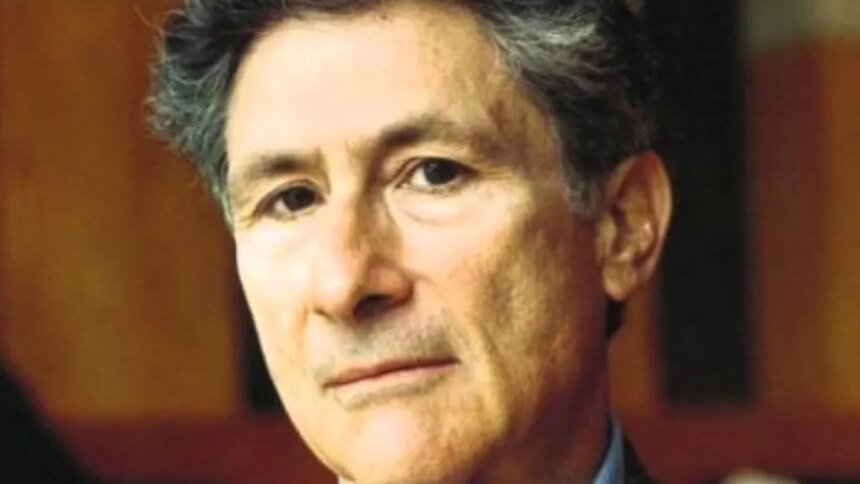
The entire world, especially in the United States and the Arab world, remembers Edward Said (1935-2003) primarily for his iconic text Orientalism (1978). This text is deservedly celebrated as a cornerstone of what later emerged as the field of “postcolonial studies.” He was preceded, of course, by other thinkers, such as the Egyptian political scientist Anwar Abdel Malik (1924-2012), the American anthropologists Bernard S. Cohen (1928-2003) and Talal Asad (born 1932), and even before them all the French researcher Raymond Schwab (1884-1956), who pointed, in one way or another, to the colonial conditions for producing knowledge about “the East.”
However, the idea did not gain global popularity and did not succeed in transforming the entire knowledge production system, until it was formulated by Edward Said in the wake of the Arab-Israeli War in 1973 (the October 6 War, 1973).
What Said himself considered a sequel to “Orientalism” (1978), namely his other iconic text, “Culture and Imperialism” (1993), is usually read as a complementary volume to that pivotal text, which researchers in this field are studying closely to form a more comprehensive picture of Said’s critical thought regarding the relationship between power and literary production.
The similarities in thinking about the relationship of knowledge and power between Edward Said and Michel Foucault (1926-1984) emerge from a common source, but follow divergent paths. For Foucault, this project was an integral part of European despair, in the post-Holocaust era, at the inherent tragedies of Enlightenment modernity. As for Said, as a displaced Palestinian and a researcher in European literature, he made this path through the material evidence of the brutal European colonization of his homeland, and even the entire world, and through the imaginative metaphorical expressions of that path in European literature.
While for Foucault the project was an inherent feature of European self-reflection, for Said it was an attempt to open the horizons of that reflection on the malicious legacies of European colonialism, which Foucault and other European thinkers of his time were mostly oblivious to.
Literary context
Recovering the genetic path of Said’s thinking, between the reality of European colonialism and the imagination of European literature that accompanied it, has become imperative today for a new generation of his students to redraw and shape its maps. As students and colleagues close to Said know well, these two texts, “Orientalism” and “Culture and Imperialism,” represent only the tip of the iceberg, as there is much in his legacy that requires renewed global attention.
Perhaps one of these texts is his most overlooked book, Joseph Conrad and the Autobiographical Novel (1966), which this year marks the sixtieth anniversary of its publication.
This extremely important text seems to Said, in our day, to be something like an autobiography of the Palestinian thinker himself, as a major architect of a field of knowledge that he formulated and is now known as “postcolonial studies.”
In this foundational text, Said looked closely at Joseph Conrad’s obsession with the colonial world, and at the European colonists’ enthusiasm for reshaping the world; This is also evident, perhaps most clearly, in his most famous novel, “Heart of Darkness” (1899). Here, in this text, we witness the first seeds of Said’s entire theoretical project, aimed at forcing European literature to confront its demonic forces.
More than a decade after he published Orientalism, Said published a collection of sobering articles in his book The World, the Text, and the Critic (1983), which is perhaps considered his most influential work in the field of literary theory. In these articles, Said put a corrective lens on the entire academic field of literary theory, by integrating the idea of “the world” into the framework of the reader’s critical apparatus.
Over the course of generations of literary criticism, a special type of conceptual separation has crystallized between the text and the world in which it was formulated, a schizophrenia that Said bridged. In this book, Said demonstrated that the text is not a manufactured thing devoid of its worldliness. Rather, the dynamics of the text are what separates this worldliness and universality. In this trinity of the world, the text, and the critic, the social life of the literary act declares itself and is embodied.
Postcolonial purpose
Today, it is necessary to read Edward Said’s ideas and his more political writings in the context of his literary theoretical ideas, given that they are interconnected, and indeed their fusion together is what enabled him to formulate a new approach to critical language. His political writings emerge from the womb of his literary theoretical ideas, and his literary ideas are rooted in his political questioning and interrogation of those texts. His eternal legacy will be harmed, especially in the Arab and Islamic world, and will be seriously undermined if it is reduced to a stereotypical, vulgar interpretation of his political ideas.
Edward Said laid the foundations for a critical trend in our critical thinking, often understood as postcolonial. This understanding is not entirely correct, but it is very incomplete. The field of postcolonial thought and decolonization efforts has expanded significantly to include other thinkers in Asia, Africa, and Latin America. Although it is necessary and important to give it a local character and link it to its Palestinian origins, this excessive environmentalization should not be at the expense of reducing its broader global importance, which in fact goes beyond its literary and critical interests themselves.
Said was primarily a scholar of English literature, but his insights are widely applicable to other literary languages, provided the necessary critical adjustments are made. He used his mind and pen in opera, and even in photography, and more importantly in European classical music.
However, the broader implications of his way of thinking extend to studies of cinema and modern and contemporary art. One of my own works, specifically “Persian Love: Persian Culture in the Global Scene” (2015), reflects an amalgamation of two of Said’s most prominent works, “Orientalism” and “Culture and Imperialism,” but with a completely different touch that stems not from Foucault but from Habermas, which I also had to adapt to make it applicable to non-European worlds. Said’s legacy lies in “How do we think?” Not “what are we thinking?”
Today, more than ever, there is a need to read and re-read Said, not only to empower a new generation of critical thinkers, but also to anticipate the next generation of battles – intellectual, moral and political – that we face with renewed, vulgar and blatant barbarism, most clearly manifested in the genocidal Zionism that seeks to spread maliciously in the heart of the Arab world through the Trojan horse represented by the “Abrahamic Accords”. We should infiltrate Edward Said’s legacy into the minds and souls of nations that fight all false and crumbling idols.
The opinions expressed in the article do not necessarily reflect the editorial position of Al Jazeera Network.