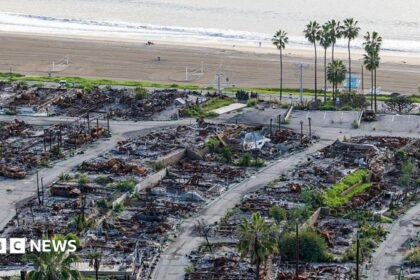
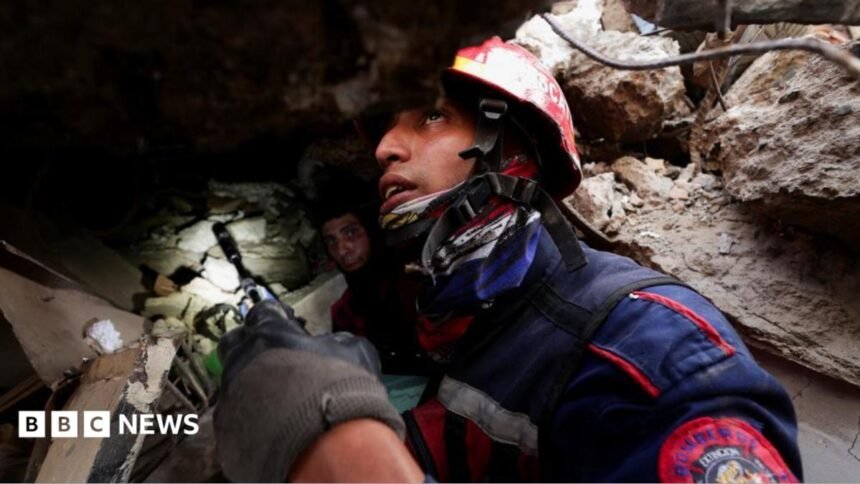

Rescuers pictured searching through rubble in La Guaira, which has been devastated by last week’s earthquakes
Rescuers pictured searching through rubble in La Guaira, which has been devastated by last week’s earthquakes
Rescuers are racing to find remaining survivors beneath the rubble of Venezuela’s twin earthquakes, in which at least 1,450 people are known to have been killed – with the number expected to rise.
The 96-hour window during which survivors were most likely to be found passed on Sunday evening.
But on the ground, teams are still hopeful of finding survivors and continue to conduct searches “to the same level of detail as on day one”, search and rescue expert Lee Ivory tells the BBC.
Ivory is deputy national coordinator for UK International Search and Rescue (UK ISAR) – which is among dozens of foreign rescue teams who are working alongside locals in Venezuela.
Armed with equipment ranging from search dogs to sound detection devices and cameras, rescuers are using a range of methods to reach those who are still alive.
Search dogs

Ivory, whose search and rescuer colleagues have been deployed to Venezuela, says the abilities of search dogs are “amazing”
Ivory, whose search and rescuer colleagues have been deployed to Venezuela, says the abilities of search dogs are “amazing”
Specially-trained search dogs are used to sniff out where potential victims may be located, says Ivory – who has been deployed to relief efforts following earthquakes in Haiti, Japan and Nepal and is currently helping to coordinate efforts in Venezuela from the UK.
They can identify a person’s smell even when they are buried as far as 10m (32.8ft) under rubble – and will let out a “really strong and sustained bark” when they do, alerting rescuers to a potential survivor.
The dogs are trained using toys imprinted with a human’s smell, Ivory explains. Then, when they actually locate a human on the ground, they are handed the toy as a reward by their handler.
Search dogs can also be very useful during the technical part of rescue operations, says Sakthy Selvakumaran of the UK-based charity Search and Rescue Assistance in Disasters (SARAID), which deploys personnel to large-scale disasters worldwide.
They can find hard-to-navigate paths through rubble to follow a scent or identify different access points to the victim, Selvakumaran tells the BBC.
Sound detectors

Sound detection devices are a key technique – as pictured here during the current rescue operation in Venezuela
Sound detection devices are a key technique – as pictured here during the current rescue operation in Venezuela
One of the most effective ways of locating victims is “by having a really good listen”, Ivory says.
Rescuers will shout out into rubble, he says, stating who they are and using some of the local language to see whether they can hear anybody trapped within.
Teams also use seismic and acoustic listening devices, which resemble little pots or cans on wires linked up to devices, to try to locate survivors.
“In essence, if someone was just scratching on a bit of concrete, we’d be able to pick that up,” he says, “even if they are entombed in the building”.
Cameras and thermal imaging equipment

Cameras allow rescuers to peer through smaller openings in the rubble
Cameras allow rescuers to peer through smaller openings in the rubble
Technical search cameras are especially useful because they can be poked into holes that are hard to access.
There are several different models, but Selvakumaran – who was deployed with SARAID to Turkey after the 2023 earthquake – says they can often come in the form of small pods on long sticks, with a camera at the end.
Some cameras can give a 360 degree view which can be recorded and viewed on another device. Video cameras are also used so rescuers “can actually speak to casualties”, says Ivory.

Thermal imaging equipment pictured in use in Turkey
Thermal imaging equipment pictured in use in Turkey
The UN’s humanitarian chief Tom Fletcher has said micro drones – nicknamed “cockroach drones” – are also being used on the ground in Venezuela.
Meanwhile, thermal imaging equipment is carried by some teams and can be used to locate people “not directly in a rescuer’s line of sight”, says Selvakumaran.
She explains that the trapped person’s body heat can warm the rubble around them, allowing rescuers to “see through some types of walls”.
Manual tools and heavy machinery
Tools ranging from disk cutters to saws and handheld angle grinders are used when conducting technical rescues.
“Anything that can help the process of breaching and breaking to get through heavy bits of concrete, or just trying to get through furniture, filing cabinets, refrigerators, anything that can help cut all of that through,” Selvakumaran explains.

Bulldozers in Caracas following the twin quakes, which struck on Wednesday
Bulldozers in Caracas following the twin quakes, which struck on Wednesday
She says some teams will have tools that are electrically-powered, or will carry diesel generators to power devices.
Heavy machinery is key when trying to rescue people who are trapped under many layers of debris.
Bulldozers, diggers and cranes can be used to shift three storeys of concrete, for instance, to find someone trapped, Selvakumaran says.
It is often local teams that try to coordinate access to heavy machinery to do the bigger heavy shifting and lifting, she adds.

Related topics
Venezuela earthquake: Live updates
Two boys pulled from Venezuela earthquake rubble among 33 people rescued over weekend
Venezuela earthquakes in maps and graphics – where they hit and how severe they could be