

Healthcare workers in Gaza are being tortured
Miss Feiler
This is a cultural article which is part of Aftonbladet’s opinion journalism.


Dr. Hussam Abu Safiya has been detained in Israeli prisons for over 18 months – without charge or trial – since December 27, 2024, when he was arrested while on duty at Kamal Adwan Hospital in Gaza. Photo: Amnesty
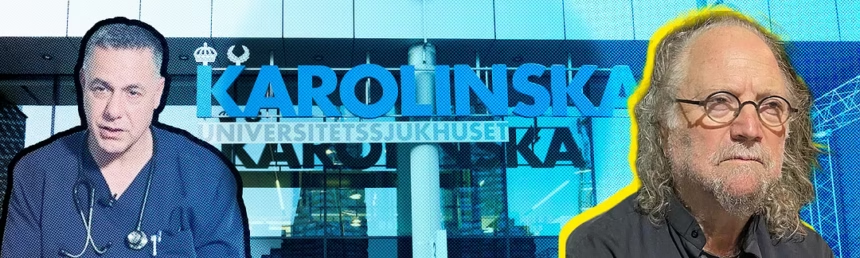
Doctors and nurses gathered the other day outside Karolinska University Hospital with a simple message. They defended a fundamental principle: that patients, hospitals and healthcare workers should be protected under international humanitarian law.
They also demanded that the Palestinian pediatrician and hospital director Dr. Hussam Abu Safiya would be released. He was detained by the Israeli army about 18 months ago, has never been charged with any crime and, according to his lawyer, has been subjected to torture and ill-treatment and is in a life-threatening condition.
That should have been the starting point for the debate.
Instead it was postponed focus almost instantly. The Minister of Health Elizabeth Lane (KD) suggested that the doctors acted disloyally towards their employer and abused their professional role. Svenska Dagbladet’s editorial writer Peter Wennblad have described the manifestation as deeply inappropriate. Soon, the discussion was no longer about the Israeli army’s documented abuses of healthcare, the killed and imprisoned healthcare workers, or the humanitarian disaster in Gaza. Instead, the doctors themselves became the object of suspicion and attack.
It is a well-known pattern in the Swedish debate. When the issue becomes uncomfortable, the focus shifts from the content to the speaker. Arguments are replaced by suspicions of hidden motives. Anyone who alleges violations of international law is suddenly expected to defend their morals, their loyalty and sometimes even their right to express themselves.
Sweden has a long tradition of protecting freedom of expression and the right to peaceful demonstrations. That right must also apply to doctors and other healthcare professionals.
It is particularly noteworthy that several of the attacks came from opinion leaders who in other contexts claim to protect democratic conversation and freedom of expression. When doctors use these very freedoms to call attention to a humanitarian disaster, they are met not by factual counterarguments but by attempts to cast doubt on their motives and undermine their credibility. It is a strange way of defending the open conversation. It’s no coincidence. Shifting attention from the message to the messenger is an effective way to avoid discussing the uncomfortable content.
Sweden has one long tradition of protecting freedom of expression and the right to peaceful demonstrations. That right must also apply to doctors and other healthcare professionals. If they are met with campaigns aimed at silencing or suspecting them rather than responding to their arguments, it is not only their freedom of expression that is threatened. Then the democratic space shrinks for all of us.
The issue is therefore not only about Gaza. It is about which democratic principles we want the Swedish public conversation to rest on. Should people be able to defend medical ethics and international law without being suspected – or should the messenger who points out inconvenient facts himself be made a target?
Dror Feiler, musician, artist and political activist