

Published On 5/7/2026
Researchers from the University of Cambridge and its subsidiary DIOSynVax announced the success of the first early human trial of a global vaccine candidate against a group of coronaviruses, whose active component was entirely designed through computer simulation and digital immunodesign techniques.
The new vaccine, known as pEVAC-PS, does not target a single mutant of the emerging coronavirus, as many traditional vaccines do. Rather, it attempts to attack common and conservative points in a broader family of viruses known as Sarbecoviruses, a group that includes the SARS virus, the SARS-CoV-2 virus that causes Covid-19, and related viruses found in bats that may in the future have the ability to transmit to humans.
From chasing the virus to predicting it
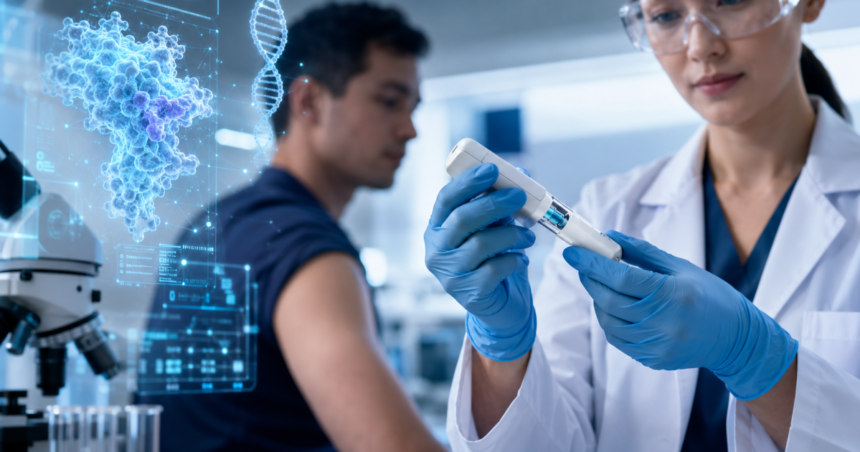
The basic idea behind this vaccine is to move the vaccine industry from a “reactive” mode to a “pre-prepared” mode. Instead of waiting for a new mutant to appear and then modifying the vaccine to chase it, the researchers used the available genetic sequence data for the Sarbecoviruses, then used a computer approach to select common parts of the viruses that do not change easily, and designed what resembles a “superantigen” that trains the immune system to recognize common weaknesses within this viral family.
According to the University of Cambridge, this is the first time that a vaccine whose active ingredient was designed entirely through computer simulation has been tested on humans. But this does not mean that artificial intelligence designed the vaccine alone from beginning to end; The most precise role of technology here is to analyze data, identify common patterns, and filter out the best immune targets, while laboratory, animal, and human experiments remain the final deciding factor in proving safety and effectiveness.
A small and important human experiment
The results of the first phase trial were published in the Journal of Infection, and included 39 healthy volunteers between the ages of 18 and 50 years. Participants had previously received two or three doses of Covid-19 vaccines, and did not have a recent confirmed infection with the virus. The volunteers received the vaccine in two doses, on the first day and the 28th day, in four ascending doses: 0.2, 0.4, 0.8, and 1.2 milligrams.
The trial concluded that the vaccine was well tolerated in the four doses, and no major safety concerns emerged. The researchers also monitored immune responses against viruses from the Sarbecovirus family, with clearer indications at higher doses of responses targeting conservative areas of the virus, in addition to neutralizing antibodies to some SARS-CoV-2 variants such as Delta and Omicron.
This result gains its importance because the first phase trials do not usually aim to prove that the vaccine prevents the disease on a large scale, but rather focus mainly on safety, tolerability, and determining appropriate doses. The US Food and Drug Administration indicates that phase one studies are relatively small, and often aim to test safety and dosage in dozens of volunteers before moving to larger phases.
Needleless vaccine
It is also noteworthy that the vaccine was not administered in the traditional way via a metal syringe, but rather a delivery technique was used inside the skin without a needle, through a device that relies on a precise flow of fluid.
The University of Cambridge believes that this method may make vaccination faster and easier, especially in environments where it is difficult to use traditional injections on a large scale, or among people who are afraid of needles.
Despite the importance of the result, describing the vaccine as a “ready-made global vaccine” would be a scientific exaggeration. The trial is still early and small, and the number of participants is limited, and most of them had previous immunity to Covid-19 due to vaccination or previous exposure to the virus, which may affect the reading of the new immune response.
A report by the specialized medical website Medical News Today confirms that the experiment showed initial safety and a modest immune response, but it has not yet proven strong or long-term protection in humans.
Also, artificial intelligence, no matter how powerful it is, cannot design a guaranteed vaccine against a completely unknown virus that has no connection to a known viral family. What it can do is analyze a family of related viruses, extract common elements, and then help scientists build a vaccine that targets these elements. That is, it may be effective against close viruses or future mutants, but not against any unlimited potential epidemic.
The University of Cambridge says that Diosinvax’s development pipeline is not limited to coronaviruses, but also includes candidate vaccines for seasonal and pandemic influenza, hemorrhagic fevers, and coronaviruses, including SARS-CoV-2.
If this platform proves successful in larger experiments, it may open the door to a new generation of vaccines with broad protection, especially against viruses that constantly change or hide in animal reservoirs before they jump to humans.