

Published On 7/8/2026
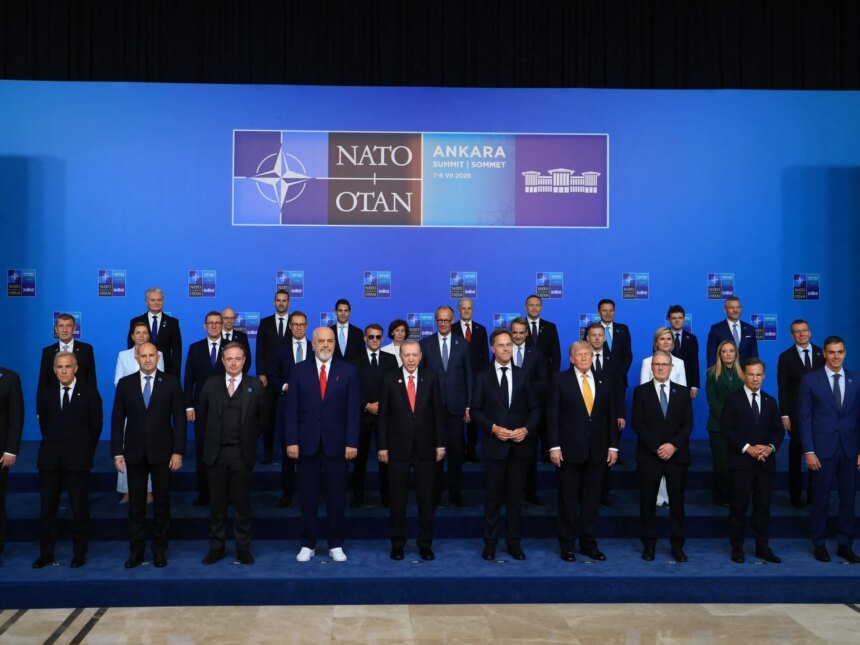
German media is watching the NATO summit in Ankara, wondering what if US President Donald Trump withdraws from the alliance. Will Germany, which has the largest economy and strategic geographic location, be able to assume a leadership role in the alliance?
The German media is watching with great concern what the outcome of the NATO summit in Ankara will be, and is searching for an answer to the two most important questions at this summit from a European perspective: What if Trump makes a major decision and withdraws from the alliance, and what role will Germany play, which has a vital and distinctive strategic location and has the largest economy in Europe?
Read also
list of 2 itemsend of list
The large German newspaper “Süddeutsche Zeitung” – in an article entitled “The Ankara Summit… NATO’s future is also determined in Magdeburg, Schwerin and Berlin” – says that it is worth “thanking Trump because he accepted the start of the NATO summit in Ankara, and contributed to revealing a truth that should not be lost amid the small and large details and disagreements that may accompany the summit, by describing German defense spending in NATO as “ridiculous.”

Incorrect claim
The writer believes that Trump’s statement is useful, not because of the validity of the claim it contains, but because of its great distance from reality, because Germany will spend about 110 billion euros this year on defense, which is more than double what it spent in 2022, that is, the year that witnessed the start of the Russian invasion of Ukraine.
These numbers – according to the newspaper – are nearly double what France, the European nuclear power, spends, and the writer says that the irony does not lie in these numbers, but rather in the belief that the American president can be influenced and win his favor simply by presenting huge numbers.
The article touched on the previous NATO summit in The Hague, and said that it focused largely on the goal of raising defense expenditures, as the alliance countries committed to increasing their defense spending within 10 years to 3.5% of their gross domestic product, and to satisfy Trump, who was demanding an increase in expenditures by 5%, other expenditures were added, such as spending on infrastructure.
The newspaper highlighted Germany’s future role in the alliance, because Chancellor Merz and Defense Minister Pistorius’ statement that NATO must become more European in order to remain a transatlantic alliance is true in principle, but it gives a more optimistic picture when looking at reality, as the issue is no longer related to a more equitable distribution of burdens, but rather that the Europeans must guarantee the principle of mutual defense to a large extent.
America as reserve guarantor
The article adds that the role of the United States will gradually shift to what the report described as the role of a reserve guarantor, noting that the success of this model depends mainly on one country, Germany, due to its economic size and strategic geographic location.
Therefore, according to the author, Berlin has become the natural candidate to be the new NATO center in Europe, especially since Meretz accepted this role, which was demonstrated by his holding meetings with European leaders before the Ankara summit.
On the other hand, the article asked: Does Germany want to play this role? To answer that increasing military spending provides one of the necessary conditions for Germany to assume a leadership role in Europe, but it is not sufficient.
The newspaper explained this by saying that the German army is still facing difficulty in transferring the funds approved by the government into an actual military force, and that European cooperation in the field of defense industries is still clashing with the national interests of each individual country.
Does Germany want this role?
The newspaper concluded that the most prominent question is: Can Germany play the role of a leader in Europe within NATO? Because this is also related to the economy, and because the German army cannot continue to enhance its capabilities if the problem of the decline in the performance of the economy is not solved, because armament by incurring debt cannot continue indefinitely.

The second question posed by the newspaper is: Does Germany even want to play this role? Here, the writer believes that the answer to this question will be a key topic in the upcoming elections, considering that voting for parties such as the far-right Alternative for Germany party and the Left Party and the new alliance Sarah Wagenknecht represents a rejection of the attempt to confront Russia and Trump’s authoritarian tendencies.
The writer concludes by saying that the future of NATO will not only be determined in Ankara, but also in Magdeburg, the capital of the state of Saxony-Anhalt, Schwerin, the capital of the state of Mecklenburg-Vorpommern, and Berlin as well, that is, through the ballot boxes in the local elections that the three states will witness next September, and the resulting local governments led by the “Alternative” party, which questions NATO and is accused of being close to Russia.
Financial burdens and debts
For its part, Die Welt newspaper focused on the impact of high German military expenditures on eroding Germany’s financial capabilities, and says that Germany “assumes a leadership role in terms of redistributing financial burdens within NATO, but the bulk of the significant increase in defense spending will be financed through debt, which raises economic warnings of long-term risks to Germany’s financial capabilities.”
The newspaper quotes a study prepared by economist Tim Loze from the German Higher School of Economics and Law in Berlin, which says that the goal of 5% of the gross domestic product will be difficult to achieve in many European countries, especially those suffering from high debt, which shows the importance of Germany, as the largest European economy, in bearing a large part of the new financial obligations.

According to the German government, the Berlin government intends to raise defense spending to about 108 billion euros this year and gradually increase it to reach about 183 billion euros by 2030.
The newspaper says that most of this money is debt, which prompted the authors of the aforementioned study and other economists to warn of the danger of eroding the financial flexibility of the German state.
The newspaper believes that continued reliance on borrowing to finance the state’s military missions may lead to higher interest burdens and reduce the government’s ability to confront future crises.
The writer concludes by saying that Chancellor Friedrich Merz seeks to present Germany as a new leadership force within NATO, but this leadership is currently based on a fragile financial foundation, because a large part of rearmament and raising defense spending depends on borrowing and not on sustainable financial resources.