


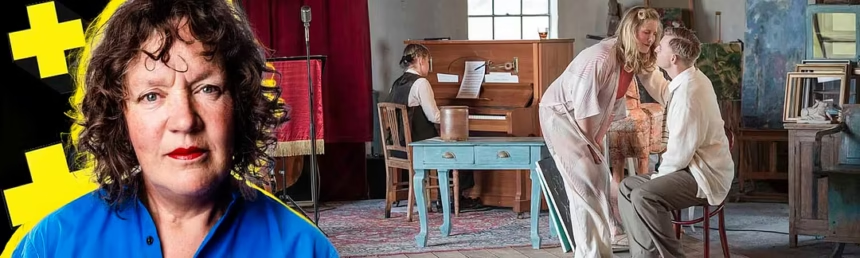
Victoria Benedictsson’s tragedy becomes dreamy, entertaining summer theater at Österlen


“Den bergtagna” at Hagestad’s summer theater
A drama about alone blissful love, stormy and, soon enough, unhappy. Victoria Benedictson’s “The Mountaineer” was found as an unfinished draft after her death in 1888 and published posthumously by her friend Axel Lundegard. A drama in itself, as later research showed how Lundegård not only published but also changed Benedictsson’s text at his own discretion.
The material in “Den bergtagna” is close to Benedictsson’s own dangerous love relationship with the Danish literary critic Georg Brandes. At the Hagestad summer theater out in Scania’s Österlen, we find ourselves in the Paris of studio floors, with the artists and bohemians who live only for art and love. In Paris, far from the empty and cold small town at home in the Scanian countryside.
The jazz music on stage is live and acoustic and strikingly strikes the emotional and slightly melancholic mood. A feeling that something is lost before it is won. Costumes and makeup suggest the 1940s, which works well as a “historical” setting for the drama. The ensemble plays with gusto throughout, especially the array of types from the “old country days”: matrons, housekeepers and hysterically giggling misses.
As in Hagestad’s previous oneand first set, Chekhov’s “Three Sisters” summer 2024the magic of the stage room is significant. The theater barn’s large window walls face in two directions, towards the horizon and the garden, and create a special dreamy space. No clear boundary between stage and salon, and details such as the actors walking in and out of the spotlights add nicely to the feeling of a shared intimacy.
It is needed, because the dialogue is often highly tense. Stupid to complain when the text is over a hundred years old. But the director Gustav Deinoff have chosen to deal with the loudness and tension by partially joining and playing with it. Not that the seriousness is lost. The whole ensemble, on the contrary, makes an impression precisely with its sincerity.
The women’s lot still tastes one-sidedly bitter. Loving always means losing for a woman.
Victoria Benedictsson’s lesson is from the end of the 19th century and the set in Hagestad would probably like to point out that it is still valid today. That the conditions for women are the same now as then. It doesn’t fully convince me.
Perhaps because the uplifted artist Gustave Alland (Peter Perski) the man who both the hard-working artist Erna (Lena Nylén Tyrstrup) and her visiting friend Louise (Emilie Strandberg) falls for, looks a bit like a caricature. It kind of comes with the role that he believes in free love, but it’s the women’s way of dealing with their disappointment that creates interest in the show. Those who choose to work to become Alland’s equal in art. Louise who chooses to love and then jump into the Seine.
All in all, it’s an entertaining and theatrically hallowed evening where Victoria Benedictsson’s work gets to take its place in a scenically slightly anachronistic and yet quite historical context.
THEATER
» The mountain taken
by Victoria Benedictsson
Processing: Stefan Larsson and Gustav Deinoff
Direction: Gustav Deinoff
Bandmaster: Sigrid Abrahamsson
Suit: Eva Hedblom and Ranin Souliman
Cast: Emilie Strandberg, Lena Nylén Tyrstrup, Peter Perski, Victor Ståhl Segerhagen, Elesine Nauclér, Harald Leander, Sanna Persson Halapi, Victoria Kahn, Sigrid Abrahamsson, Signe Lundström, Beppe Röhr
Scene: Hagestad’s summer theatre, Löderup
Playing time: 2 hours 40 minutes
Subscribe to the newsletter about performing arts: Premiere Lions & Scengångere
That means Aftonbladet’s plus rating

 World class
 Very good Good
 Approved
 Failed
 Wretched