


Published On 7/6/2026
|
Last update: 7/8/2026 15:11 (Mecca time)
One technology stands behind most of the mutual accusations in the artificial intelligence war between the United States and China recently, which is the distillation technology that enables the company to build a competing model at a portion of the original cost of building the original model. In the latest chapters of the confrontation, the American artificial intelligence company Anthropic accused its Chinese counterpart Alibaba last June of using this technology to exploit Claude in building a competing model.
Despite the repeated mention of distillation technology, the majority of users are ignorant of its meaning and the mechanism of its use against models, and why do American companies fear it in this way? This is the question that this report answers.
Read also
list of 2 itemsend of list
Teacher and student
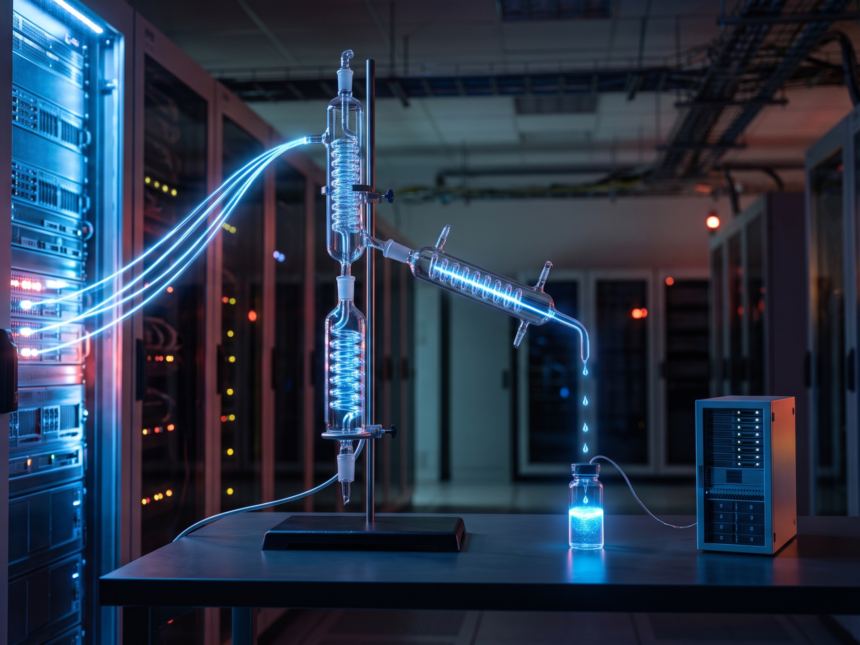
The concept of distillation technology can be simplified by imagining artificial intelligence models, whether the prototype or the new model resulting from this technology, as a relationship between a teacher and a student.
The American Bloomberg Agency report describes this technology as one of the tools widely used by artificial intelligence companies to train large linguistic models based on the outputs of the original model.
The artificial intelligence company that uses distillation directs a large volume of questions to the teacher model, which acts as a teacher receiving the questions of the new model, which in this case is a student who receives the answers from the teacher model and uses them in training.

Therefore, the main difference between distillation technology and other AI model training techniques is in the quality of data used for training. While it is usual for companies to use pure data, distillation allows the company to use the data generated from the learned model.
The student model directs a large group of questions to the teacher model, then uses the questions and answers together for training, which enables him to obtain abilities similar to the teacher model, but at a much lower cost than the original model.
This technology results in a model with capabilities that mimic the original model that was used in training, and sometimes the student model may be able to directly access the level of the original model, and other times, companies use tens of thousands of accounts and human users to send and collect these questions.
IBM’s report on the technology indicates that its use began in 2006, although it got its name in 2015, and its use has diversified in many sectors, including training neural networks, speech and image recognition, and even object discovery.
A project from within…an attack from without
Thus, the use of distillation techniques is acceptable in some contexts, when a company uses it to train a new model using a large model, but most of the time companies place conditions in their use policy that prevent competing companies from using distillation techniques.
Therefore, Anthropic, OpenAI, and other American companies describe the use of this technology by Chinese companies as a direct attack on them and an exploitation of their capabilities in a way that threatens their success, according to a report by the British Financial Times.
In February 2026, OpenAI accused DeepSec of using distillation techniques so that it could train its famous model and provide it at a much lower cost than the cost of training the original model.
Distillation technology poses a threat to companies that keep their models closed and therefore their training mechanisms essentially closed so that no one can imitate their training method. This is because the company that uses distillation can develop an artificial intelligence model that mimics the capabilities of the original model, but at a lower cost, and thus provide it to users and customers at a reduced price, which threatens the profit model of the original company and the investments it made in developing its models.
A new front in the technology war
These accusations by American companies coincide with the trade restrictions placed by the US government on exports of leading chips used in training artificial intelligence models.

Chinese companies cannot access the same chipsets used by their American counterparts, as the government of US President Donald Trump prevents Chinese companies from accessing the latest NVIDIA and AMD leading chipsets used in this sector.
The Bloomberg report notes that evidence of a drip attack is usually circumstantial at best and cannot be proven conclusively, as companies rely on discovering a high usage rate and finding a lot of existing questions and answers.
The report explains that Anthropic said that it discovered that there were more than 16 million interactions with Cloud by accounts that the company accuses of being fraudulent, so it accused Chinese companies of being behind these accounts and interactions.
Backward accusations
While accusations are usually directed by American companies against their Chinese counterparts, the Financial Times report refers to the statements of SpaceX CEO Elon Musk, one of the companies that also works in the artificial intelligence sector.
Musk believes that Anthropic was also accused of stealing training data from several different sources and was forced to pay several billion to settle these cases, adding: “This is a reality.”
For its part, Anthropic believes that the spread of distillation attacks and the use of technology in general is accelerating the emergence of powerful artificial intelligence models that do not have direct restrictions on use and do not have the main insurance tools that prevent bad uses that include the manufacture of cyber attacks and even bio-weapons.
The main question regarding distillation techniques remains not whether they are legal or not, but rather the ultimate use of the resulting models. If anyone can clone GPT Chat or Cloud Mythos 5, what prevents him from using these models that do not have the original limitations of the original model in malicious attacks?