

Published On 7/7/2026
Natural gas prices jumped in Europe on Tuesday, with renewed fears of disruption to liquefied gas supplies through the Strait of Hormuz, after reports of the targeting of commercial ships near the vital shipping lane through which a large share of global energy trade passes.
As of the time of writing, the European gas benchmark TTF has risen to €46.25. (about 52.9 dollars) per megawatt-hour, an increase of 4.3% from the previous session, according to contract trading data linked to the European index, while it had reached about 46 euros earlier today. (about 52.6 dollars) per megawatt/hour.
Read also
list of 2 itemsend of list
The increase came after a new maritime accident in the Strait of Hormuz, as the Associated Press reported that a tanker off the coast of Oman caught fire after being hit by a projectile, citing the British Army.

The British Maritime Trade Operations Authority stated that the tanker was hit near the Lima area in Oman while sailing south out of the strait towards the Gulf of Oman, and that the projectile hit the left side of the ship, without recording an environmental impact of the incident until that time.
Axios quoted American officials as saying that the Iranian army fired at least two missiles towards commercial ships crossing the Strait of Hormuz on Monday evening, noting that two ships suffered significant damage without causing casualties, and that the incident threatens to undermine a recent memorandum of understanding in which Iran pledged to stop attacks in the strait.
European gas markets treated the incident as an indication that the geopolitical risk premium had not yet left the market, despite the recent US-Iranian understandings and attempts to reopen the Strait in a stable manner.
The European market’s sensitivity to any news from Hormuz increases because the continent has become more dependent on liquefied gas after reducing Russian gas imports via pipelines since the energy crisis in 2022 and 2023.
Hormuz and liquefied gas
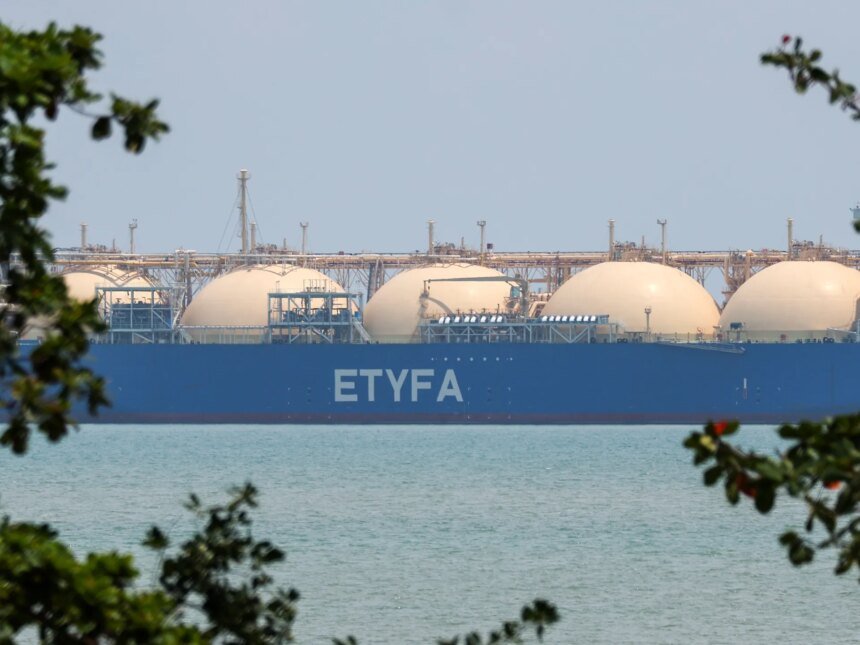
The International Energy Agency says that most liquefied gas exports from Qatar and the UAE pass through the strait, and that the total quantities of liquefied gas transiting it reached more than 112 billion cubic meters in 2025, or approximately 20% of global liquefied gas trade.
The agency explains that Europe accounted for just over 10% of the quantities of liquefied gas passing through Hormuz in 2025, and that these quantities represented about 7% of the total flows of liquefied gas to Europe, while the Asian markets were the main destination for Qatar and the UAE’s exports through the strait.
Although Europe’s direct share of Hormuz gas is less than Asia, any widespread disruption of this corridor raises prices globally because the liquefied gas market is interconnected, and any shortage in supplies heading to Asia pushes Asian buyers to compete with Europe for spot shipments from other sources.
The International Energy Agency says that the disruption of liquefied gas flows through Hormuz will represent a major shock to the global gas market, because the Qatari role in the liquefied gas trade is large, and because there are no practical alternative ways to deliver these quantities to the global market in the short term.
It was also estimated that the loss of about 20% of global liquefied gas supplies would fuel price fluctuations and impose adjustments in demand among gas importers in Asia and Europe.
The agency said in its gas market report for the second quarter of 2026 that the effective closure of the Strait of Hormuz at the beginning of March caused a severe disturbance in the fundamentals of the global gas market, and pushed gas prices in Asia and Europe to their highest levels since the energy crisis in 2022 and 2023.