


In recent years, the Asia-Pacific region has witnessed an accelerating build-up of tensions, from escalating US-Chinese competition, to growing security alliances and increasing military activities in the South China Sea and the Taiwan Strait.
In this context, local and regional media follow every qualitative military development in the region, as it is an indicator of the path of power balances. Therefore, the announcement of the Chinese missile test comes in this charged climate to reflect a technical military event and a multi-dimensional strategic message.
Read also
list of 4 itemsend of list
An unprecedented experience
China Daily reports that on July 6, the Chinese Navy launched an intercontinental ballistic missile from a nuclear submarine, carrying a training warhead that landed precisely in the designated area in the Pacific Ocean. The operation was described as the first announced test of this kind in decades, and the longest-range in the history of Chinese naval missiles.
The Chinese Navy spokesman confirmed – according to the newspaper – that the test comes within “annual training arrangements” and that it took place after notifying the concerned countries, and in accordance with international law. The Chinese Ministry of Foreign Affairs also stressed – in statements reported by several press reports – that the experiment does not target any specific country.
Nuclear deterrence triad
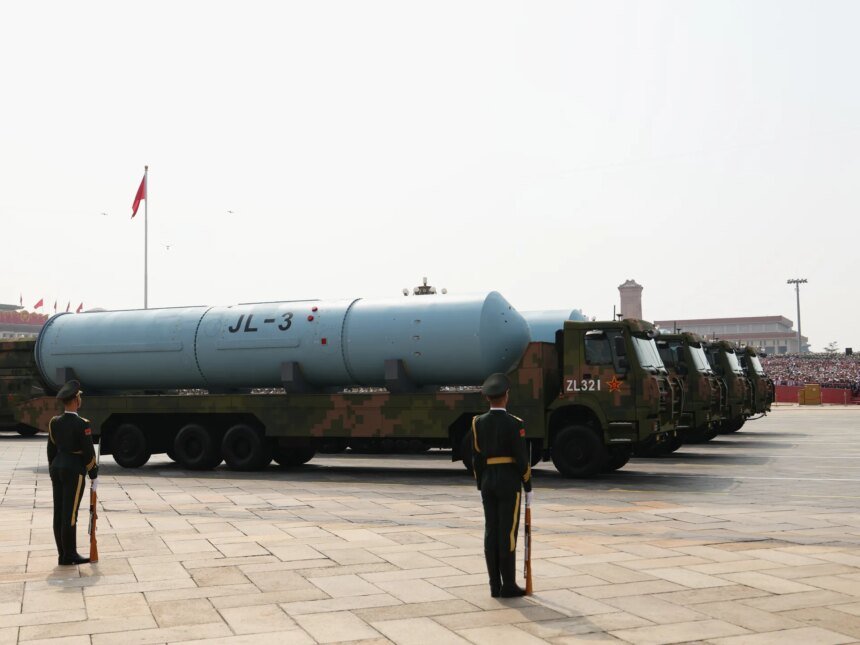
The Huan Qiu newspaper focused on the strategic dimension of the test, considering that it represents a new step in the development of the Chinese nuclear triad (land, sea and air), as the missiles constitute the long-range (Jingle-1) launched from the air, the (Julang-3) intercontinental ballistic missile launched from submarines, and the (Dong Feng-61) missile.(Dong Feng-31) The two ground-launched intercontinental ballistic missiles are a three-dimensional strategic nuclear force for the Chinese People’s Liberation Army, according to the Chinese news agency Xinhua.
Speaking to the Huanqiu newspaper, military expert Zhang Junxi pointed out that “nuclear submarines are the most stable and reliable deterrent platforms thanks to their ability to conceal themselves and operate for long periods underwater.”
The expert adds, “The test verified the complete chain of operations, from underwater maneuvering to launch and long-range guidance, proving China’s ability to carry out a second nuclear strike even if it was subjected to a surprise attack,” stressing that “possessing a second strike capability represents the cornerstone of nuclear deterrence, because it prevents adversaries from thinking about launching a preemptive nuclear attack.”
The Julang-3 missile is classified as a strategic weapon because it is designed to strike “strategic targets” such as capitals, military command centers, economic infrastructure, and energy centers.
(Ju Lang-3) and the implications of development
Huan Qiu newspaper suggests that the missile used is the Julang-3, a new generation of naval ballistic missiles with a range exceeding 10,000 kilometers. Experts believe that this missile has become the “backbone” of China’s naval nuclear deterrent capability.
China Daily also points out that China currently possesses missile systems such as (Julang-2) and (Julang-3) with an intercontinental strike range, the ability to carry multiple warheads, and high penetrating power, which makes them reliable assets for launching nuclear counter-strikes.
This missile is classified as a strategic weapon because it is designed to strike “strategic targets” such as capitals, military command centers, economic infrastructure, and energy centers. Thus, it represents a supreme deterrent tool, as reaching these targets is considered a decisive factor in changing the equation of war comprehensively, and not just the course of the limited battle.

Silent deterrence platform
At the platform level, Huan Qiu pointed out the possibility of using Type 094 submarines or upgraded versions in the recent launch, with the possibility of newer generations being in service, but they are subject to a secrecy policy that restricts the disclosure of all combat capabilities.
The South China Morning Post reports that the Type 094 submarines and their upgraded versions are capable of launching missiles such as (Julang-2) and (Julang-3), which theoretically allows them to strike distant targets that reach American territory from waters close to the Chinese coast.
Media reports show a clear focus on the characteristics of nuclear submarines as deterrent platforms that are difficult to detect and destroy, because nuclear-powered submarines do not need frequent refueling or external air, and they can remain for months in the depths of the sea at distances far from the coast, which gives them a high ability to stealth and maneuver.
Expert Zhang Junxi stresses that these submarines represent the most stable platforms for a second nuclear strike, because they can continue to carry ballistic missiles even if the land and air platforms are subjected to strong destructive strikes.
Messages of deterrence or escalation
International interpretations of the nature of the messages conveyed by this Chinese missile test varied She saw American parties –According to the South China Morning Post, the launch represented a “hostile signal” toward Washington’s allies in the region, while Australian Foreign Minister Penny Wong described the move as “destabilizing.”
On the other hand, the newspaper quoted researcher James Acton, co-director of the Nuclear Policy Program at the Carnegie Endowment for International Peace, as saying that missile tests are a common practice among nuclear states, calling for dealing with them with “calmness and determination,” indicating the need to avoid exaggerated reactions.
Zhang Junxi:
Type 094 or later submarines represent the most stable second-strike nuclear platforms, as they can continue to carry ballistic missiles even if land and air platforms are subjected to strong destructive strikes.
Academics, such as Misato Matsuoka, an expert on the US-Japanese alliance at Teikyo University in Tokyo, also considered that the basic message is directed to the United States, which is that China’s naval deterrence has become “more realistic and resilient,” with the message also extending to Washington’s allies such as Japan and Australia.
The timing of the experiment is linked to a broader context, as it came shortly before the North Atlantic Treaty Organization (NATO) summit, and at a time of increasing political and security repercussions in Europe and Asia.
The South China Morning Post quoted NATO Secretary General Mark Rutte as saying:Swearing He cannot be naive towards the growing Chinese military capabilities,” he said, noting the interconnected challenges between the two regions.
Analysts also pointed out that the experiment may be an indirect response to the growing defense cooperation in Asia, and an attempt to show the readiness of the Chinese army despite the anti-corruption campaigns that targeted some of its leaders.
What’s behind the test?
Chinese sources unanimously agreed that testing the missile from a nuclear submarine represents a deliberate step within the framework of modernizing nuclear deterrence, aiming to demonstrate the capability of a second strike and confirming the Chinese army’s readiness to deal with extreme pressure scenarios without sliding into the race to use nuclear weapons.
This test goes beyond proving technical capabilities, and reflects China’s move to a more advanced stage in ensuring the resilience of its nuclear capabilities, especially across the sea, which is the most difficult area for targeting. It also sends a clear message of deterrence that any attempt at military pressure or nuclear threat will not go unanswered.
At the same time, according to the Global Times, Beijing is trying to present this force within a defensive framework aimed at “preventing war through deterrence,” while emphasizing its commitment to the policy of no first use of nuclear weapons.
While Beijing sees this experience as evidence of “responsible power” and the ability to maintain stability, its opponents view it as an additional link in the regional arms race.
In both cases, it seems that the basic message has been conveyed to everyone, which is that the balance of deterrence in Asia and the Pacific has entered a more complex stage, in which military power intersects with political calculations and alliances in an unprecedented way.